Attorney Case Summary & Demand-Letter Outline
Plaintiff: Brian Wilson, individually and on behalf of United Funding Logistics, LLC (Houston, Texas).
Defendant: The Better Business Bureau (the relevant BBB corporate entity / serving BBB, e.g., BBB of Metropolitan Houston, plus International Association of BBBs as appropriate — to be confirmed by counsel).
Nature of action: Defamation (libel), business disparagement / trade libel, false light, negligent misrepresentation, intentional & negligent infliction of emotional distress, and tortious interference with prospective business relations — arising from the BBB's publication of an unverified "Pattern of Complaints" fraud alert on the plaintiff's business profile, the removal of more than 90 positive client reviews, the auto-verification of fabricated negative reviews, and the imposition of an F rating on a non-accredited business whose profile the BBB concedes it created without the owner's consent.
Jurisdictional hook: The BBB's publication targeted a Houston business and was visible to Houston consumers, lenders, and the Harris County Attorney's Office — whose civil enforcement petition (Case No. 2026-46516) expressly relied on the BBB's records. The defendant purposefully directed its publication into Texas commerce. Texas law is the expected governing law; counsel should confirm.
The BBB published a public fraud accusation — that Wilson "conditioned FCRA settlement payments on five-star reviews" — as a "Pattern of Complaints" alert directly on his business profile. In the very same alert box, the BBB admitted it "does not verify the accuracy of information provided by third parties, and does not guarantee the accuracy of any information in Business Profiles." An organization that published an unverified fraud charge as a verified-seeming "alert," while its own footer conceded it never checked whether the charge was true, did not exercise due care. The documented record — more than 90 positive client reviews removed, fabricated negative reviews (one containing a racial slur) auto-verified with zero documentation, and an F rating imposed on a business whose profile was created from an impersonator's application with a misspelled email — supports a claim that the BBB acted with at minimum negligence and arguably actual malice. The result was foreseeable: reputational destruction, lost business, the triggering of a county civil enforcement action, and documented mental anguish. The plaintiff's theory is not petitioning or opinion — it is the commercial publication of an unverified fraud accusation as fact. That is the conduct the commercial-speech carve-outs to anti-SLAPP statutes exist to reach.
The two exhibits below are the backbone of the falsity and fault elements. Exhibit U is the publication itself — the BBB's fraud accusation printed above its own admission that it never verified the accusation. Exhibit V establishes the non-member, non-consent foundation that defeats any claim the BBB's standards were contractually binding on Wilson. Counsel should open both in the live NFA-005 report before drafting.
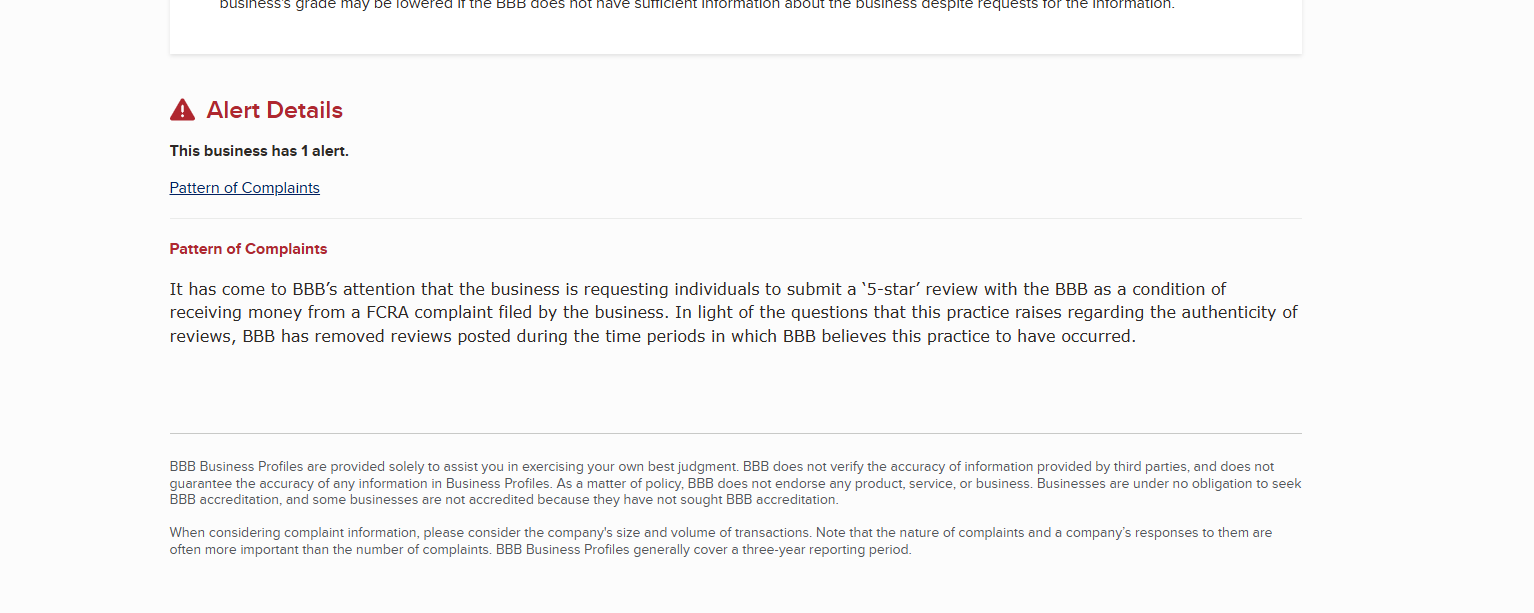
The BBB published a public fraud accusation against a named business — then admitted, in the same alert box, that it never verified the accusation. An organization that grades businesses on their “failure to respond” published an unverified fraud charge on a man’s profile and dared him to prove a negative. This is not consumer protection. This is a private company publishing an unverified allegation as fact, shielded by a disclaimer it wrote for itself.
The Foundation — A Standard Wilson Never Agreed To
Before the disclaimer and before the double standard, there is a more basic problem the BBB has never answered: Wilson never agreed to be judged by the BBB at all. The BBB’s own Accreditation Standards are, by the BBB’s own published terms, the standards “for business accreditation by BBBs,” which a business “affirms that it meets and abides by” and for which “BBB charges a fee.” Wilson never accredited. He never applied. He never paid. He never affirmed that he would abide by the BBB’s standards. The BBB imposed its private, fee-based accreditation framework on a business that was never a member — and then published a fraud alert when that non-member failed to satisfy standards he never agreed to.
Worse, the BBB created UFL’s profile without Wilson’s consent — its VP of Dispute Resolution, Samantha Durham, confirmed in writing that the BBB creates business profiles “with or without the owner’s consent” and could not remove it. The only “accreditation application” on file (January 28, 2024) was submitted by an impersonator — with a misspelled email and a transposed phone number. The BBB accepted the fraudulent application, updated his profile with information he never submitted, and then judged him for failing to respond to complaints routed to an email address he could not access.
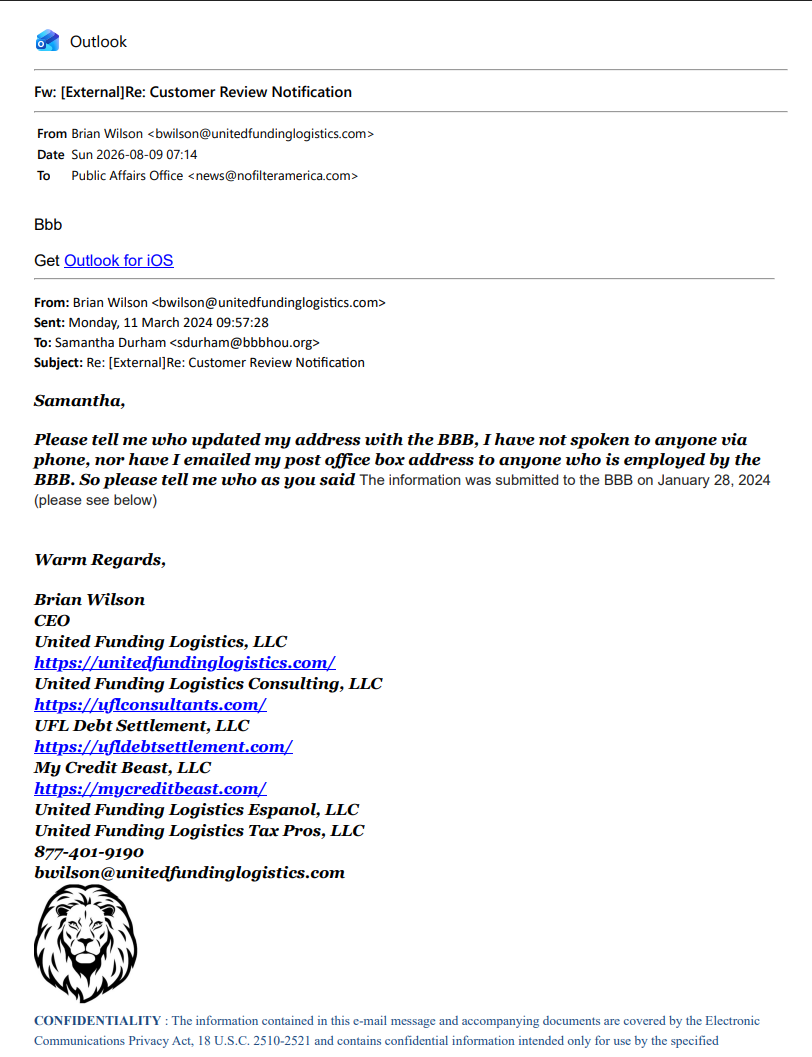
Strip away the disclosure clauses and the FTC parallels and take the accusation on its harshest possible terms. Even if Brian Wilson had offered every client a brand-new television for a five-star review — even on that reading — he would have breached no obligation to the Better Business Bureau. He never signed an accreditation agreement. He never paid a fee. He never affirmed the BBB’s Code. He never opted in. The BBB’s Code of Advertising is a voluntary code for voluntary members, and Wilson was never one. You cannot violate a contract you never made, with an organization you never joined, over a profile it built for you without your consent. The BBB’s alert accuses Wilson of breaking standards that never applied to him.
The BBB's expected first line of defense is an anti-SLAPP motion — most likely the Texas Citizens Participation Act (Tex. Civ. Prac. & Rem. Code ch. 27) if the action is filed in Texas. The TCPA, and most analogous statutes, exempt commercial speech by their own terms. Tex. Civ. Prac. & Rem. Code §27.010(a)(3) provides that the chapter does not apply to "a commercial speech claim." The BBB's "Pattern of Complaints" alert published on a commercial business-rating platform, aimed at consumer commercial decision-making, is commercial speech — not petitioning activity, not political commentary, and not a statement made in a judicial or governmental proceeding. A plaintiff who pleads a prima facie business-disparagement claim grounded in the BBB's commercial publication is not targeting protected speech; the TCPA's commercial-speech exemption should remove the defense at the threshold.
- Commercial speech, not petitioning. The alert is a consumer-protection-style commercial publication sold to the public as a reliability grade. It is not a filing, a report to a governmental body, or a statement in a legal proceeding. The HCAO's later reliance on BBB records does not retroactively convert the BBB's own publication into petitioning activity.
- Even if the TCPA is invoked, the plaintiff carries the prima facie burden. Under the post-2019 TCPA framework, once the defendant moves, the plaintiff must establish, by clear and specific evidence, a prima facie case for each essential element. The exhibits catalogued below (Section VI) supply the false statement, publication, fault, and damages elements directly from primary sources — the BBB's own alert and footer.
- Defamation-plus: statements of verifiable fact. The alert's core charge ("conditioned FCRA settlement payments on five-star reviews") is a provably false statement of fact, not opinion or rhetorical hyperbole. A provably false factual accusation published as an "alert" is not the protected opinion anti-SLAPP shields.
- No "official proceeding" safe harbor. The BBB is a private, non-governmental corporation. Its "accreditation" and "alerts" are private commercial products, not official governmental determinations. It cannot claim the immunity that attaches to statements made in or connected to a judicial, legislative, or administrative proceeding.
- Equally important: the disclaimer is the liability, not the defense. The BBB's own footer — that it does not verify third-party information — is the evidence of negligence. Publishing an unverified fraud accusation as an "alert," then disclaiming verification underneath it, is the act of publishing without due care. The disclaimer does not un-publish the defamatory statement.
A. Business Disparagement / Trade Libel
The lead claim — the one the commercial-speech anti-SLAPP carve-out is designed to protect from dismissal.
- False statement about the plaintiff's business — the "conditioned FCRA settlement payments on five-star reviews" charge. Disputable and, on the record, unsustained by any verified evidence.
- Published to a third party — live on the plaintiff's public BBB profile, visible to consumers, lenders, and (as documented) the Harris County Attorney's Office.
- Malice / reckless disregard — the BBB's own "does not verify" footer, plus the documented pattern of auto-verifying fabricated negatives while suppressing documented positives, supports at minimum reckless disregard of truth.
- Financial damages — removal of 90+ positive reviews, F rating, lost clients/lenders, and the downstream HCAO enforcement action. See Section V.
B. Defamation (Libel)
A false statement of fact, published, damaging reputation, published with the requisite fault.
- False defamatory statement published as fact ("alert"), not opinion.
- Publication to third parties via the public profile.
- Fault — at minimum negligence (the BBB admits it did not verify); arguably actual malice given the documented manipulation record.
- Damages — presumed in cases of libel per se where the statement accuses the plaintiff of committing a crime (fraud) or injures the plaintiff in business. Fraud accusations are libel per se in most jurisdictions.
Note for counsel: Because the BBB is arguably a media/public-figure-adjacent publisher reporting on a matter of public interest (consumer ratings), the plaintiff should anticipate a Gertz / actual-malice argument from the defendant. Frame the plaintiff as a private figure and the statement as a provably false factual charge published with at minimum reckless disregard — the BBB's own "we did not verify" footer is the reckless-disregard evidence.
C. False Light
Publication that places the plaintiff in a false light highly offensive to a reasonable person, with the requisite fault.
- False light — the BBB's framing recast a voluntary perk in a self-funded free FCRA queue as a fraud "shakedown" of paid settlement money. The record contradicts this framing.
- Highly offensive — a public fraud accusation on a named business profile.
- Fault — negligence or reckless disregard, as above.
D. Negligent Misrepresentation
The BBB presented unverified third-party information as a verified-seeming "alert," inducing reliance by consumers and a governmental office.
- Misrepresentation in the course of business (rating/alert publication).
- Negligent as to truth — self-admitted ("does not verify").
- Justifiable reliance — consumers, lenders, and the HCAO relied on the BBB's published "alert."
- Damages flowing from that reliance.
E. Intentional & Negligent Infliction of Emotional Distress
The user's specifically requested theory — mental anguish and suffering caused by the BBB's conduct.
- Intentional or reckless conduct — publishing an unverified fraud charge, removing 90+ positive reviews, auto-verifying fabricated negatives (one with a racial slur), and imposing an F rating on a non-member whose profile was built without consent.
- Extreme and outrageous — beyond all bounds of decency: the documented pattern is sufficient for a jury to find outrageousness.
- Severe emotional distress — the plaintiff's documented mental anguish, corroborated by the record of the downstream legal and reputational consequences.
- Negligent conduct creating an unreasonable risk of emotional distress (publication without verification).
- Foreseeable severe distress in the identified plaintiff.
- Documented resulting harm.
Note for counsel: IIED is a high-bar claim in Texas and many jurisdictions. Plead it in the alternative; the strongest vehicle for the emotional-distress theory may be IIED as a backstop to defamation/disparagement, with NIED available where the evidence supports negligence but not intent. The "documented pattern" record is what elevates this above boilerplate.
F. Tortious Interference with Prospective Business Relations
- Prospective business relationship — Wilson's existing and prospective UFL client/lender relationships.
- Intentional, knowing interference — the BBB's publication of the alert and removal of positive reviews.
- Without privilege or justification — commercial-speech publication of unverified accusations is not privileged.
- Actual damages — lost clients, lost lender relationships, lost revenue.
- Financial loss / lost business. Lost clients deterred by the F rating and fraud alert; lenders/partners who walked; lost revenue attributable to the removal of 90+ positive reviews; the cascading cost of defending the Harris County Attorney's civil enforcement action, which the record shows relied on BBB's records.
- Reputational harm. The published "Pattern of Complaints" fraud alert — a defamatory statement that lives in search results and consumer memory; the F rating imposed on a documented business with $187,483.27 in verified debt-relief results.
- Mental anguish & suffering. The plaintiff's documented emotional distress, framed against the documented pattern of the BBB's conduct. This is the user's centerpiece theory — plead it directly and back it with the chronology.
- Cost of cure / mitigation. Documented costs incurred to investigate the impersonation, report to the FBI/HPD, and attempt to repair the plaintiff's public profile.
- Punitive damages. Malice or reckless disregard is supported by the BBB's own "does not verify" footer, the documented auto-verification of fabricated negatives (including a review containing a racial slur), and the documented suppression of verified-positive client reviews. Plead punitive in jurisdictions that permit it.
- Injunctive relief. Removal of the "Pattern of Complaints" alert, removal/reissuance of the F rating absent verified complaints, and a published correction.
- Attorney's fees & costs where recoverable.
Every claim above is anchored to an exhibit already in the published investigation. Counsel should pull these directly from the live report.
| Exhibit | What It Proves | Supports Claim |
|---|---|---|
| Exhibit U | The "Pattern of Complaints" alert with the BBB's own "does not verify" footer printed beneath the fraud accusation — the self-refuting publication. | A, B, D, E |
| Exhibit V | March 11, 2024 email: Wilson demanding to know how the BBB obtained his P.O. Box — establishing non-consent and that the profile was built from an impersonator's application. | F (no privilege), E |
| Durham Quote | BBB VP's written admission that the BBB "creates profiles with or without the owner's consent" and "cannot remove it" — the non-member, non-consent foundation. | A, B, E |
| Exhibits N / O / P | Hard-copy dispute letters mailed to all three bureaus (Sept. 30, 2023) — disproves the "no real services" premise underlying the alert's framing. | B (falsity), F |
| Exhibits Q / R | Live "In Dispute" dashboard — 19 items moved to dispute — the real work the BBB's alert recast as a fraud scheme. | B (falsity) |
| Compare Cards | Fabricated negative reviews (Jefe Rodriguez — racial slur; John Charles — fresh email) auto-verified with zero documentation, vs. real positive reviews forced to "prove" themselves — the malice/reckless-disregard record. | A, B (malice), E |
| 90+ Reviews Removed | The documented suppression of 90+ positive client reviews — tortious interference and the reputational-damages engine. | A, F |
| $5M Demand Letter | Context establishing motive/timing — the alert followed Wilson's public challenge and demand to BBB Houston's president. | A, E (malice context) |
| BBB Terms of Use / Code of Advertising §30 | The BBB's own standards — the truth-warranty it imposes on users but exempts itself from, and the disclosure-only treatment of incentivized reviews that refutes the "fraud" framing. | B (falsity), A (double standard = malice context) |
Re: Demand for retraction, removal, and compensation — publication of an unverified "Pattern of Complaints" alert and F rating on the business profile of Brian Wilson / United Funding Logistics, LLC.
1. The Publication. Identify the specific alert, the date it appeared, the URL, and the exact language of the fraud accusation.
2. The Admission. Quote the BBB's own footer from the same alert box: that it does not verify the accuracy of third-party information. State that this admission is itself the evidence of negligent publication.
3. The Falsity. State, with exhibit citations, that the accusation is unsustained by any verified evidence and is contradicted by the documented record (dispute letters, live dispute dashboards, debt-collector victory letters totaling $187,483.27 in relief).
4. The Non-Member Foundation. Establish that Wilson never accredited, never paid, never opted in, and that the profile was built from an impersonator's application — the BBB imposed its private fee-based standards on a non-member.
5. The Pattern of Misconduct. Catalogue the auto-verification of fabricated negatives (including the racial-slur review), the suppression of 90+ verified positives, and the timing relative to Wilson's $5,000,000 demand to BBB Houston's president.
6. The Damages. Itemize financial loss, reputational harm, mental anguish, downstream enforcement costs, and punitive exposure.
7. The Demand. (a) Immediate removal of the "Pattern of Complaints" alert; (b) removal/reissuance of the F rating absent verified complaints from actual UFL clients; (c) a published correction/retraction; (d) compensation for documented damages; (e) a response deadline (typically 30 days).
8. Reservation of Rights. Preserve all claims, including litigation for compensatory and punitive damages and injunctive relief, and attorneys' fees where recoverable.
- Confirm the precise BBB corporate defendant entity and registered agent for service.
- Confirm the governing jurisdiction and the applicable anti-SLAPP statute's commercial-speech carve-out language (Texas TCPA §27.010(a)(3) if filed in Texas).
- Verify the limitations period for each cause of action in the governing jurisdiction.
- Independently authenticate each exhibit before filing (timestamps, custody, metadata where applicable).
- Plead the commercial-speech exemption affirmatively to front-run the expected anti-SLAPP motion.
- Obtain a forensic/competent quantification of financial damages (lost revenue, mitigation costs, enforcement-defense costs).
- Document the mental-anguish theory with corroborating records; consider a treating-provider affidavit.
- Preserve all BBB-side artifacts (alert screenshots, profile snapshots, review removal logs) before any change, with timestamps.