MANUFACTURED OPINIONS
The Dark Money Machine
FOLLOW THE MONEY: THE DARK MONEY EMPIRE BEHIND THE CURTAIN
You thought you were watching independent commentary. You were watching a paid political operation — and the people running it made sure you would never know.
If this investigation was useful, help others discover it by sharing.
Viewing is free — downloading and printing evidence files requires an active NFA Investigation Alerts subscription.
You thought you were watching independent commentary. You were watching a paid political operation — and the people running it made sure you would never know.
In the summer of 2025, a private group chat lit up among dozens of the most prominent left-leaning social media influencers in America. The topic: whether to accept $8,000 per month from a secretive program called the Chorus Creator Incubator — funded by one of the most powerful dark money organizations in the United States — in exchange for pushing Democratic talking points online. The catch? They had to keep it completely secret.
"I believe we are in Stage 5: Acceptance," one influencer wrote in the chat. And with that, dozens of creators with a combined 13 million followers signed on the dotted line.
The organization behind the money was the Sixteen Thirty Fund — a Washington, D.C.-based 501(c)(4) nonprofit that functions as what researchers have called "one of the left's largest hubs of dark money" and "a clearinghouse of undisclosed cash for the left." In 2024 alone, it reported $282 million in revenue. Its donors include organizations funded by George Soros, Mark Zuckerberg, Pierre Omidyar, and Swiss billionaire Hansjorg Wyss.
The operational arm was Chorus — described publicly as a "creator-led nonprofit program." In reality, its legal directors were partisan election operatives: a former DCCC communications director, the president of an opposition research firm, and the executive director of an organization whose stated mission is to "win state and local elections."
The influencers receiving the money included some of the most recognizable names in progressive online media. Their audiences had no idea they were watching content produced under a secret contract — because the contract specifically prohibited them from saying so.
💰 THE FUNDING CHAIN — HOW THE MONEY FLOWS
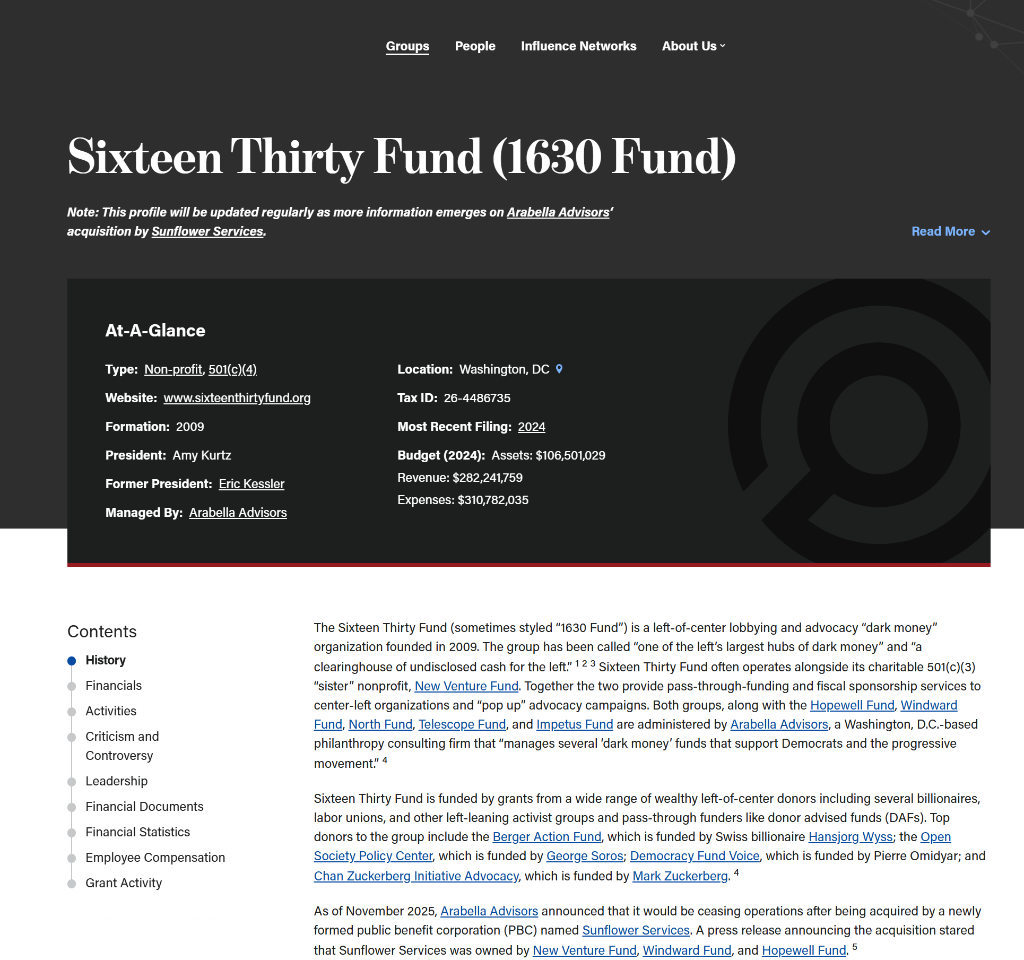
THE EMPIRE: The Sixteen Thirty Fund is a 501(c)(4) political lobbying organization founded in 2009 and managed by Arabella Advisors. Revenue: $282,241,759. Assets: $106,501,029. Expenses: $310,782,035. Top donors include organizations funded by George Soros, Mark Zuckerberg, Pierre Omidyar, and Swiss billionaire Hansjorg Wyss. The fund operates alongside its charitable sister nonprofit, New Venture Fund, and is administered alongside the Hopewell Fund, Windward Fund, North Fund, Telescope Fund, and Impetus Fund — all managed by Arabella Advisors, now rebranded as Sunflower Services after coming under Congressional scrutiny.
WIRED obtained the actual contracts signed by Chorus influencers. The terms were extraordinary — not for what they required, but for what they prohibited. The influencers were not simply hired to produce content. They were hired to produce content and then permanently conceal the source of their payment.
Graham Wilson, the Chorus lawyer, was captured on a recorded Zoom call with influencers explaining exactly why the nonprofit structure was chosen — and it was not for charitable purposes.
"It gives us the ability to raise money from donors. It also, with this structure, it avoids a lot of the public disclosure or public disclaimers — you know, 'Paid for by blah blah blah blah' — that you see on political ads. We don't need to deal with any of that. Your names aren't showing up on, like, reports filed with the FEC."
— Graham Wilson, Attorney & Chorus Founder · Recorded Zoom Call with Influencers · 2025 · Source: WIRED
Creators will "not publicize" their relationship with Chorus or tell others they are members of the program "without Chorus's prior express consent." Disclosure of any affiliation — even acknowledging the program exists — is grounds for immediate termination and financial cutoff.
Creators are forbidden from "disclos[ing] the identity of any Funder." The Sixteen Thirty Fund — the actual source of the $8,000/month payments — cannot be named, referenced, or acknowledged.
Creators must route "all bookings with lawmakers and political leaders through Chorus." Independently arranged meetings with government officials must also be reported to Chorus. The influencer's access to elected officials becomes a Chorus-controlled asset.
Chorus reserves the unilateral right to force creators to remove or correct any content made at a Chorus-organized event based solely on Chorus's discretion. The creator has no right of appeal.
Creators must attend daily messaging check-ins on "rapid response days" led by Chorus leadership. They must also attend at least two Chorus "newsroom" events per month — events Chorus plans, often with lawmakers — and participate in regular advocacy trainings.
Creators would "be kicked out and essentially cut off financially if they even so much as acknowledged that they were part of the program." The penalty for transparency is financial ruin.
Over 90 influencers were recruited into the Chorus program in its first cohort alone. The influencers in the initial group chat collectively had at least 13 million followers across social platforms. They represented some of the most well-known progressive voices in American digital media.
The following individuals were named in the WIRED investigation or confirmed by the House Oversight Committee's review of Chorus quarterly reports and contractor lists. All were offered the Chorus contract. Many signed it.
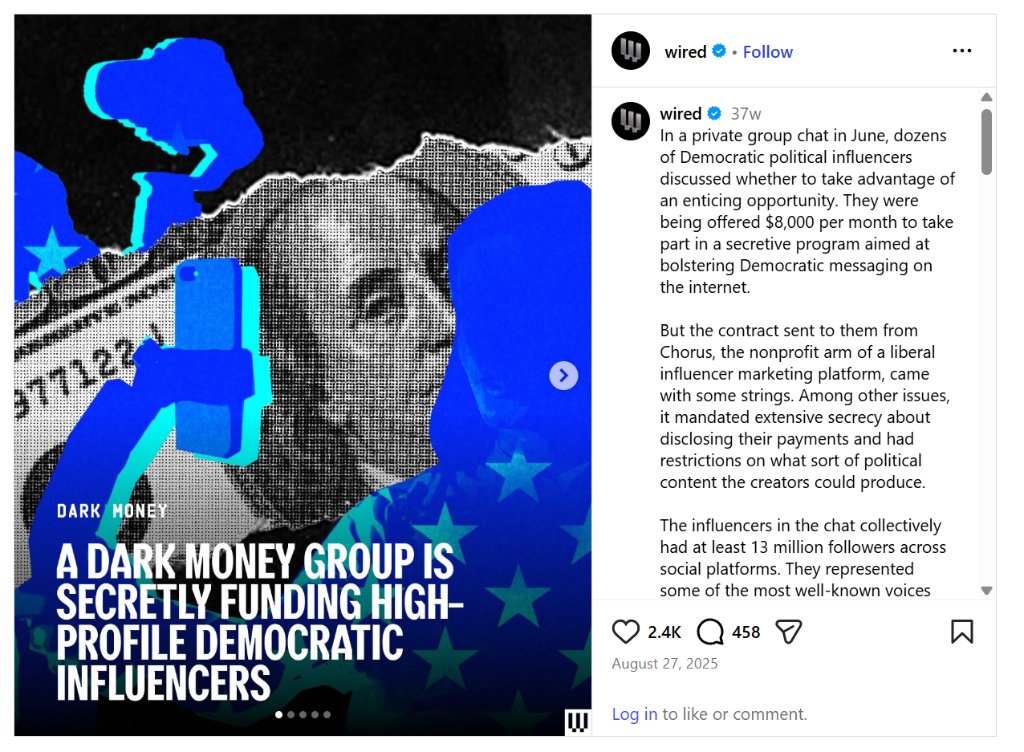
THE BOMBSHELL: WIRED's Instagram post breaking the story. Over 2,400 likes and 458 comments. The post confirmed the private group chat, the $8,000/month offer, and the mandatory secrecy clause — triggering a national media firestorm and eventually a Congressional investigation.
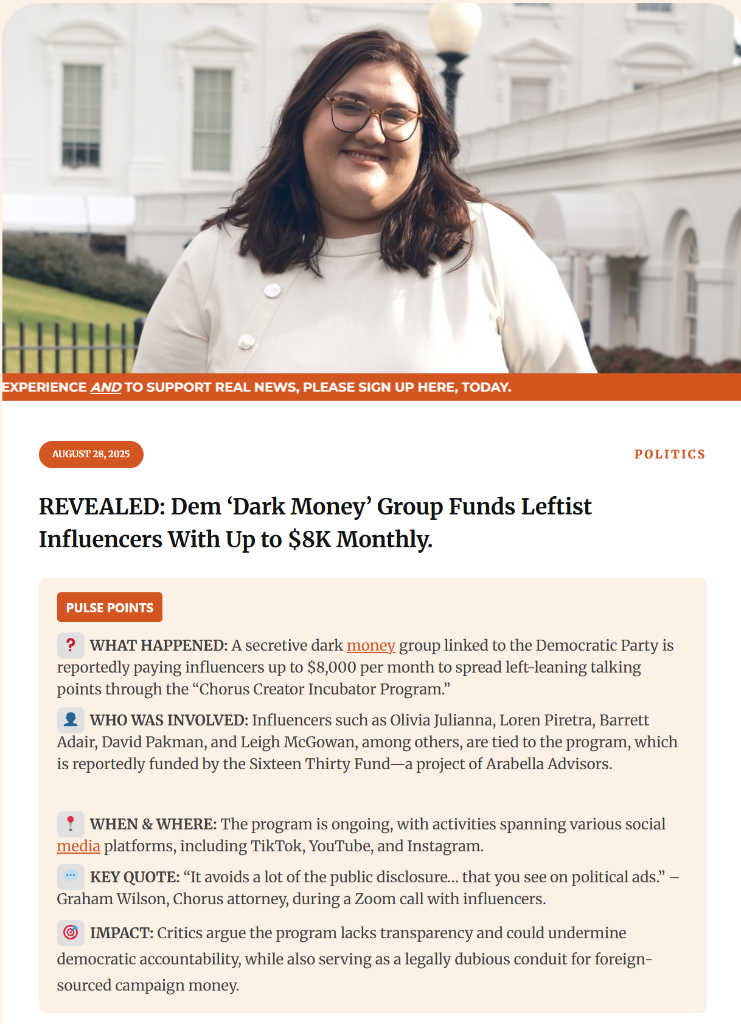
NAMED PARTICIPANT: Olivia Julianna was included in communications about the Chorus program and onboarding sessions for those receiving payments from the Sixteen Thirty Fund. She spoke at the 2024 Democratic National Convention. Her audience had no knowledge of her potential financial relationship with the Democratic dark money apparatus.
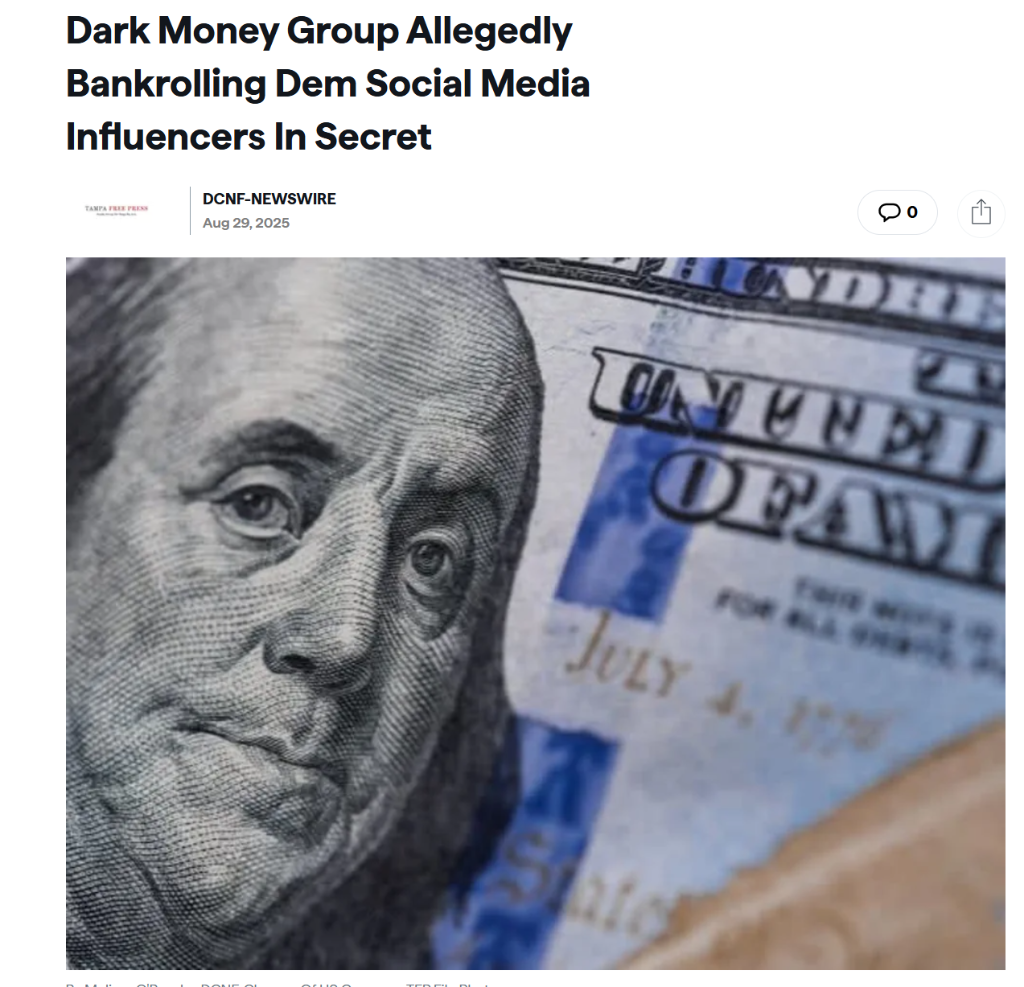
National wire service pickup of the WIRED investigation. Confirms named participants: Olivia Julianna, Loren Piretra, Barrett Adair, David Pakman, and Leigh McGowan (Politics Girl). Key quote from Graham Wilson cited: "It avoids a lot of the public disclosure... that you see on political ads."
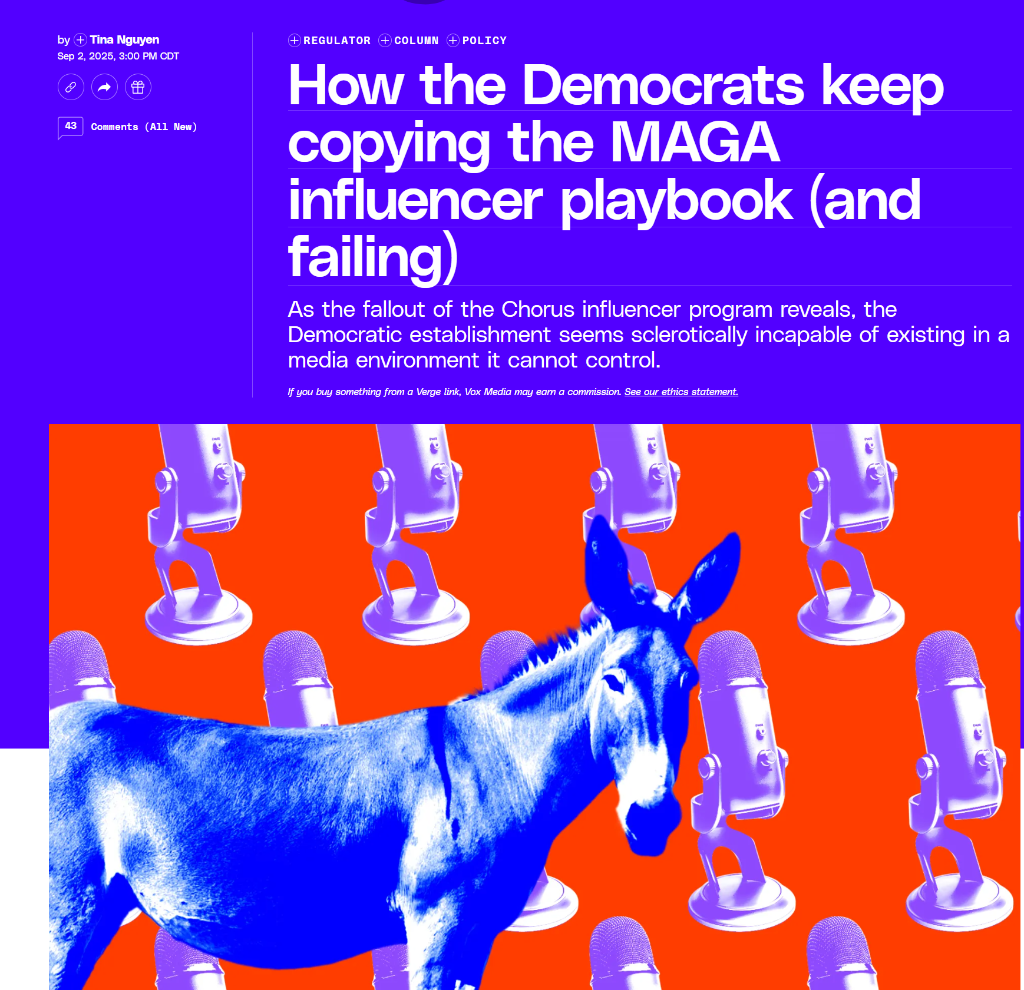
The Verge's analysis of the Chorus fallout notes the contrast with transparent conservative influencer programs: "Other groups like Turning Point USA would come in with their influencer affiliate program, be pretty open about who they were funded by and what they did, and everyone was like, 'Okay, sure, we're chill with it.'" The Democratic version required total secrecy.
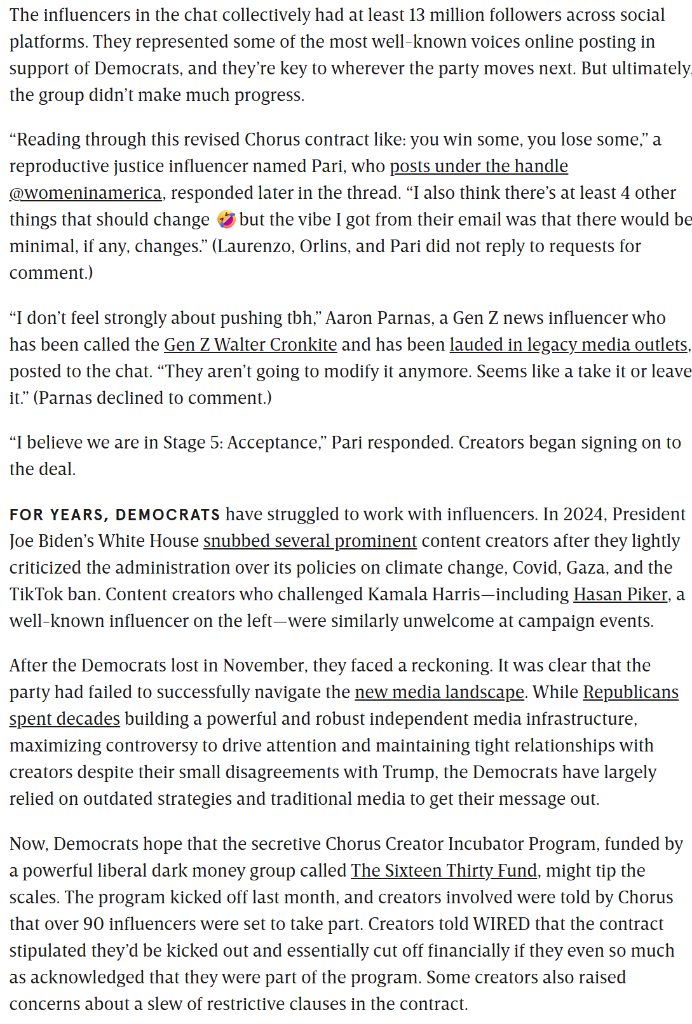
Direct from WIRED's reporting: Aaron Parnas in the group chat — "I don't feel strongly about pushing tbh. They aren't going to modify it anymore. Seems like a take it or leave it." Pari (@womeninamerica): "I believe we are in Stage 5: Acceptance." Creators began signing.
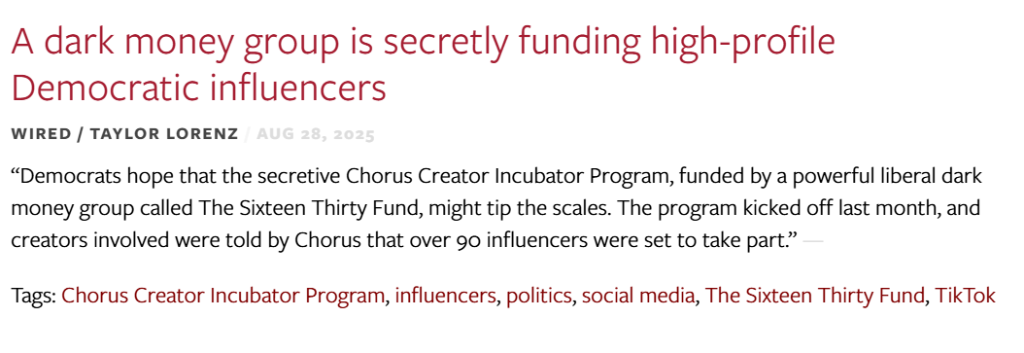
WIRED's framing of why Chorus was created: After Democrats lost in November 2024, "it was clear that the party had failed to successfully navigate the new media landscape. While Republicans spent decades building a powerful and robust independent media infrastructure... the Democrats have largely relied on outdated strategies." Chorus was the answer — built in secret.
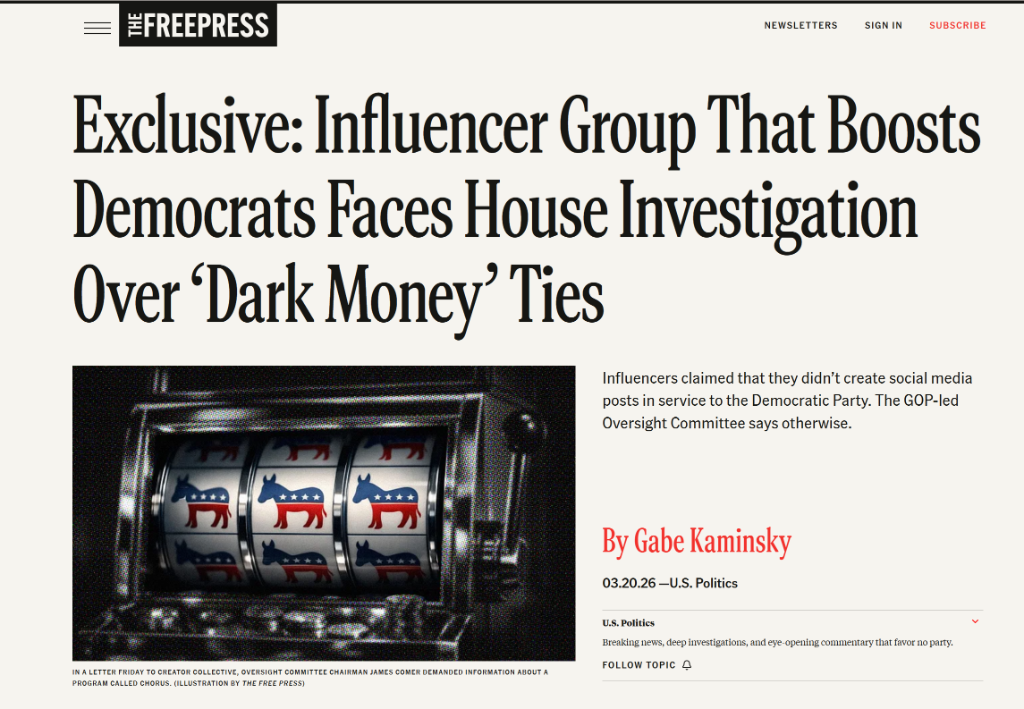
The Free Press confirmed the House Oversight Committee investigation and the demand letter sent to Creator Collective. The committee found "a disturbing pattern of activity" and evidence influencers created content "advocating for candidates, ballot initiatives, and political parties" despite signing certifications saying they did not.
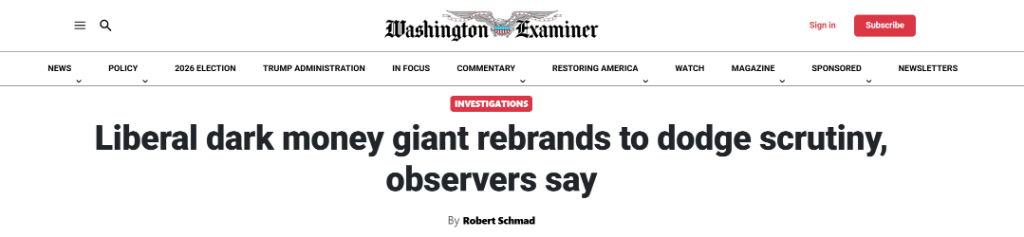
The Washington Examiner investigation confirmed that the Sixteen Thirty Fund and Arabella Advisors rebranded as Sunflower Services — a move observers described as a deliberate attempt to distance the organization from Congressional scrutiny during the active investigation.
On November 18, 2025, House Oversight Committee Chairman James Comer sent formal inquiry letters to the Sixteen Thirty Fund and Sunflower Services demanding all documents related to the Chorus program. The response from the Sixteen Thirty Fund was stunning — not for what it said, but for what happened immediately after it was received.
Three days after receiving the Committee's November 18 letter — on November 21, 2025 — Graham Wilson filed with the D.C. Government as founder of a new independent nonprofit corporation called the Creator Collective.
One month later, on December 16, 2025, the Sixteen Thirty Fund wrote to the Committee and stated that Chorus is "not an independent legal entity." That statement was technically true when written. But the very next day — December 17 — Wilson registered "Chorus" as a trade name under the Creator Collective he had just incorporated.
The Committee called it an attempt to "obfuscate Chorus's legal structure" and "hide potentially responsive documents." By March 20, 2026, Chairman Comer had sent a third letter — this time directly to Graham Wilson — documenting what the Committee called "a disturbing pattern of activity." By May 14, 2026, a formal Congressional subpoena had been issued demanding all documents by May 28, 2026.
To date, the Sixteen Thirty Fund has produced just 135 pages since November 18, 2025 — a pace of less than one page per day. Of those 135 pages, 62 contained what the Committee described as "obstructive redactions."


Dozens of Democratic influencers discuss whether to accept Chorus contract. Key clause: total secrecy about payments and funder identity. Creators with 13M+ combined followers begin signing.
2025
WIRED obtains the actual contracts and the recorded Graham Wilson Zoom call. Wilson on tape: "Your names aren't showing up on, like, reports filed with the FEC." National media firestorm begins.
2025
Notes key difference: conservative influencer programs like Turning Point USA were transparent about funding. Chorus required total secrecy. One observer: "everyone was like, 'Okay, sure, we're chill with it'" about TPUSA — the opposite of Chorus.
2025
12-category document demand. Deadline: December 2, 2025. Demands all contracts, communications, influencer identities, funding records, and FEC compliance documents.
2025
Records show Wilson filed as founder of a new independent nonprofit called the Creator Collective just three days after receiving the Committee's letter. The Committee later calls this an attempt to hide documents from Congressional subpoena.
2025
Letter to Chairman Comer asserts Chorus is merely a project of the Sixteen Thirty Fund, not a separate entity. This statement is made while the Creator Collective — incorporating Chorus — has already been filed with D.C. authorities.
2025
One day after telling Congress Chorus is not a separate legal entity, Wilson registers "Chorus" as a trade name under Creator Collective. The Committee calls this "an attempt to obfuscate Chorus's legal structure."
2026
Only revealed to the Committee on February 6, 2026 — after Committee staff pressed for verification. The structural change is not disclosed on Chorus's website or social media channels.
2026
7-page letter to Wilson documents the cover-up timeline, reveals Chorus's real leadership (partisan election operatives, not creators), exposes 50 influencer quarterly reports contradicting signed certifications, and reveals Chorus's website was hidden behind "Withheld for Privacy" — an Iceland-based service used by nefarious actors.
2026
Comer issues formal subpoena to Sixteen Thirty Fund President Amy Kurtz. Committee notes 135 pages produced in 6 months — less than one page per day. Of 135 pages, 62 contained obstructive redactions. Documents due May 28, 2026.
Every Chorus influencer signed a quarterly certification attesting that they "did not create any content on behalf of Chorus or using any Chorus resources that expressly advocated the election or defeat of, or solicited funds for, a clearly identified candidate, political party, or ballot measure."
The House Oversight Committee obtained 50 of those quarterly reports. What they found directly contradicted the signed certifications. Three specific examples were documented in the Committee's March 20, 2026 letter to Graham Wilson.
SOURCE: All three examples are documented with screenshots in the official House Oversight Committee letter to Graham Wilson dated March 20, 2026 — a Congressional record. These are not allegations. They are documented findings of the United States House of Representatives. READ THE FULL LETTER →
⚖️ THE NFA INVESTIGATIVE FINDING
Based on a comprehensive review of Congressional subpoenas, official inquiry letters, WIRED's documented reporting, InfluenceWatch financial records, and the House Oversight Committee's findings, No Filter America Investigations reaches the following conclusions:
Every influencer who took this money and never disclosed it committed a fraud on their audience. Every American who watched their content believed they were watching an independent opinion. They were watching a paid political operation. The contract was written to make sure they never knew the difference.
WHAT YOU NEED TO KNOW
The next time a political influencer tells you what to think, what to vote for, or what to believe — ask one question: Who paid for this?
Under the Chorus contract, they were prohibited from answering you. Their silence was purchased. Your opinion was the product.
"Your names aren't showing up on,like, reports filed with the FEC."
— Graham Wilson, Chorus Attorney · On the Record
They were paid $8,000 a month to tell you what to think. They were contractually forbidden from telling you who was paying them. Now Congress has subpoenaed the documents — and they're still hiding them.
"Your names aren't showing up on, like, reports filed with the FEC." — Graham Wilson, Chorus Attorney, On the Record
READ THE FULL INVESTIGATION →Get notified when a new investigation or evidence file is published.
No spam. No selling your data. Investigations only — unsubscribe anytime.
If this investigation was useful, help others discover it by sharing.
Get notified when a new investigation or evidence file is published.
No spam. No selling your data. Investigations only — unsubscribe anytime.
Get notified when a new investigation or evidence file is published.
No spam. No selling your data. Investigations only — unsubscribe anytime.