
The Epstein/Trump File: 38,000 Mentions
One Witness & The Machine Behind It Subtitle: How Dark Money, Anonymous Allegations, and a Coordinated Media Narrative Turned Zero Evidence Into America's Biggest Political Story

38K Times Trump's name appears across 5,300+ files, 0 - Physical or corroborating evidence found by DOJ.
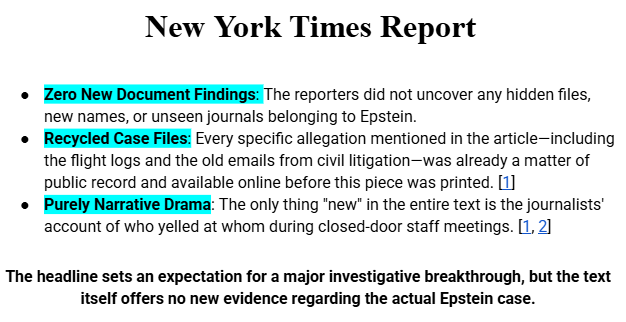
The number sounded like a smoking gun. Thirty-eight thousand mentions of Donald Trump inside the Epstein files. The New York Times rushed a headline. Media outlets ran wall-to-wall coverage. The nation's attention locked onto a number designed to imply guilt.
So where does 38,000 come from? The answer is simple: data software scanning millions of pages of a public figure's digital archive. Epstein kept a massive personal archive of news articles, political newsletters, forwarded emails, and public documents. Every time the word "Trump" appeared in any of those millions of pages — including news articles about Mar-a-Lago, political campaign coverage, and social correspondence — it counted as a "mention."
If this investigation was useful, help others discover it by sharing.
Viewing is free — downloading and printing evidence files requires an active NFA Investigation Alerts subscription.
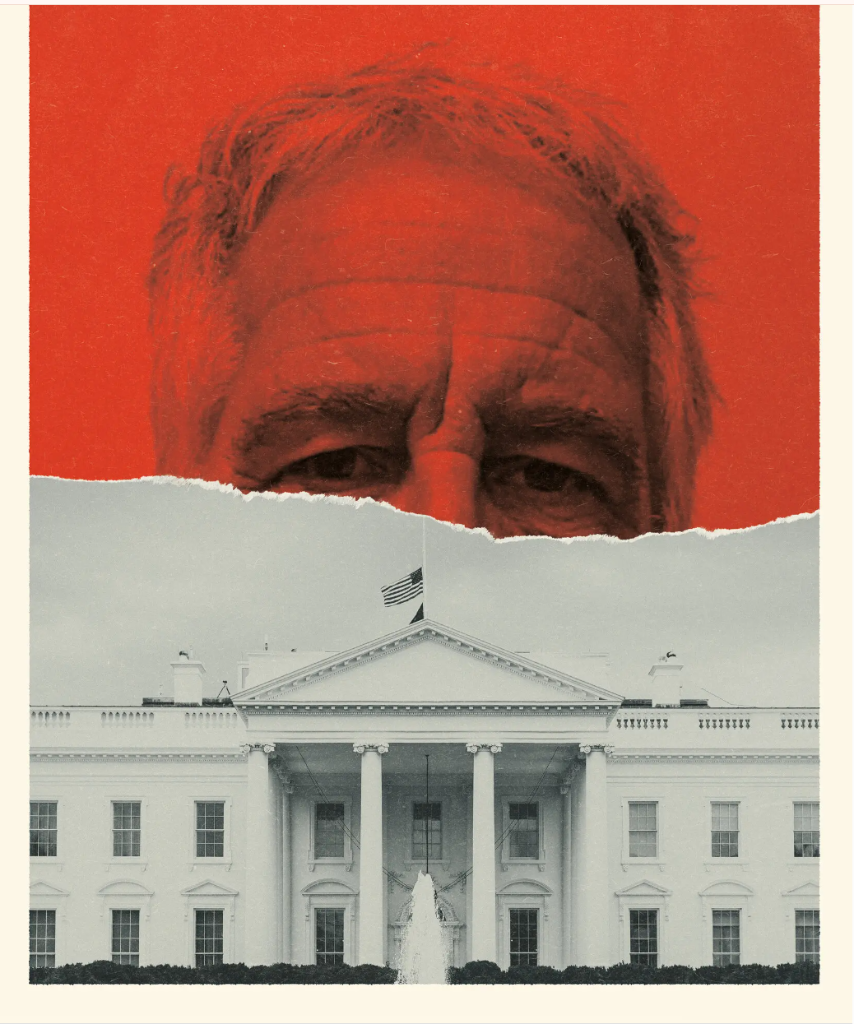
The number sounded like a smoking gun. Thirty-eight thousand mentions of Donald Trump inside the Epstein files. The New York Times rushed a headline. Media outlets ran wall-to-wall coverage. The nation's attention locked onto a number designed to imply guilt.
But NFA went to the source documents. We read the FBI 302s. We reviewed the official DOJ release letter signed by Attorney General Pamela Bondi and Deputy AG Todd Blanche. We cross-referenced the Congressional testimony. And what we found tells a very different story — one not about evidence of presidential misconduct, but about a coordinated, dark-money-funded machine that is manufacturing a narrative using a single uncorroborated allegation from an anonymous woman whose identity remains sealed by federal law.
This investigation examines three things: what the 38,000 number actually means, who the South Carolina woman is and whether her account is credible, and who is funding the ongoing push to keep Trump's name attached to the Epstein story long after the government itself said there is nothing there.
The Department of Justice officially stated — in writing, signed by the Attorney General of the United States — that after reviewing the Epstein files, they did not find credible evidence against Trump to merit a criminal investigation.
So where does 38,000 come from? The answer is simple: data software scanning millions of pages of a public figure's digital archive. Epstein kept a massive personal archive of news articles, political newsletters, forwarded emails, and public documents. Every time the word "Trump" appeared in any of those millions of pages — including news articles about Mar-a-Lago, political campaign coverage, and social correspondence — it counted as a "mention."
Independent analysis confirms the references fall into three specific categories: benign social mentions and news articles forwarded by Epstein, flight log and "Black Book" contact data that repeats across multiple investigative folders, and a compiled list of unverified FBI tip-line calls made before the 2020 election that the DOJ itself flagged as "untrue and sensationalist."
The DOJ was explicit: "Some of the documents contain untrue and sensationalist claims against President Trump that were submitted to the FBI right before the 2020 election. To be clear, the claims are unfounded and false."
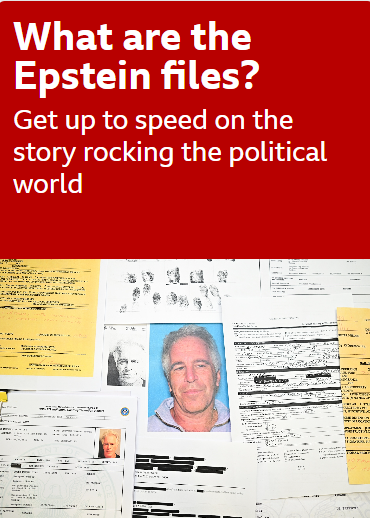
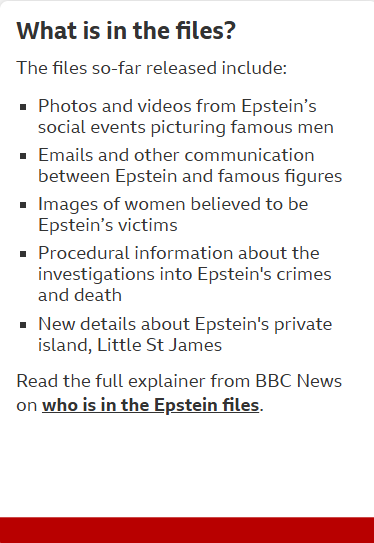
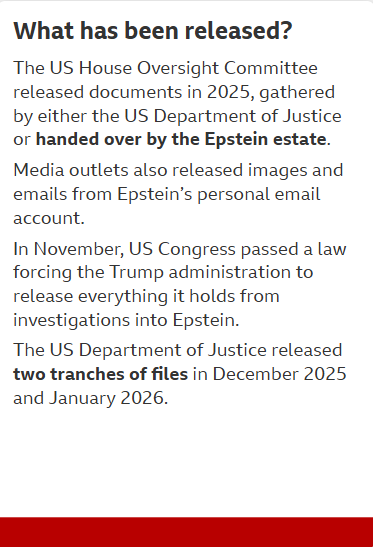
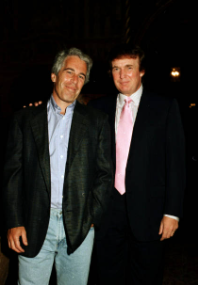
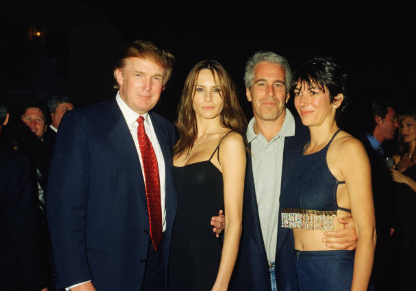
Epstein and Trump were acquainted. This is not disputed. They moved in overlapping social circles in New York and Palm Beach during the 1980s and 1990s. Photographs confirm they were present at the same social events. Epstein himself wrote in a 2019 email that Trump "came to my house many times" — but in the same email, explicitly added that Trump "never got a massage" from any of the women.
Virginia Giuffre, Epstein's most prominent and widely corroborated accuser, stated under oath in her unsealed deposition that she worked at Trump's Mar-a-Lago resort when Epstein recruited her. She then explicitly clarified: Trump never flirted with her, she never saw him at Epstein's houses, and she never saw him engage in any wrongdoing.
Palm Beach Police Chief Michael Reiter told the FBI that Trump called the police department in 2006 after the raid on Epstein — to thank them. Reiter stated Trump remarked that "everyone knew" about Epstein's behavior. This is the only other significant Trump reference in the official law enforcement files.
The Ghislaine Maxwell proffer interview — conducted July 25, 2025 by Deputy AG Todd Blanche himself, with Maxwell under a proffer agreement and legally obligated to tell the truth — contains exactly one reference to Trump's name, and it has nothing to do with the South Carolina woman's allegations.
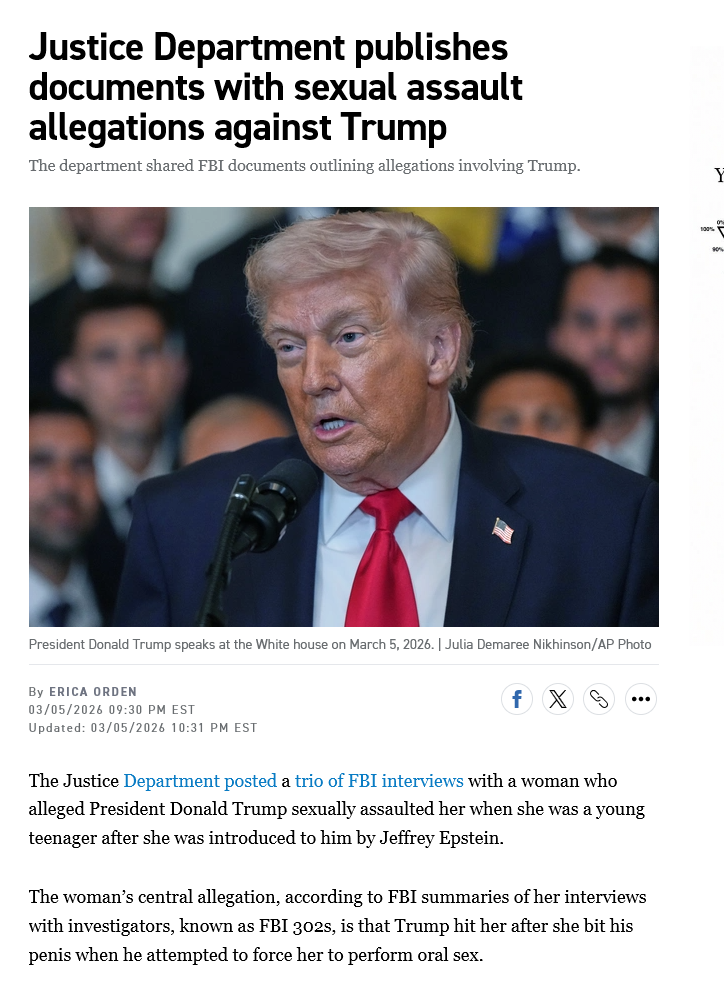
She is identified in official government documents only as "Jane Doe 4." She goes by "the South Carolina woman." Under the Epstein Files Transparency Act, her identity cannot be disclosed. Her case against the Epstein estate was settled out of court in 2021 for an undisclosed amount. She is the only named source of any specific allegation against Donald Trump in the entire 3.5 million page document release.
Born in 1968 in Binghamton, New York. Her family moved to South Carolina, where she was a child when Jeffrey Epstein rented a luxury villa through her mother — a local real estate agent — in the Sea Pines Plantation neighborhood on Hilton Head Island in 1984. The FBI FD-302 documents from case number 31E-NY-3027571 document that she came to the villa believing she had a babysitting job. She was 13 years old.
What followed, according to her FBI statements, was years of exploitation, blackmail, and abuse at the hands of Epstein and his associates. The FBI found her account credible enough to interview her on four separate dates: July 24, August 7, August 20, and October 16, 2019. The specific allegation against Trump — that Epstein took her to a high-rise building in New York or New Jersey and introduced her to Trump, leading to an alleged sexual assault — appears in the August 7, 2019 interview, Document Serial 252.
But here is the critical investigative question that every major media outlet has failed to answer: Is she credible?
Re: Epstein Files Transparency Act — Production of Department Materials
The Department's collection efforts resulted in more than 6 million pages being identified as potentially responsive... Today, the Department is releasing over 3 million responsive pages, including more than 2,000 videos and 180,000 images... More than 500 attorneys and reviewers from the Department contributed to this effort.
The DOJ stated: "This production may include fake or falsely submitted images, documents or videos, as everything that was sent to the FBI by the public was included in the production... Some of the documents contain untrue and sensationalist claims against President Trump that were submitted to the FBI right before the 2020 election. To be clear, the claims are unfounded and false."
— Signed: Pamela J. Bondi, U.S. Attorney General | Todd Blanche, Deputy U.S. Attorney General
NFA has reviewed the actual FBI FD-302 documents from case 31E-NY-3027571. Here is what the primary source record shows about the South Carolina woman's background, her account, and the factors that bear directly on her credibility.
What supports her account: The FBI determined her initial allegations against Epstein were significant enough to warrant four separate follow-up interviews — an unusual level of engagement. When journalists cross-referenced her specific background details from childhood — property records, school records, family financial filings from the 1980s — those specific background details were found to be factually accurate. Her account of how Epstein gained access to her through her mother's real estate work is internally consistent and corroborated by property records.
Her description of Epstein's behavior — the blackmail of her mother through explicit photographs, the mother's subsequent federal prison sentence for embezzlement, the years of threatening phone calls, the near-road incidents on Interstate 5 — is consistent with documented patterns in other Epstein cases. She described his physical appearance, his cologne ("Grey Flannel"), his drinking habits (gin and tonic), and his music preferences (Neal Diamond) in granular, specific detail that would be difficult to fabricate.
What undermines her account: Her criminal record includes theft (one year in a Georgia county jail for stealing cash from a terminally ill elderly man she was in a relationship with), welfare fraud (pretrial diversion for food stamp fraud), and multiple drug-related citations over decades. Journalists who investigated her background describe decades of drug dependency, domestic turmoil, and poverty.
Most critically: there is no physical evidence corroborating the specific allegation against Trump. No charges were ever filed. The DOJ reviewed every document and declined prosecution. Her allegation against Trump appears in only one of the four FBI interview summaries — and three of those four summaries were initially missing from the public DOJ release, flagged by Rep. Robert Garcia (D-CA) as a potential violation of the Epstein Files Transparency Act.
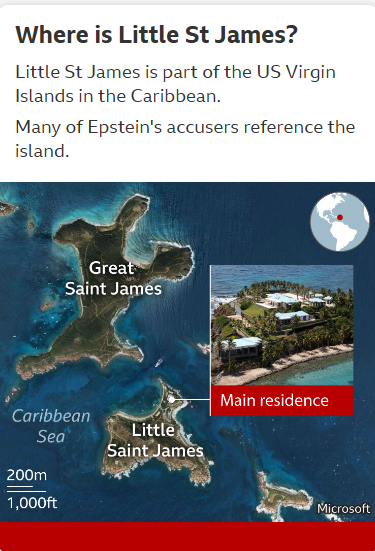
Furthermore, the specific Trump encounter — alleged to have occurred at an unidentified high-rise building in New York or New Jersey — is not linked to the island, not linked to any documented Epstein location, and is not corroborated by any other witness. Virginia Giuffre, who has named numerous men in sworn testimony, never mentioned Donald Trump in connection with any wrongdoing.
| NFA CREDIBILITY ASSESSMENT — Jane Doe 4 / "The South Carolina Woman" | |
|---|---|
|
✓ FACTORS SUPPORTING CREDIBILITY
|
✗ FACTORS UNDERMINING CREDIBILITY
|
"She recalled at least one incident in which EPSTEIN took her off of the Island when she was between 13 to 15 years old. He drove her and/or flew her to either New York or New Jersey. She was, 'introduced to someone with money, money... It was Donald Trump.'"
— FBI FD-302, Interview #2, August 7, 2019 | Case No. 31E-NY-3027571 | Serial 252, Page 7 | U.S. Department of Justice
This is the document. This is the allegation. These are the exact words from the primary source. NFA is presenting it in full — not to validate it, and not to dismiss it. The public deserves to read what is actually in the file, rather than a media-filtered version designed to generate maximum political damage.
What the FBI document also shows: she stated Trump "didn't like her from the get-go" because she was a "boy-girl" (a tomboy). She described the alleged encounter in the same document. She also disclosed, in the same session, that she believed she had "two additional interactions" with Trump but refused to discuss them further. Those additional interviews — if they contain details about Trump — are among the three summaries that Rep. Garcia says are missing from the public release.
Here is the story that no mainstream outlet has told. The Epstein files are not simply a news event. They are a battlefield. And on that battlefield, a dark money organization with no public financial transparency has planted its flag — and is funding a nationwide narrative operation designed to permanently attach Donald Trump's name to Jeffrey Epstein in the public consciousness.
The organization is called DEFIANCE.org. It was founded in late 2025 by Miles Taylor — the former DHS Chief of Staff who wrote the anonymous "Anonymous" op-ed criticizing Trump — and Xander Schultz. It operates as a 501(c)(4) social welfare organization, which means it is not required to publicly disclose its donors. No IRS Form 990s are yet available.
DEFIANCE.org committed an initial $100,000 seed grant to fund the "Donald J. Trump and Jeffrey Epstein Memorial Reading Room" — a traveling installation organized by the Institute for Primary Facts. The exhibit features 3.5 million pages of DOJ Epstein documents, printed and bound into 3,400 physical volumes, with a detailed timeline charting the "relationship" between Trump and Epstein. It debuted in New York City's Tribeca neighborhood and is touring major cities.
The same organization — DEFIANCE.org — is also the funding backbone behind FederalOverreach.org (FAFO), the coalition of District Attorneys being organized to prosecute federal ICE agents for state law violations, as documented in NFA's previous investigation into Hennepin County Attorney Mary Moriarty.
The pattern is consistent: DEFIANCE.org identifies high-value political targets, funds a public-facing initiative designed to look like grassroots activism, and uses that initiative to keep damaging narratives alive in public discourse. The Epstein Reading Room is not a journalism project. It is a political operation funded by a dark money group with no financial transparency, whose stated mission is opposing the Trump administration.
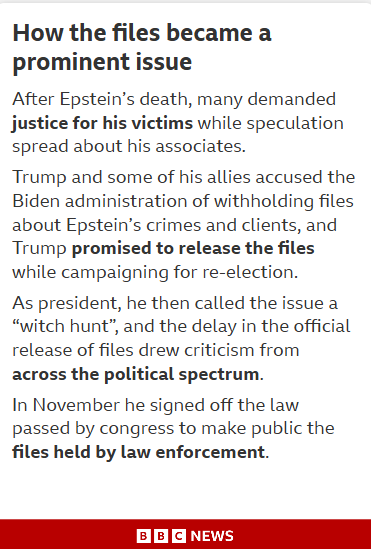
The most damning story in the Epstein files has nothing to do with Trump. It is the documented, decades-long failure of American law enforcement to act on credible reports of child sex trafficking by a connected, wealthy predator.
Maria Farmer reported Epstein to the FBI in 1996. She named Epstein, Ghislaine Maxwell, and Les Wexner. The FBI acknowledged her report. Then did nothing. In 2006, the same FBI tracked her down, said they were going to "get him," and then gave Epstein a sweetheart deal. Farmer has since developed Hodgkin's Lymphoma, a brain tumor, and Addison's disease — conditions she attributes to three decades of stress from fighting a government that repeatedly betrayed her.
Courtney Wild was abused from age 14 to 17. She fought in federal court for over a decade to have her rights recognized under the Crime Victims' Rights Act. A federal judge ruled her rights were violated by the non-prosecution agreement. And then, in her words: "The court found that the government violated the law... and nothing happened."
These are the real stories the Epstein files contain. Not a number. Not 38,000 mentions. But the documented, systematic failure of the United States government to protect children from a man who was protected by his money, his connections, and the institutions that were supposed to stop him.
Not evidence.
No Filter America does not tell you what to think. We tell you what the documents say. Here is what the primary source record establishes:
On the 38,000 mentions: This number is a product of data software, not criminal evidence. The DOJ — under an administration with every incentive to prosecute Trump if legitimate evidence existed — reviewed all materials and found nothing. The official government finding is that the claims are unfounded.
On the South Carolina woman: She is a real person who was genuinely victimized by Jeffrey Epstein beginning at age 13. Her account of Epstein's conduct has hallmarks of credibility. The FBI treated her seriously. Her background details check out. But the specific allegation against Trump is uncorroborated, unlocated, unsupported by any other witness, and occurred 37 years before she reported it. The credibility factors cut both ways. No reasonable person can call this settled.
On the media coverage: The New York Times published a "bombshell" that contained no new evidence. Media outlets ran 38,000 as a headline number without explaining what it means. The narrative was manufactured — not discovered.
On DEFIANCE.org: A dark money 501(c)(4) with no donor transparency, founded by a man whose stated mission is opposing the Trump administration, is funding a nationwide traveling exhibit designed to cement the Epstein-Trump connection in the public mind. This is not journalism. This is political warfare dressed as activism, bankrolled by money that does not have to be disclosed to anyone.
But the specific campaign to brand Donald Trump a child predator using the Epstein files is built on a single anonymous allegation, zero physical evidence, and a dark money organization that does not have to tell you who is paying for it.
The 38,000 number is not evidence. It is a headline. The South Carolina woman's account has genuine credibility factors — and genuine credibility problems. The DOJ found nothing. The most prominent Epstein accusers cleared Trump under oath. Ghislaine Maxwell, under a legal proffer agreement with the Deputy AG himself, never mentioned the encounter.
The machine keeping this story alive is not journalism. It is funded political opposition dressed in the language of accountability. No Filter America names the machine. You decide what it means.

Get notified when a new investigation or evidence file is published.
No spam. No selling your data. Investigations only — unsubscribe anytime.
If this investigation was useful, help others discover it by sharing.
Get notified when a new investigation or evidence file is published.
No spam. No selling your data. Investigations only — unsubscribe anytime.
Get notified when a new investigation or evidence file is published.
No spam. No selling your data. Investigations only — unsubscribe anytime.