

Executive Summary
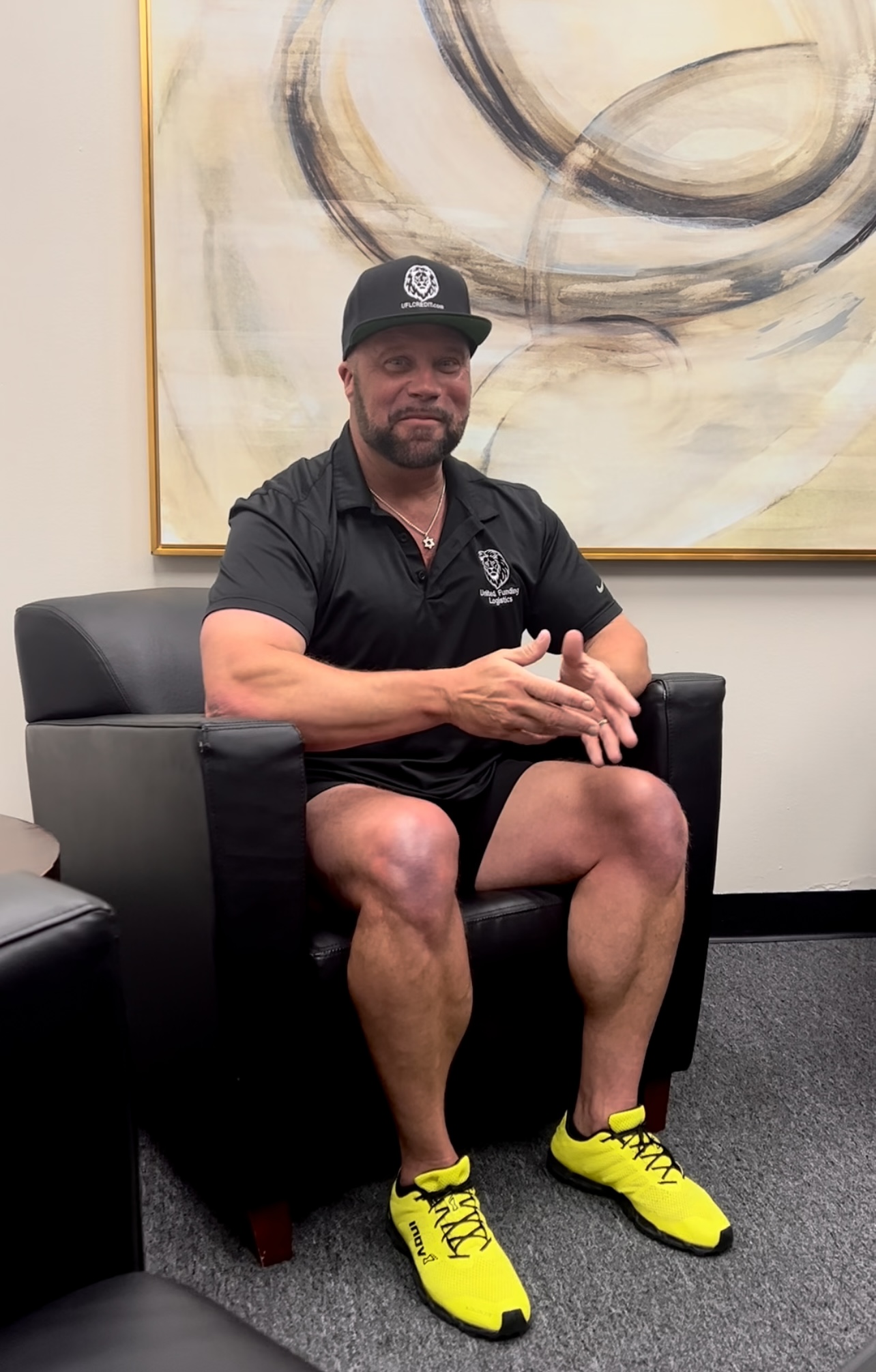
Brian Wilson ran United Funding Logistics, LLC, a Houston-based credit repair and debt settlement company with a database of 36,000 client transactions and a wall of debt collector victory letters proving real results for real clients. After publicly accusing the Better Business Bureau of operating a "pay to play" rating system — and sending a $5,000,000 demand letter to BBB Houston president Dan Parsons — Wilson was given an F rating amid complaints that he maintains included people who were never his clients. Wilson contends that some of those complaints were connected to a sprawling impersonation operation involving 90+ fake TikTok accounts using his photograph and business identity to scam consumers, a credential-harvesting phishing infrastructure targeting Apple, Amazon, Comcast, and banks, and a separate Alabama-based entity called MyCreditBeast.com that was fraudulently charging Wilson's own business debit card while billing his clients under a similar name.
Wilson reported everything. The Houston Police Department took an incident report. The FBI's Internet Crime Complaint Center received a formal complaint documenting 50+ victims within two days. Neither investigation produced an arrest. Meanwhile, the BBB removed all positive reviews from Wilson's profile, stamped complaints from individuals Wilson maintains were never UFL clients as "Verified," and published a "Pattern of Complaints" alert alleging Wilson conditioned client payments on 5-star reviews — an allegation Wilson denies and that the BBB has not substantiated with evidence.
The BBB's record later became relevant to the Harris County Attorney's Office investigation. Harris County filed a civil enforcement lawsuit — naming as a co-defendant the same "Credit Beast" entity that Wilson had reported to the FBI as an impersonation fraud victim. What remains disputed is how much weight investigators placed on BBB complaints and reviews, whether those records included people affected by impersonation, and whether the review population accurately represented UFL's actual customer base. The Unauthorized Practice of Law Committee opened three separate files against Wilson, gave him 18 hours to sign a Cease and Desist or face a hearing without counsel, conducted an 80-minute hearing where he was questioned without a lawyer, and then went 82 days without producing the recording they promised. On August 12, 2026, Wilson filed a formal complaint with the statewide UPLC requesting administrative review.
This is the documented sequence of events that followed one man's challenge to an institution everyone assumes is on the right side. Whether the sequence establishes a pattern of institutional retaliation or reflects independent decisions by separate agencies is a conclusion readers can evaluate for themselves.
The Alert the BBB Posted Without Proof
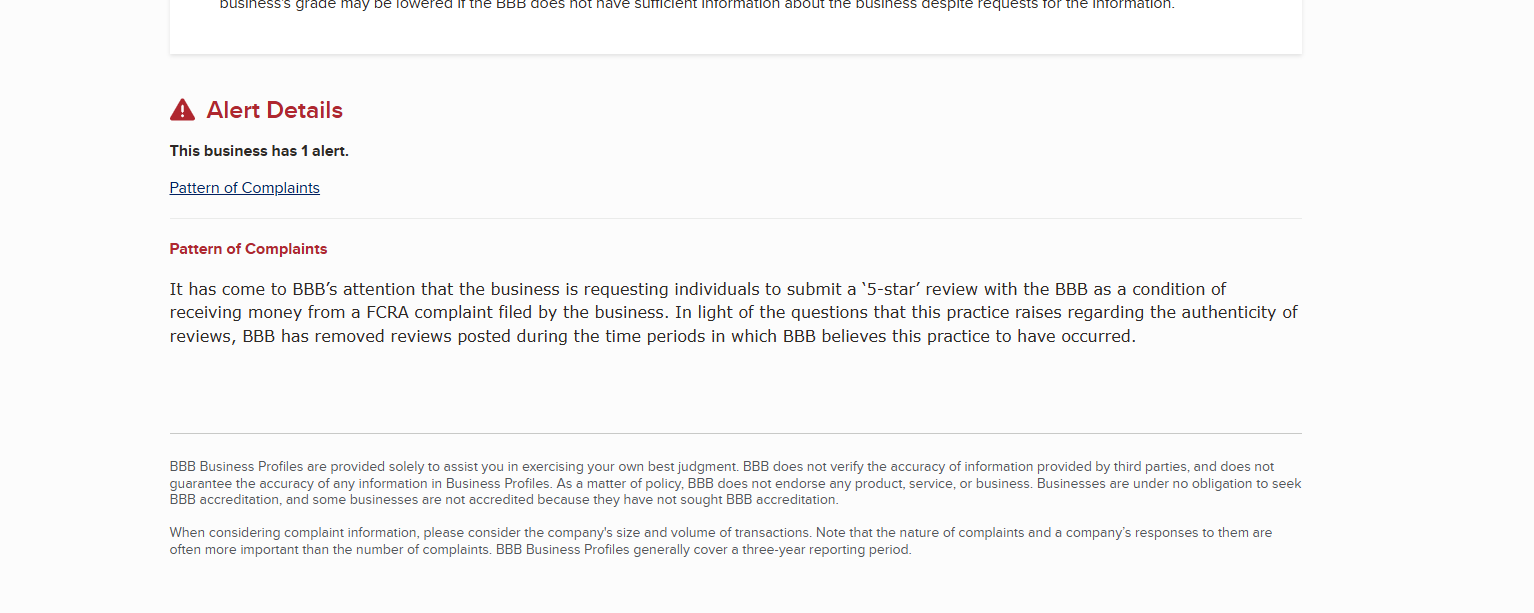
After removing more than 90 positive reviews and stamping an F rating on United Funding Logistics, the Better Business Bureau took one more step: it published a “Pattern of Complaints” alert directly on Wilson’s public business profile. The alert accused Wilson of conditioning FCRA settlement payments on five-star reviews — a public fraud charge visible to every consumer, lender, and search engine that ever looked up his business. The BBB published it without a hearing, without a sworn statement, without a single receipt, and without ever verifying the allegation. And the BBB admitted it — in the very same box where it printed the accusation.
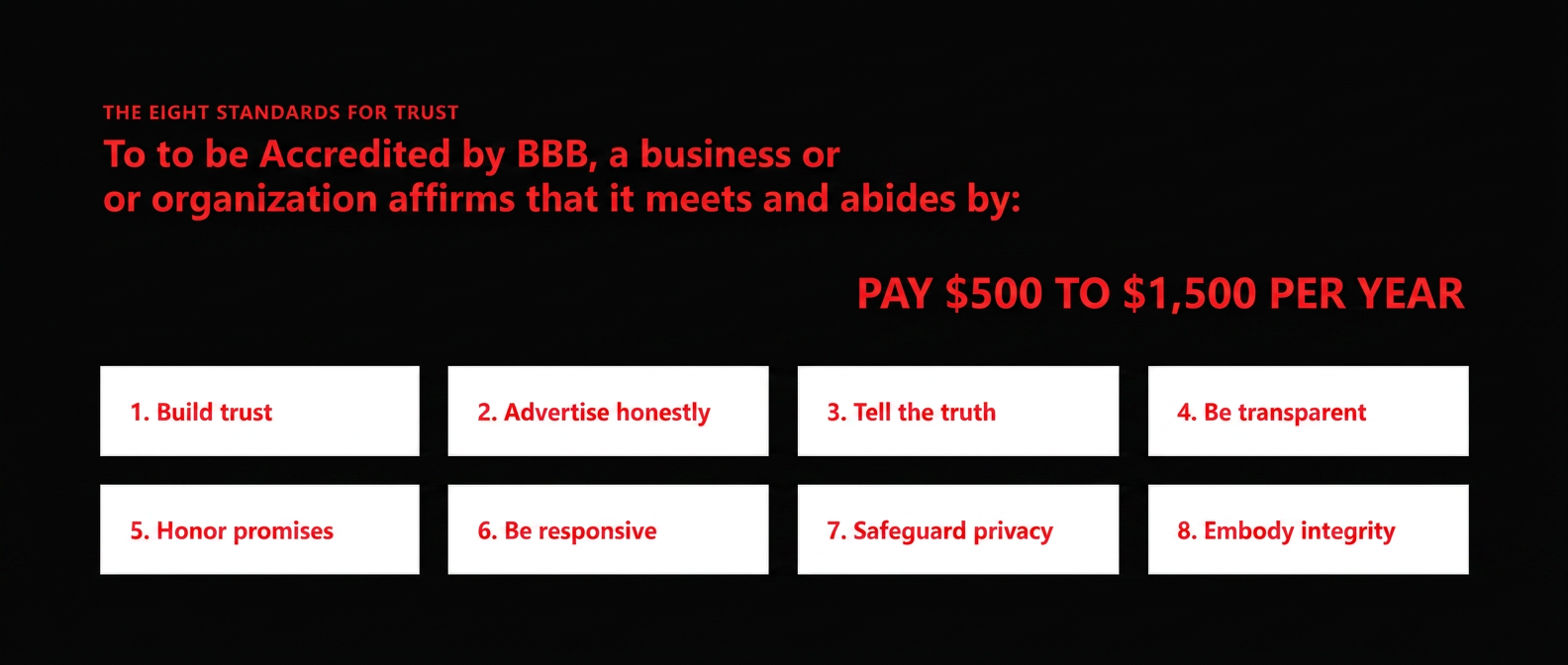
Before the disclaimer and before the double standard, there is a more basic problem the BBB has never answered: Wilson never agreed to be judged by the BBB at all. The BBB’s own Accreditation Standards — the eight “standards for trust” it used to justify the F rating and the alert — are, by the BBB’s own published terms, the standards “for business accreditation by BBBs,” which a business “affirms that it meets and abides by” and for which “BBB charges a fee.” Wilson never accredited. He never applied. He never paid. He never affirmed that he would abide by the BBB’s standards. The BBB imposed its private, fee-based accreditation framework on a business that was never a member — and then published a fraud alert when that non-member failed to satisfy standards he never agreed to.
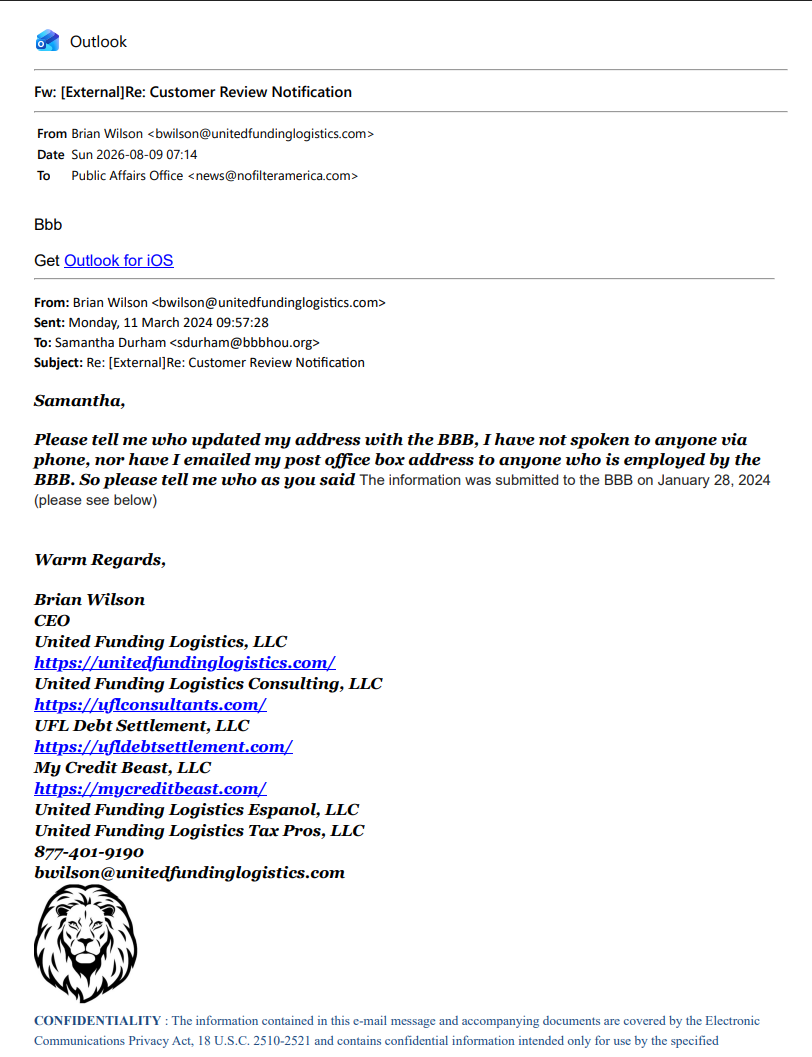
Worse, Wilson never even had a working channel to the BBB. The BBB created United Funding Logistics’ profile without Wilson’s consent — its VP of Dispute Resolution, Samantha Durham, confirmed in writing that the BBB creates business profiles “with or without the owner’s consent” and could not remove it. The only “accreditation application” on file (January 28, 2024) was submitted by an impersonator — with a misspelled email (unitiedfundinglogistic@gmail.com) and a transposed phone number. The post office box on the application, however, was Wilson’s real one — and that alarmed him enough that on March 11, 2024 he emailed Durham demanding to know how the BBB had obtained it. By Wilson’s own account, he did not even have the password to the misspelled email on the profile — he had never used it. The BBB accepted the fraudulent application, updated his profile with information he never submitted, and then judged him for failing to respond to complaints routed to an email address he could not access.
The F rating’s own stated basis proves the point. The BBB lowered Wilson’s rating for “Failure to respond to 64 complaint(s) filed against business.” The BBB’s “Be responsive” standard — the accreditation rule that requires a business to “Address disputes forwarded by BBB quickly and in good faith” — is a duty a business takes on by choosing to accredit. Wilson never chose to accredit. The BBB created his profile without consent, routed complaints to an email he did not control, and then punished him for not responding to a process he never entered. An organization cannot impose a contractual duty on a non-member by unilaterally publishing his name.
Read the alert the way a consumer reads it. The heading says “Pattern of Complaints.” The body says Wilson conditioned client payments on five-star reviews. That is a fraud accusation. Then the footer — in the same box, beneath the accusation — says the BBB “does not verify the accuracy of information provided by third parties, and does not guarantee the accuracy of any information in Business Profiles.” The BBB is telling the public to treat the accusation as unverified — after it already published it as an alert. The accusation does the damage the moment it loads. The disclaimer does not un-publish it.
The BBB’s own Terms of Use — the rules every user must accept to submit anything to the BBB’s sites — require every submitter to represent and warrant that “All User Content that you post is accurate, complete, and true in all respects.” The same Terms expressly forbid any user from submitting content that is “false, fraudulent, or misleading.” A consumer who posted an unverified fraud accusation about a business would be in violation of the BBB’s own rules. The BBB published an unverified fraud accusation about a business — and wrote itself a disclaimer to make it legal.
The BBB’s own Terms even distinguish a “BBB alert” from ordinary content — stating that while most BBB content “should not be construed as a representation of the opinions of BBB,” alerts and ratings are the exceptions. In other words, the BBB explicitly treats its own alert as its own opinion — not a user submission. Which means the “you must warrant this is true” standard the BBB applies to consumers does not apply to the BBB’s own published accusation. The BBB holds the public to a truth standard it exempts itself from. Rules for thee.
Strip the alert down to its single substantive charge: Wilson “conditioned FCRA settlement payments on five-star reviews” — in plain English, he incentivized reviews. That is the accusation the BBB published as a public fraud alert. So the first question is whether the BBB’s own business-side standards even prohibit what Wilson is accused of doing. They do not. The BBB Code of Advertising — the standards the BBB’s Accreditation Standards fold in under “Advertise honestly” — contains Section 30, Testimonials and Endorsements. Section 30 does not prohibit a business from offering an incentive for a review. The only clause in Section 30 that addresses compensated feedback is Clause 30.1.13 — and it is a disclosure rule, not a ban. It prohibits a business from compensating a consumer for a review “but fail to ensure that consumers disclose such facts.” Under the BBB’s own Code, an incentivized review is permissible — the incentive simply has to be disclosed. The BBB’s alert framed the practice as a fraud scheme. The BBB’s own Code treats it as a paperwork matter.
The federal standard mirrors this. The FTC’s Consumer Reviews and Testimonials Rule (§465.4) permits a business to offer an incentive for a review; it prohibits only implying that the review must be positive to receive the incentive. Even on the most aggressive reading of Wilson’s conduct — offering priority placement in a voluntary, free FCRA queue to clients who left a review — nothing in the BBB’s own Code or the FTC’s rule makes that a fraud scheme. It is, at most, a disclosure obligation Wilson would have had if he had been an accredited business agreeing to the BBB’s Code — which, as shown above, he never was.
The alert’s framing — “conditioning settlement payments on five-star reviews” — is also a misdescription of the record. Wilson had no obligation to pursue FCRA remedies for any client. He paid for that legal-referral and dispute work with his own money, as a free, voluntary benefit no client was entitled to. What he offered clients who left a review was priority placement in a free queue — a perk in a service the client was never owed. The BBB’s alert recast a voluntary perk in a self-funded free service as a shakedown of paid settlement money. The evidence does not support that framing; the BBB’s own Code does not support treating it as a fraud scheme; and the man the BBB accused never agreed to be bound by the BBB’s standards in the first place.
The cruelest irony is in the BBB’s own review-manipulation clause. The Terms forbid any reviewer from submitting a review through a service that “discourages negative reviews,” or that “imposes any process on negative reviews that prevents or delays their submission,” or that “in any other way provides an inappropriate advantage to positive reviews.” The rule exists to stop businesses from rigging the review system against negative reviews.
The documented record in this file shows the BBB did the inverse — and worse. It auto-verified two fake negative reviews (one containing a racial slur) with zero documentation, while forcing a real, year-long client to submit appointment screenshots just to publish a positive review, then removing more than 90 positive reviews entirely. The BBB’s own Terms prohibit the exact pattern of review manipulation this investigation documents — except the BBB practiced it against the business, not for it. The rule the BBB wrote to protect consumers from rigged reviews is the rule the BBB itself violated.
The alert’s allegation — that Wilson conditioned FCRA payments on five-star reviews — originated with the BBB. The Better Business Bureau published the fraud accusation on Wilson’s public business profile as a “Pattern of Complaints” alert, and the Harris County Attorney’s Office followed the BBB’s posting. Paralegal Erin L. Robinson emailed Nathan and Devin Jones in June 2025 specifically because they had left positive BBB reviews — the same reviews the BBB had already treated as suspect and used to justify its alert (see the Witnesses Under Fire section). The HCAO did not independently verify the reviews it treated as suspicious; it took the BBB’s published accusation as its roadmap. Nathan Jones, one of the “suspicious” positive reviewers the HCAO contacted, was simultaneously a documented internal UFL coordinator on Wilson’s FCRA litigation file transfers. The BBB originated the allegation; the HCAO amplified it. The alert is not evidence — it is the source, and the county followed the source.
- How can an organization publish a public fraud accusation against a named business — then print beneath it that it never verified the accusation? The BBB’s own footer disclaims the accuracy of the alert it just published.
- Why does the BBB hold consumers to a “true, accurate, and complete” standard it exempts its own alerts from? A user who posted an unverified fraud charge would violate the BBB’s Terms. The BBB published one and called it an alert.
- Does the BBB’s own anti-manipulation clause — forbidding any service that “discourages negative reviews” or “provides an inappropriate advantage to positive reviews” — not describe exactly what the BBB did to UFL’s profile? The BBB auto-verified fake negatives and blocked real positives.
- If the BBB “does not verify the accuracy of information provided by third parties,” on what basis did it publish that information as an alert rather than investigate it? An alert is not a neutral record. It is a published verdict.
The Business
Before the ratings, the lawsuits, and the impersonation army, there was a business that worked.
United Funding Logistics, LLC operated out of 8203 Willow Place Drive South, Suite 120, Houston, Texas. Its core service was credit repair and debt settlement — disputing inaccurate credit reporting under the Fair Credit Reporting Act, negotiating with debt collectors, and helping consumers navigate a financial system most people can't afford a lawyer to understand.
Wilson's database contained 36,000 client transactions. That is not a marketing number. It is the figure Wilson reported to the FBI's Internet Crime Complaint Center when he filed a formal complaint documenting that someone was impersonating his business and billing his clients. It is the scale of a real operation.
UFL's database contained 36,000 client transactions, as documented in Wilson's FBI IC3 complaint. This figure was provided to federal law enforcement under penalty of Title 18 U.S. Code Section 1001 (false statement provision).
Proof of Work
Wilson preserved a collection of debt collector response letters — the paper trail that proves UFL actually did what it claimed to do. These are not testimonials. They are letters from third-party debt collectors and collection agencies confirming that accounts were closed, collections ceased, balances zeroed, and deletion requests sent to credit bureaus on behalf of UFL's clients.
The letters span February through May 2023. They come from major collection agencies — Jefferson Capital Systems, Cavalry Portfolio Services, Midland Credit Management, Portfolio Recovery Associates, Afni Inc., Franklin Service Inc., and Central States Recovery. Each one is a third-party confirmation that UFL delivered results.
Across 73 unique debt collector response letters reviewed by NFA, the total documented debt relief exceeds $187,483.27. This figure includes accounts closed, collections ceased, and tradeline deletions requested across multiple creditors including Verizon Wireless, PayPal Credit, Sprint, AT&T, Capital One, Affirm, PNC Bank, Santander Consumer USA, Wells Fargo, OneMain Financial, Barclays Bank, Macy's, Conn Appliances, and regional finance companies. An additional five letters confirm account closures and tradeline deletions without specifying a dollar amount. Wilson states he has hundreds more such letters, totaling in the millions.
Every letter is stamped "RECEIVED" with a date. Every letter is addressed to United Funding Logistics. Every letter confirms the same outcome: a real client got real relief from a real debt.
"My database has 36,000 client transactions and at over 50 of my current clients have notified my office in the past two days reporting these charges. I expect the number to grow daily. Please help me."
This is the business the BBB would later rate an F. This is the business the Harris County Attorney would later call a fraud. This is the business whose owner would later be questioned for 80 minutes by a state committee without a lawyer — all while the actual fraudsters operating 90+ fake TikTok accounts, a credential-harvesting phishing network, and an Alabama-based copycat website faced no consequences at all.
The Evidence Ledger — Documented Debt Relief
The BBB gave Wilson an F. The Harris County Attorney called him a fraud. The UPLC tried to make him sign a Cease and Desist. This is the evidence of UFL's documented client results.
Below is a partial ledger of debt collector response letters — third-party confirmations that UFL delivered real results for real clients. Every entry is a letter from a collection agency or debt buyer confirming that an account was closed, a collection was ceased, a balance was zeroed, and/or a tradeline deletion was requested with the credit bureaus. Every letter is dated. Every letter is addressed to United Funding Logistics.
Wilson states he has hundreds of these letters, totaling in the millions of dollars in documented debt relief. NFA has reviewed 73 unique letters. The total from these 73 exceeds $187,483.27.
| # | Creditor / Collector | Client Account | Amount | Result |
|---|---|---|---|---|
| 1 | Jefferson Capital | PayPal Credit | $4,208.54 | Ceased collection, deletion requested |
| 2 | Cavalry Portfolio | — | $2,875.95 | Account closed, tradeline deletion |
| 3 | Midland Credit Mgmt | — | $1,827.39 | Closed, ceased collections, $0 balance |
| 4 | Portfolio Recovery | — | $9,787.38 | Account closed, deletion requested |
| 5 | Afni Inc. | Sprint | $10,712.46 | Deletion request sent to bureaus |
| 6 | Franklin Service | AT&T | — | Account deleted, closed at client request |
| 7 | Central States Recovery | — | $2,265.93 | Terminated all collection, bureaus instructed to delete |
| 8 | Jefferson Capital | Regional Finance TN | $421.90 | Ceased collection, not reporting |
| 9 | Jefferson Capital | Platinum MC | $1,347.10 | Closed file, terminated collection |
| 10 | Jefferson Capital | Imagine Mastercard | $676.97 | Ceased collection, not reporting |
| 11 | Jefferson Capital | Verizon Wireless | $2,190.88 | Closed file, terminated collection |
| 12 | Jefferson Capital | [REDACTED] — AVANT — Acct #…8633 | $702.39 | Ceased collection; not reporting to bureaus |
| 13 | Jefferson Capital | [REDACTED] — Acct #032575461600001 | $1,967.55 | Collection ceased; not reporting to bureaus |
| 14 | Jefferson Capital | [REDACTED] — INDIGO MASTERCARD — Acct #…3585 | $725.61 | Collection ceased; not reporting to bureaus |
| 15 | Jefferson Capital | [REDACTED] — VERIZON WIRELESS — Acct #072591662500001 | $2,244.12 | Ceased collection; not reporting to bureaus |
| 16 | Jefferson Capital | [REDACTED] — VERIZON WIRELESS — Acct #082586325000001 | $2,709.46 | Ceased collection; deletion requested from credit file |
| 17 | Jefferson Capital | [REDACTED] — REGIONAL FINANCE NM — Acct #112000267138 | $907.82 | Ceased collection; not reporting to bureaus |
| 18 | Jefferson Capital | [REDACTED] — VERIZON WIRELESS — Acct #042589618500001 | $3,447.89 | Ceased collection |
| 19 | Jefferson Capital | [REDACTED] — Acct #R9XC-JZ8L | $404.77 | Collection ceased; not reporting to bureaus |
| 20 | Jefferson Capital | [REDACTED] — INDIGO MASTERCARD — Acct #…2314 | $714.33 | File closed; collection terminated |
| 21 | Jefferson Capital | [REDACTED] — INDIGO MASTERCARD — Acct #…5582 | $681.21 | Ceased collection; deletion requested from credit file |
| 22 | Jefferson Capital | [REDACTED] — INDIGO MASTERCARD — Acct #…5847 | $838.13 | Ceased collection; deletion requested from credit file |
| 23 | Jefferson Capital | [REDACTED] — OPORTUN — Acct #4114667 | $410.46 | Ceased collection; not reporting to bureaus |
| 24 | Jefferson Capital | [REDACTED] — AMERICAN CREDIT ACCEPT — Acct #47200160163311001 | $5,675.21 | Ceased collection |
| 25 | Jefferson Capital | [REDACTED] — MILESTONE MC — Acct #…4374 | $1,171.04 | File closed; collection terminated |
| 26 | Jefferson Capital | [REDACTED] — EXETER FINANCE — Acct #2727428 | $8,394.27 | File closed; collection terminated |
| 27 | Jefferson Capital | [REDACTED] — FINGERHUT ADVANTAGE — Acct #…2795 | $402.06 | File closed; collection terminated |
| 28 | Jefferson Capital | [REDACTED] — LENDINGCLUB — Acct #168801534 | $13,422.54 | File closed; collection terminated |
| 29 | Jefferson Capital | [REDACTED] — US CELLULAR — Acct #852201444 | $719.62 | Ceased collection; deletion requested from credit file |
| 30 | Jefferson Capital | [REDACTED] — VERIZON WIRELESS — Acct #082203529200001 | $487.35 | Ceased collection; deletion requested from credit file |
| 31 | Jefferson Capital | [REDACTED] — INDIGO MASTERCARD — Acct #…0592 | $616.27 | Ceased collection; not reporting to bureaus |
| Documented Total (31 letters shown above) | $82,956.60 | + additional non-quantified deletions | ||
| Updated Total (73 letters reviewed) | $187,483.27 | + 5 additional non-quantified closures | ||
Across 73 unique debt collector response letters reviewed by NFA, the total documented debt relief exceeds $187,483.27. This figure includes accounts closed, collections ceased, and tradeline deletions requested across multiple creditors including Verizon Wireless, PayPal Credit, Sprint, AT&T, Capital One, Affirm, PNC Bank, Santander Consumer USA, Wells Fargo, OneMain Financial, Barclays Bank, Macy's, Conn Appliances, and regional finance companies. An additional five letters confirm account closures and tradeline deletions without specifying a dollar amount. Wilson states he has hundreds more such letters, totaling in the millions.
Selected Evidence — Debt Collector Victory Letters
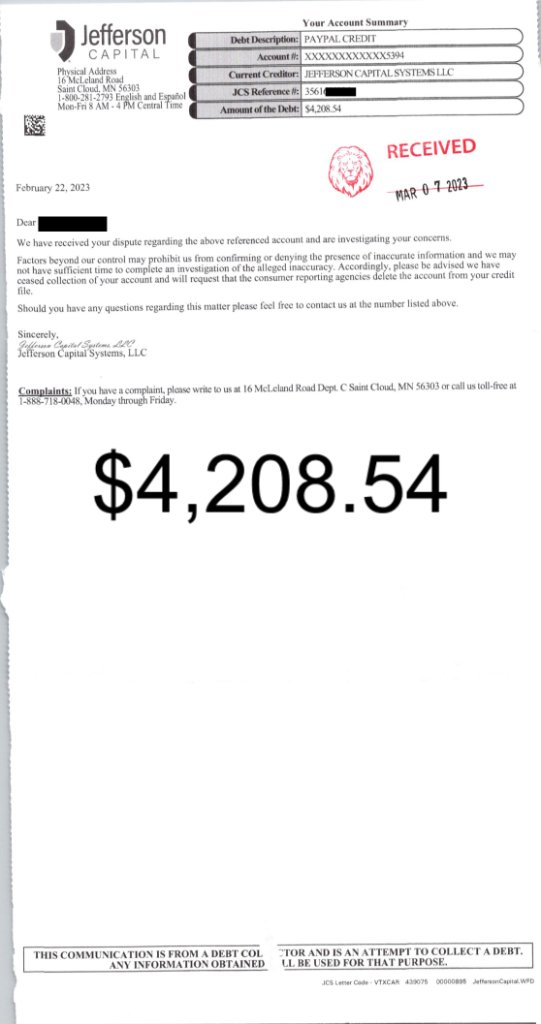
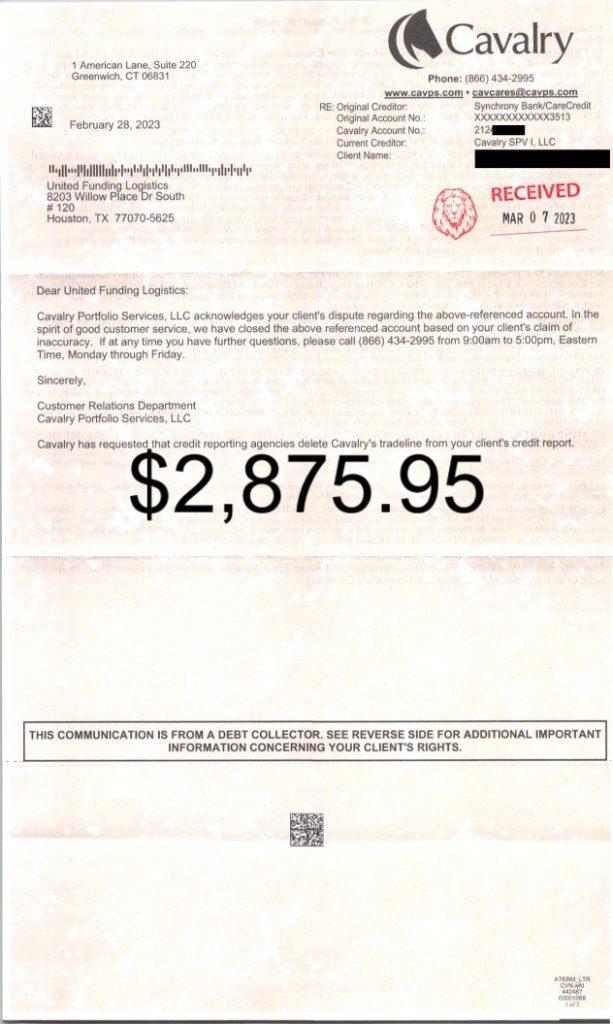
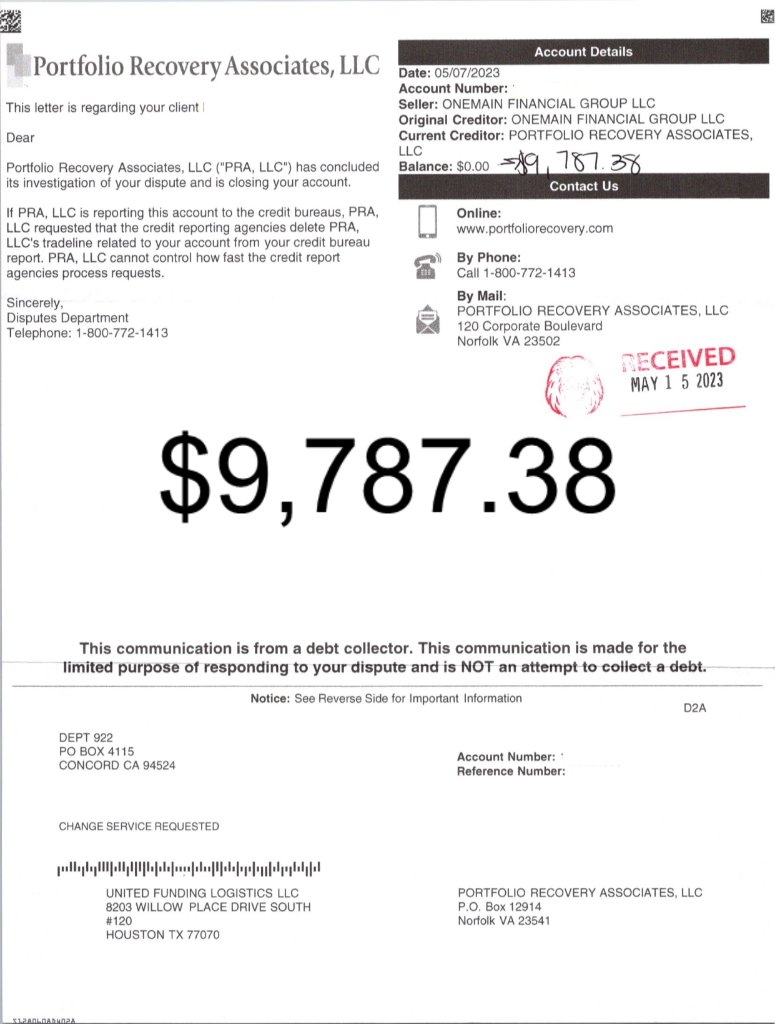
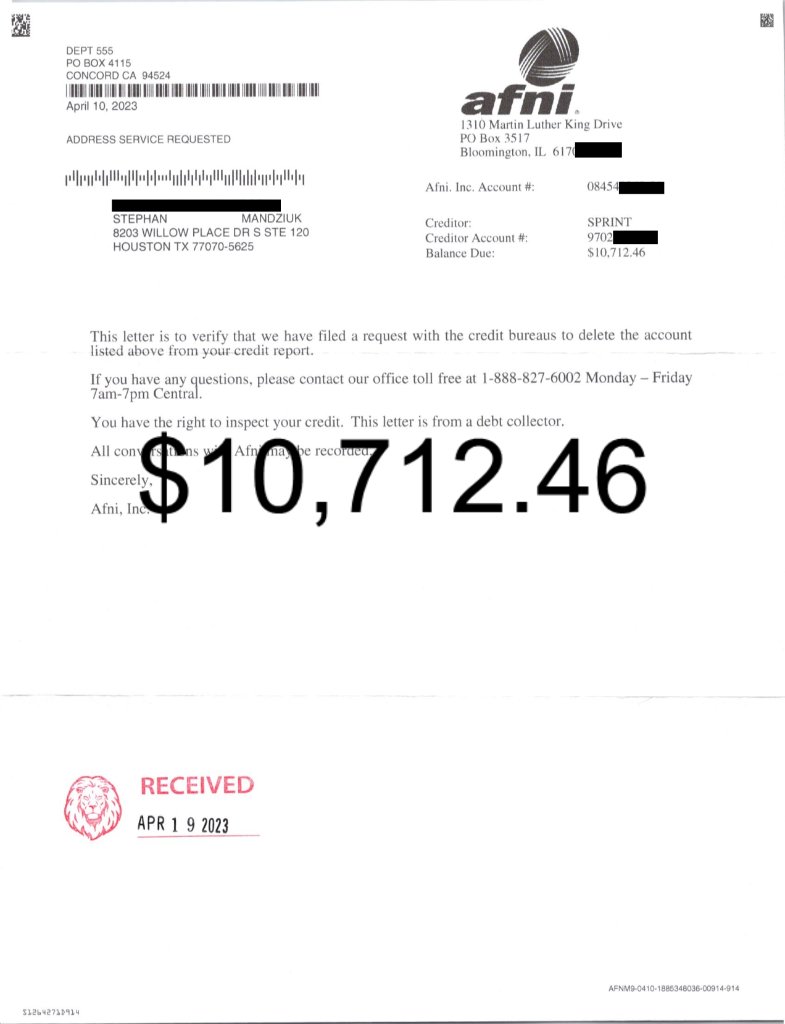
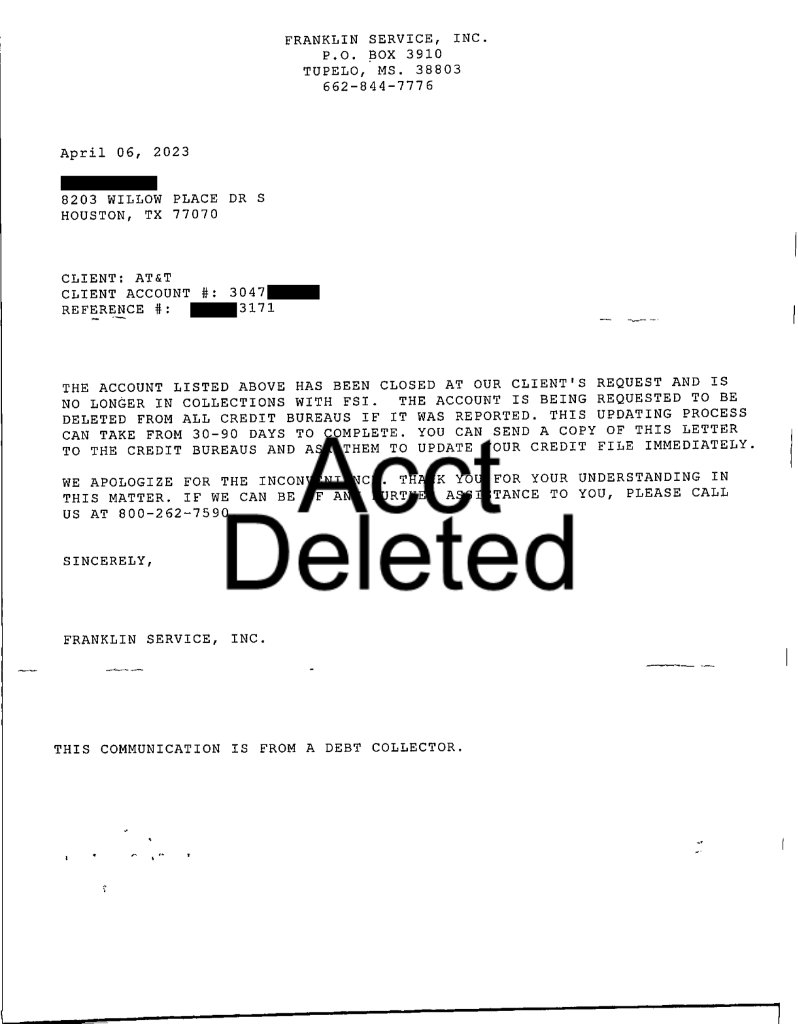
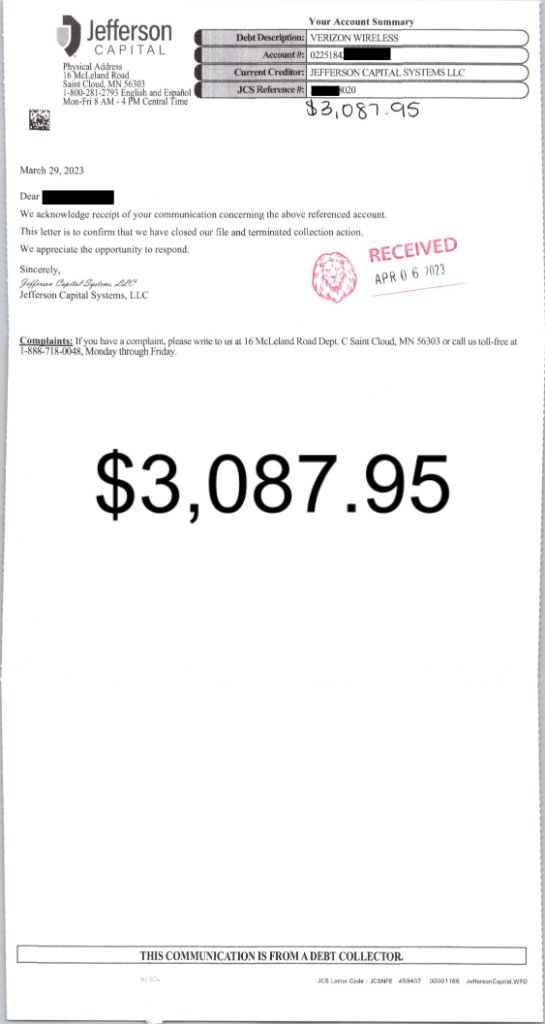
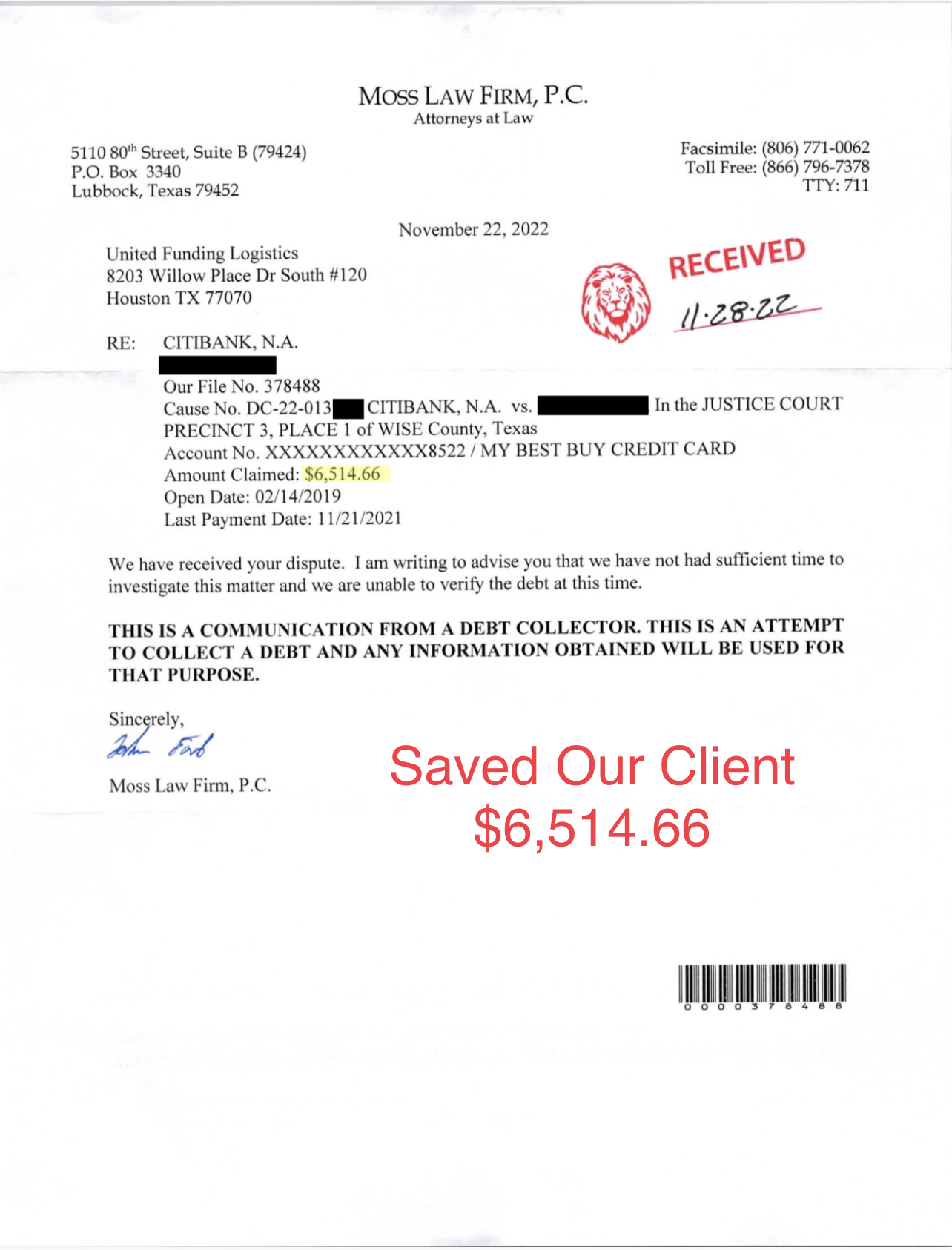
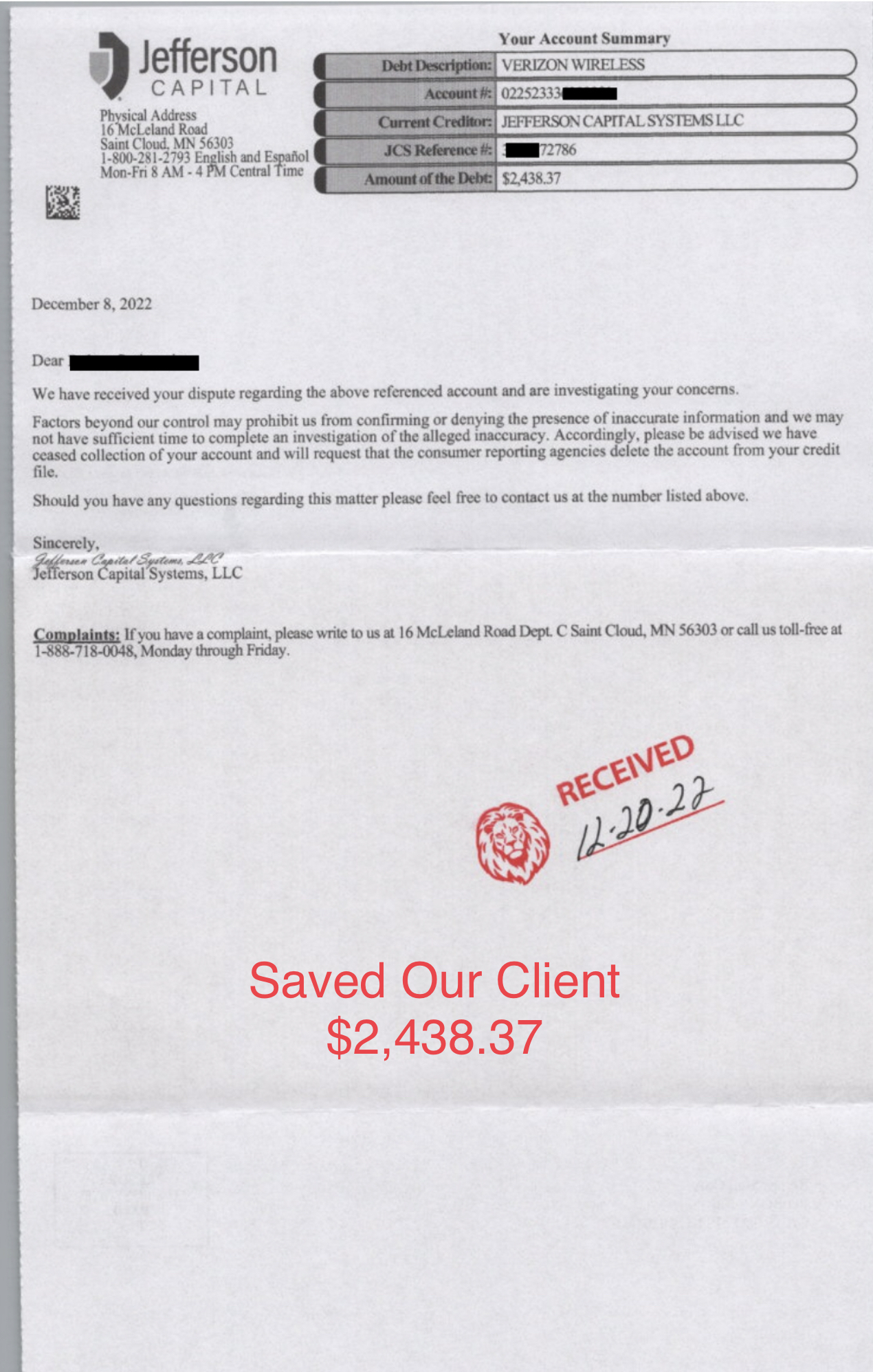
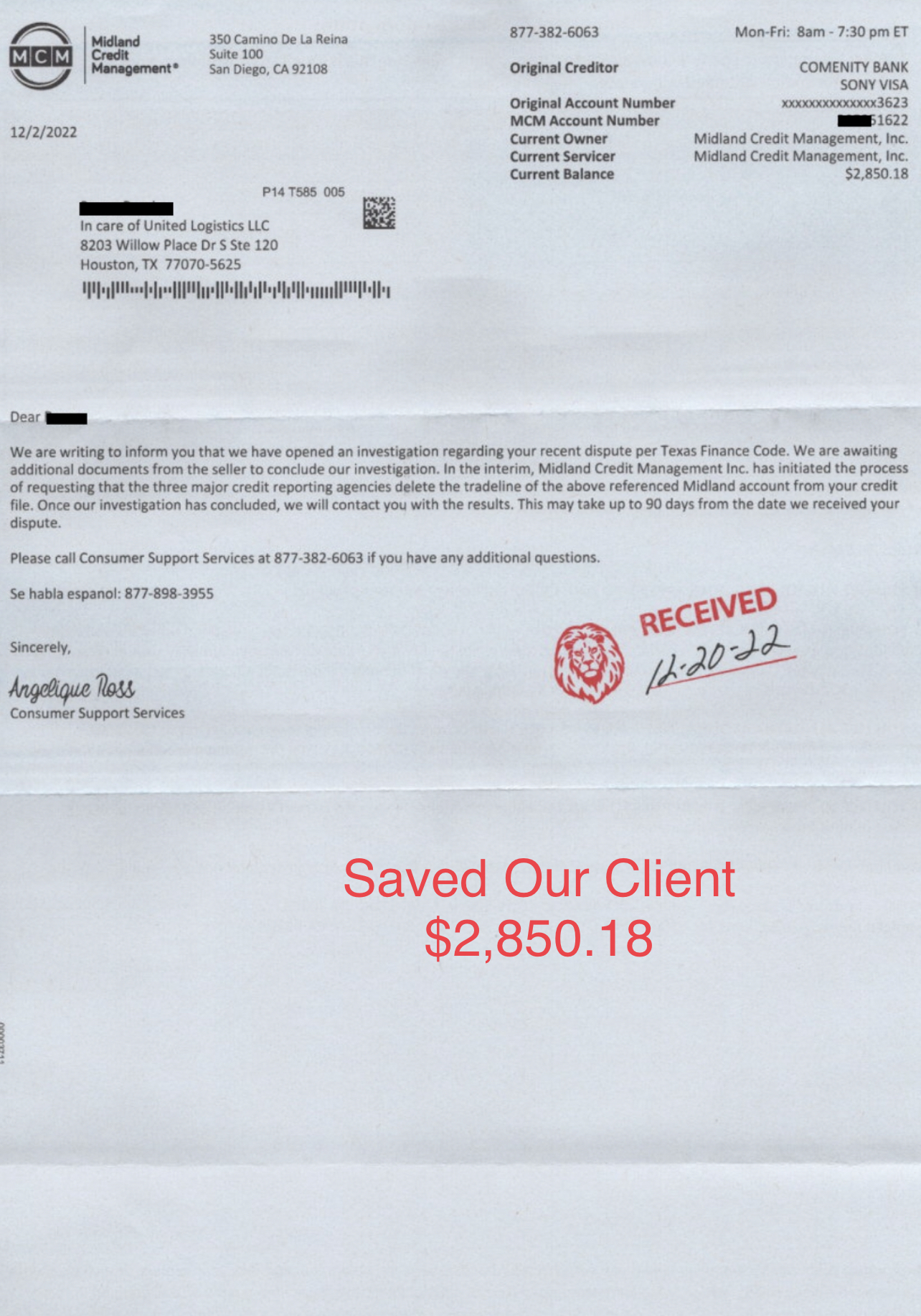
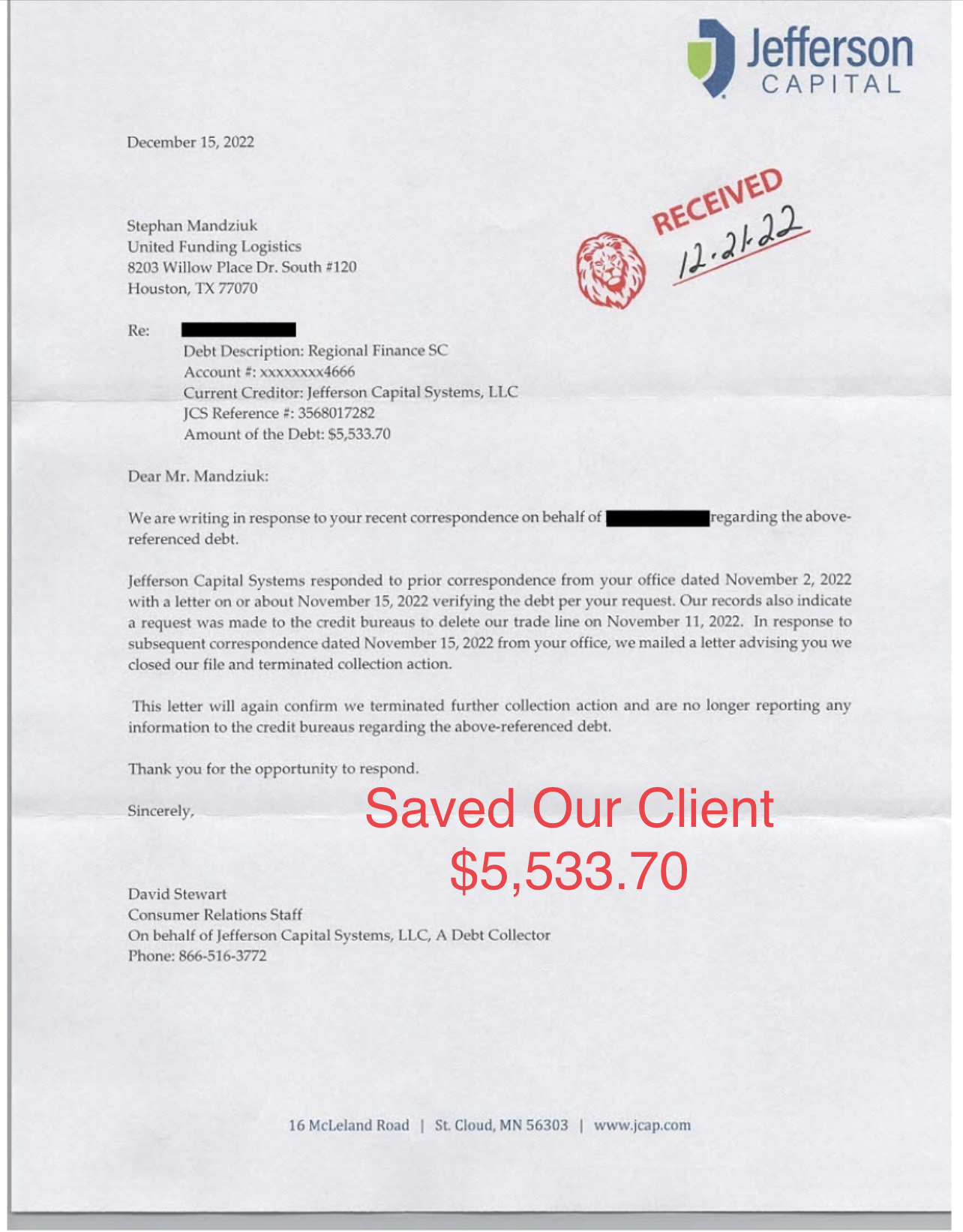
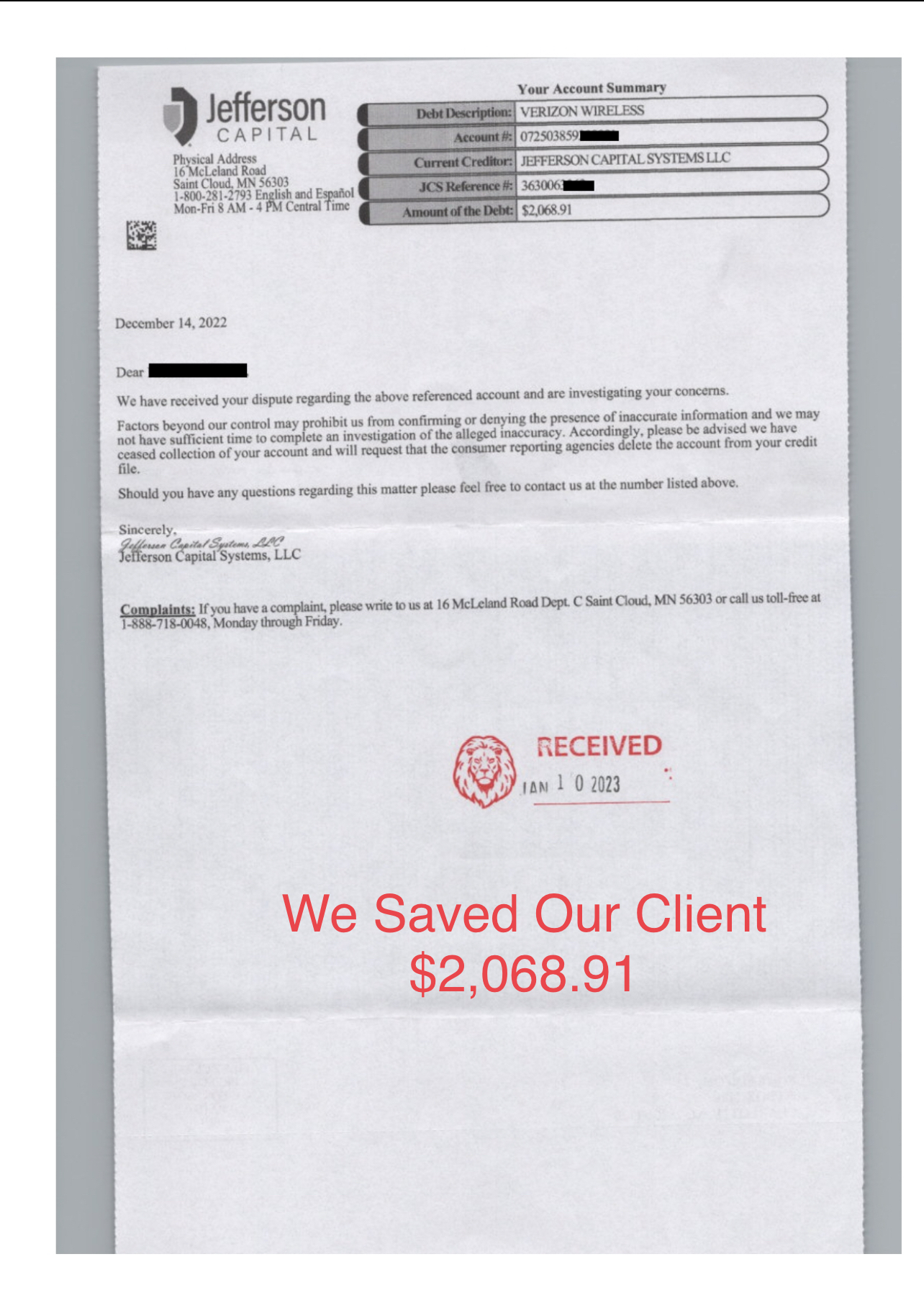
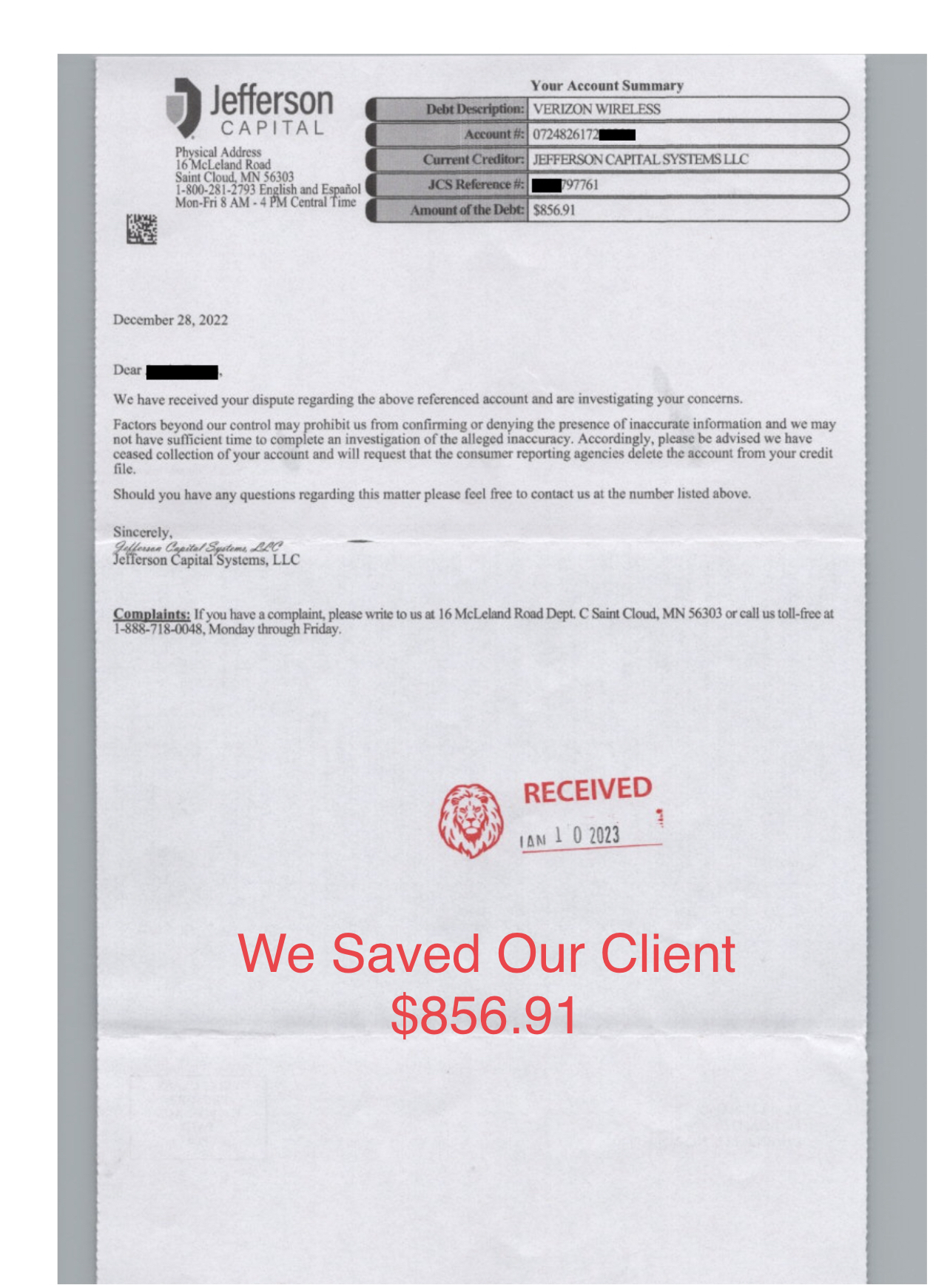
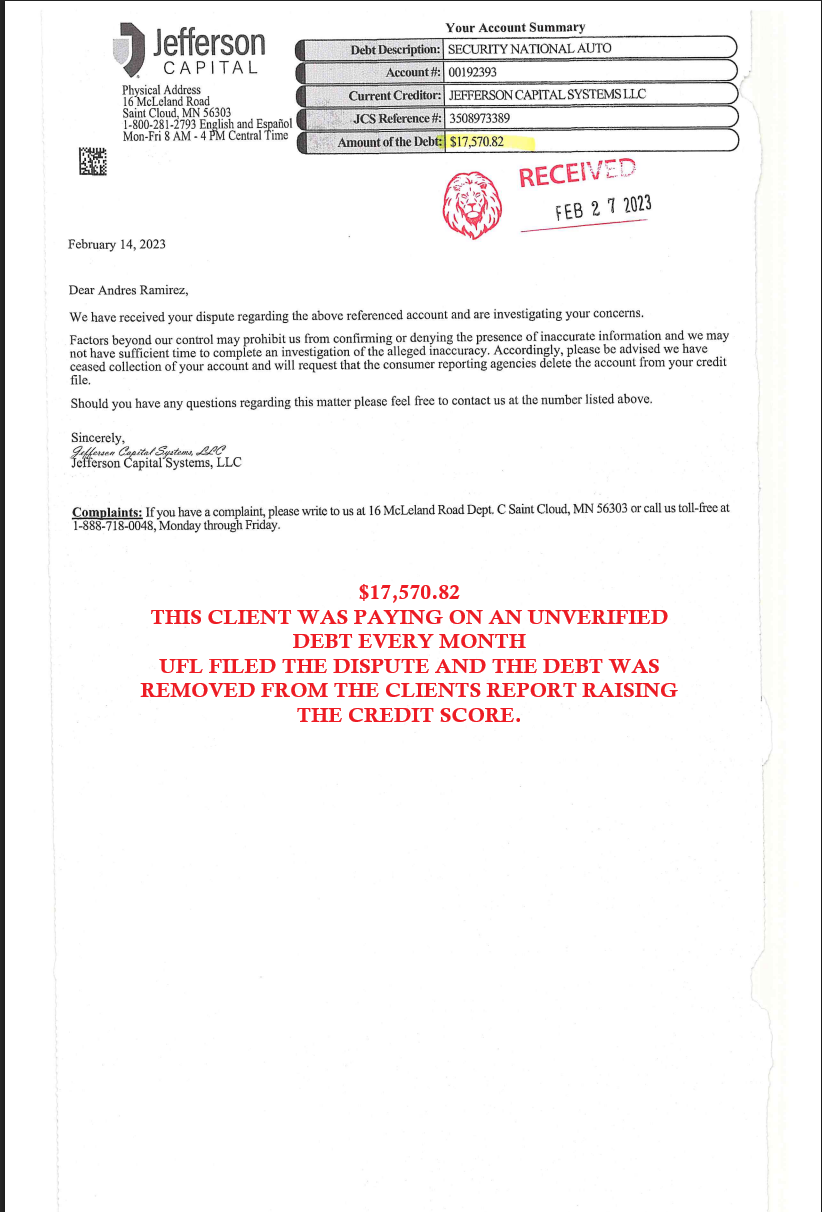
These are not reviews. They are not testimonials. They are confirmations from the debt collectors themselves — the institutions that were owed the money — that UFL's disputes worked. Every letter is a third-party validation that Brian Wilson's business did exactly what it claimed to do: eliminated real debt for real clients.
This is the wall of evidence the BBB called an F.
The Watchdog That Wasn't
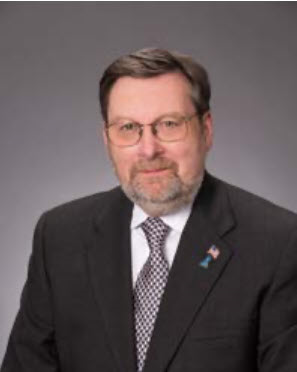
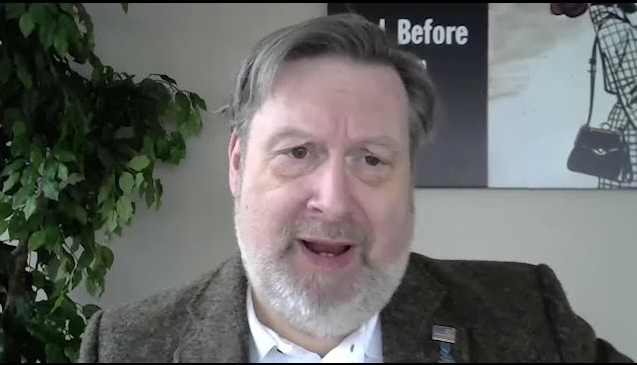
The Better Business Bureau is not a government agency. It is a private, nonprofit organization. The BBB of Metropolitan Houston, located at 1333 W. Loop South, Suite 1200, is one of the largest local chapters. Its president is Dan Parsons.
Reading the Money — IRS Form 990, EIN 74-0510080
The Better Business Bureau of Metropolitan (Houston) is registered with the IRS as a 501(c)(6) business league / trade association, exempt since March 1952. Its most recent Form 990 filing, for fiscal year 2024, is public record. The numbers tell their own story.
Per the filing's own categorization: $4.1M (90%) of the BBB Houston chapter's revenue is classified as "contributions & grants," $347K (8%) as program service revenue, and $90K (2%) as investment income. The organization is, by its own accounting, a donor- and membership-funded operation — not one that earns its money by selling a product to the public. Its revenue depends on the businesses and donors who fund it, not on the consumers who read its ratings.
That 90% is not charitable philanthropy. It is membership and accreditation fees paid by the businesses the BBB rates. The Form 990's own program descriptions confirm this directly: "Business Services — Provides services to the member companies," and "Accreditation — Recruits new members that qualify to support the better business bureau." The BBB is a business league whose members are the businesses it grades — and Wilson experienced this arrangement firsthand.
The Houston BBB solicited Wilson to pay $1,200 per year in accreditation/membership fees. Wilson refused. Shortly after, his rating became a matter of public dispute.
Wilson states the BBB requested $1,200/year in membership fees from UFL, and that he declined. This figure is Wilson's stated account; NFA has not yet reviewed a specific invoice or solicitation document confirming the exact amount. It is presented here as his account, consistent with the broader "pay to play" thesis this investigation documents.
90% of BBB Houston's revenue is membership and accreditation dues paid by the businesses it rates — not consumer fees, not government funding, not broad-based charitable giving. The organization that grades businesses on trustworthiness is funded directly by the businesses receiving the grades, and a business that declines to pay is not exempt from being rated by the same organization it just declined to fund.
The $251,000 President — And the Team Around Him
Dan Parsons has led the BBB Houston chapter as President, drawing compensation of $251,373 in FY2024 — a figure that has held remarkably steady for years:
| Name | Title | FY2024 | FY2023 | FY2022 | FY2021 | FY2020 |
|---|---|---|---|---|---|---|
| Dan Parsons | President | $251,373 | $249,343 | $249,395 | $249,403 | $249,452 |
| Lillian Kelly | VP Finance & Admin | $219,528 | $211,414 | $205,251 | $198,826 | $201,580 |
| Jeff Shoemaker | VP Accreditation | $190,286 | $180,747 | $157,922 | $147,992 | $152,183 |
| Jordan Rzad | VP Marketing | $141,542 | — | $120,708 | $119,259 | — |
| Samantha Durham | VP Dispute Resolution/ADR | $114,899 | — | — | — | — |
| Hilda Martinez | VP South Texas | $111,280 | — | — | — | — |
| Leah Napoliello | VP Public Affairs | $110,443 | — | — | — | — |
| Jason Behich | Director | $0 | — | — | — | — |
Total salaries, benefits, and payroll across the organization came to approximately $3.0M — 66% of total expenses. The organization holds $5.3M in total assets against $3.2M in total liabilities, with an operating runway of 11.1 months and a razor-thin surplus margin of +1%. Revenue has actually declined at an average annual rate of -2% over the past five years.
Where the Grant Money Goes
The BBB Houston chapter's Schedule I shows it received a single reported grant in FY2023 — $12,000 from Rainforest Cafe Friends of the Future. It paid out one grant of its own: $60,000 to the "Better Business Bureau of Metropolitan Houston Educational Fund" in FY2020 — an affiliated fund under the BBB's own umbrella.
Better Business Bureau of Metropolitan (Houston): $4.6M total revenue, $4.5M total expenses, $2.1M net assets. 90% of revenue categorized as contributions & grants; 8% as program service revenue; 2% as investment income. President Dan Parsons' reported compensation: $251,373 (FY2024). 45 voting members on the governing board, all independent. The organization reports having a conflict-of-interest policy, a whistleblower policy, a document retention policy, and independent review of CEO compensation — all marked "Yes" on its own filing.
"KarenBuster(s).com" — And What the BBB's Response Reveals
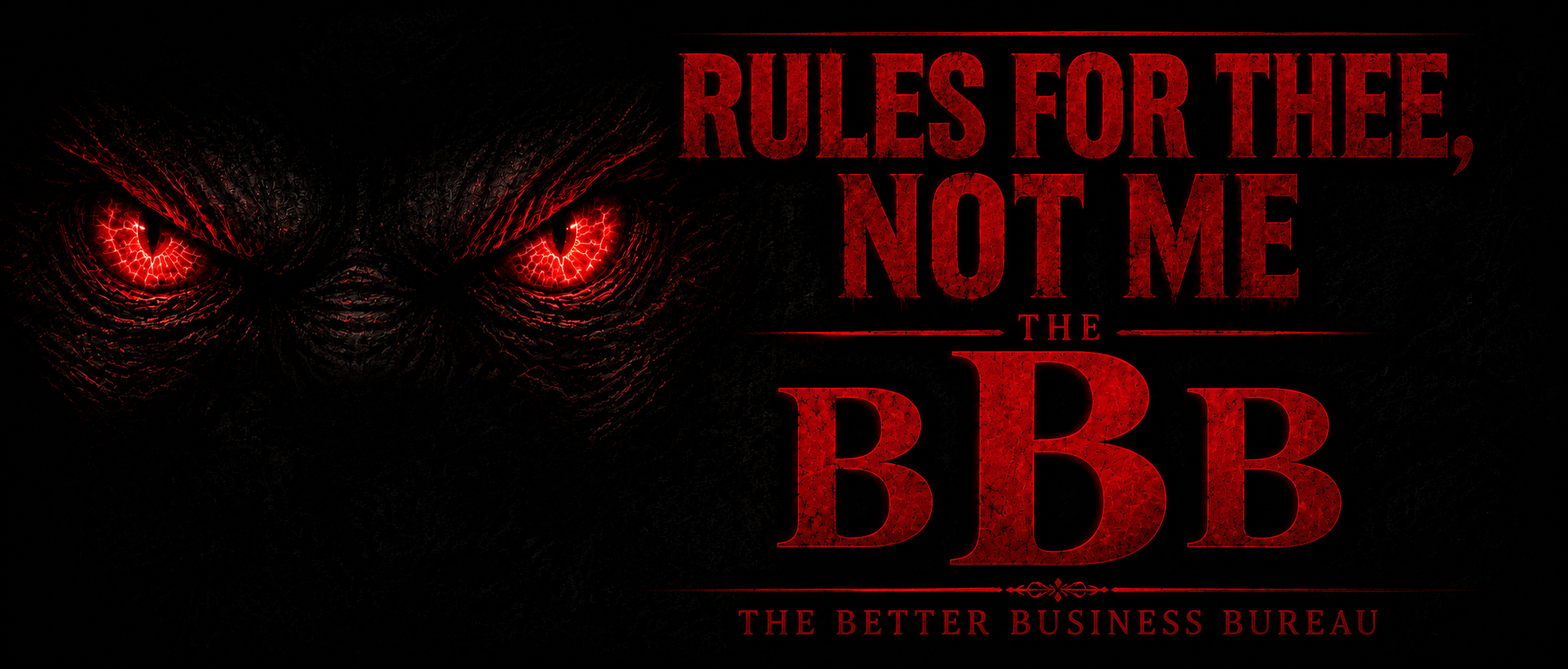
Wilson's first conflict with the BBB began when he built a website — referred to in his own words as karenbusters.com — created specifically to expose what Wilson believed were fraudulent BBB practices, including the posting of unverified complaints against businesses that did not pay BBB accreditation fees.
Wilson alleges that Dan Parsons threatened to sue him for millions of dollars over the creation of this website. This allegation is stated by Wilson and has not been independently corroborated by a separate document showing the threat itself.
Dan Parsons, president of the BBB Houston chapter, threatened to sue Brian Wilson for millions of dollars over the creation of a website built to expose BBB practices. This is Wilson's account. No document containing the threat has been produced. The allegation is logged for transparency.
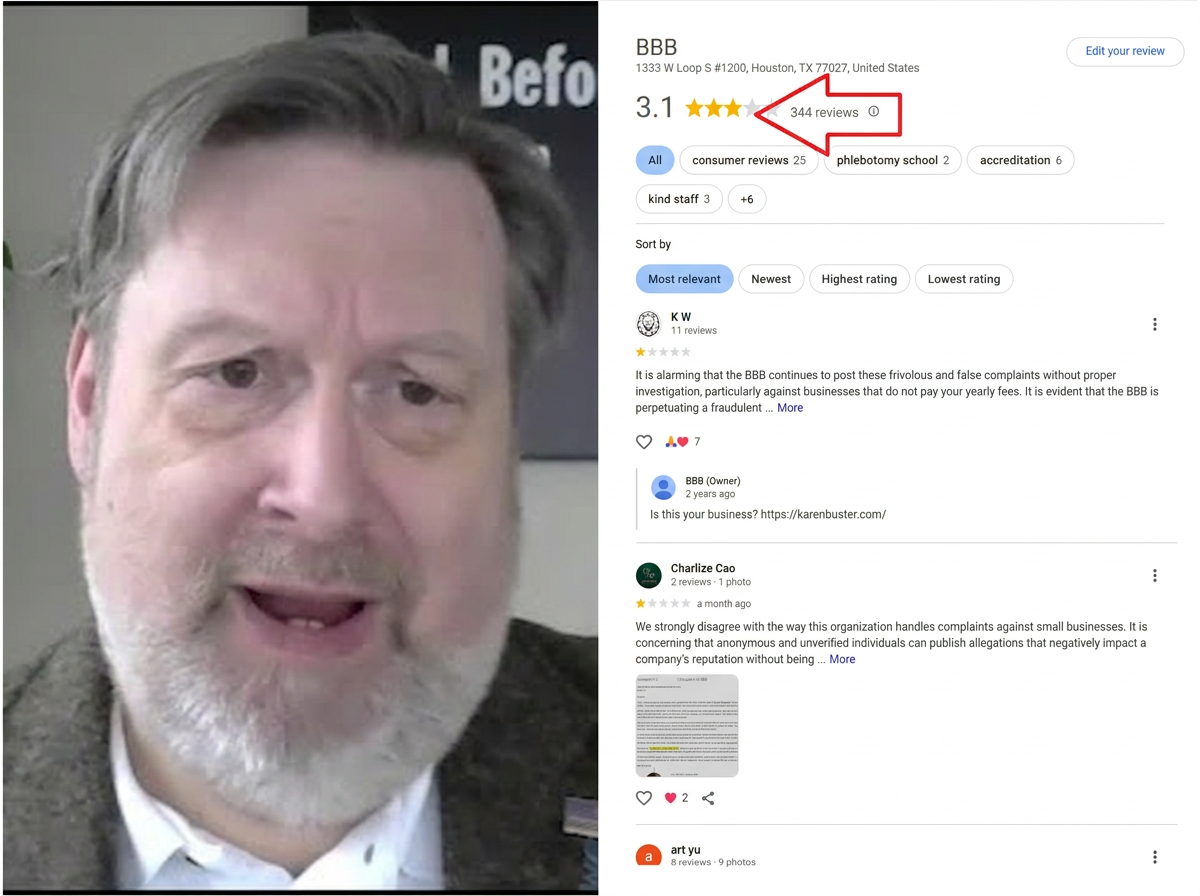
What is documented is the BBB's own response to Wilson's public criticism — and it is more revealing than a simple dismissal. Two years before the events of this investigation, Wilson left a detailed 1-star Google review of the BBB Houston branch under the name "K W." The review was substantive — it accused the BBB of posting frivolous complaints without investigation, of failing to verify submitted information, and of marking legitimate business responses as "NO RESPONSE" when they didn't conform to the BBB's expectations. Nothing in the review identified Wilson by name, business, or any connection to karenbuster.com.
The BBB's official response did not answer a single point Wilson raised. Instead, it asked one direct question: "Is this your business? https://karenbuster.com/"
Wilson's review was posted under an anonymous-looking initials handle, "K W," with no stated connection to karenbuster.com anywhere in the text. For the BBB's official account to respond by name-checking that specific website is, in Wilson's view, direct evidence that the organization had already identified him personally and was tracking the site built to expose it — rather than issuing a generic dismissal to an anonymous critic. This is Wilson's interpretation of the evidence, presented as analysis, not as an established fact. The BBB has not been asked by NFA to explain how it connected "K W" to karenbuster.com, and no internal BBB record confirming that connection has been produced. But the exhibit itself — a targeted, specific reply to an anonymous review — is real, and readers can judge for themselves whether it looks like retaliation.
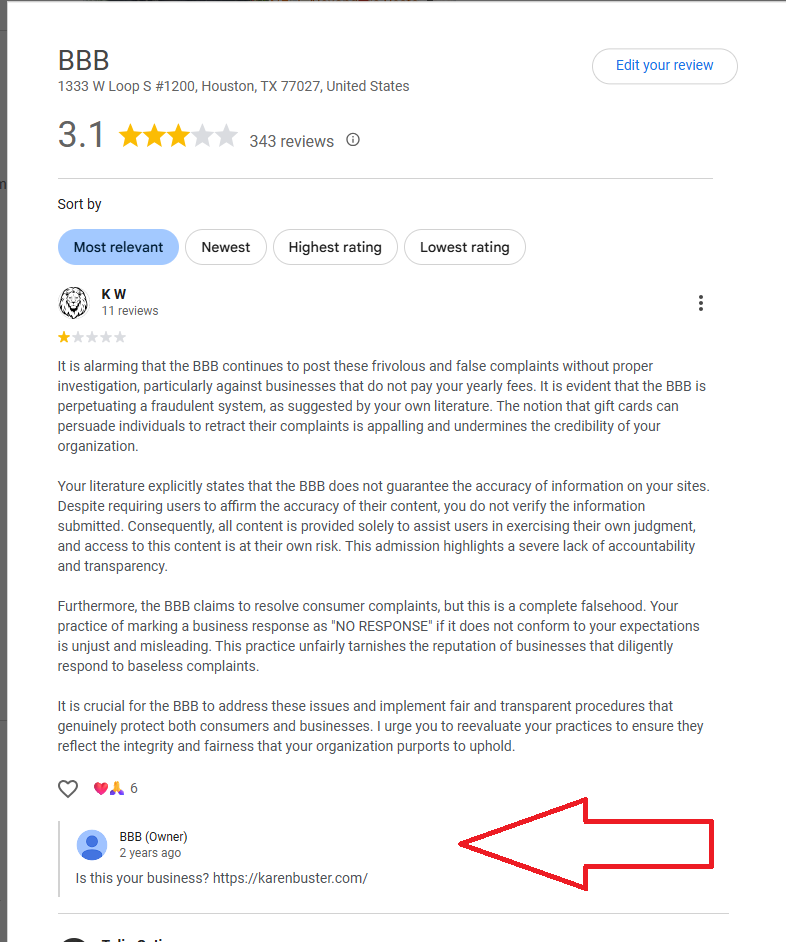
— K W (Brian Wilson), 1-star Google review, approximately 2 years before this investigation
The Email That Proves BBB Knew
On March 11, 2024, at 10:56 AM, Wilson sent a detailed email directly to Samantha Durham (sdurham@bbbhou.org) and the BBB Houston general inbox (info@bbbhou.org). He attached the Oregon detective's correspondence, screenshots of fake accounts, and his September 2023 Cash App fraud report. The subject line was straightforward. The content was not.
On March 11, 2024, Wilson sent a timestamped email directly to BBB Houston staff explicitly stating that some complaints published on the BBB's website originated from impersonation scam victims, not real UFL clients. The email was sent to Samantha Durham (VP, Dispute Resolution) and the general BBB Houston inbox. It included supporting documentation.
No response from BBB to the specific claim that some published complaints came from scam victims has been documented in the evidence available to NFA. Wilson states he received no substantive response. The BBB's subsequent actions — maintaining the F rating, keeping the "Pattern of Complaints" alert, and continuing to publish complaints Wilson said were fraudulent — are documented in this investigation.
Wilson also told Durham about the September 2023 fraud report he had filed with Cash App:
"The total loss to my company United Funding Logistics, LLC is over $14,000.00 dollars. Over 80 potential clients have been defrauded $175.00 for Individual Lifetime Services or $275.00 for lifetime Services. I filed three Police Reports in Houston Texas."
Three reports across three agencies. Houston Police. The FBI. Bend, Oregon. Every door closed. And the BBB — the institution publishing the complaints that drove Wilson's F rating — was told in writing that some of those complaints came from fraud victims. It kept them published anyway.
The F Rating — Manufactured
After Wilson went public with his accusations against the BBB, his business received an F rating. The BBB's own published reasons for the rating were:
- Failure to respond to 64 complaint(s) filed against business
- 6 complaint(s) filed against business that were not resolved
- 81 complaint(s) filed against business
But who filed those complaints? Wilson maintains that many of the complainants were never his clients. They were consumers who had been defrauded by the impersonation accounts — fake TikTok profiles using Wilson's face, fake websites using a similar business name, and a phishing operation harvesting credentials across the internet. Those victims filed complaints against "United Funding Logistics" — the name they saw on the scam — and the BBB published them as "Verified" complaints against Wilson's real business.
The BBB's complaint verification process stamps complaints as "Verified" when the complainant affirms the accuracy of their submission. The BBB does not independently verify whether the complainant was actually a customer of the business. Wilson states that complaints from non-customers — people defrauded by impersonation accounts, not by UFL — were published as verified complaints against his business.
Two Fake Reviews — Both Marked "Verified: Yes"
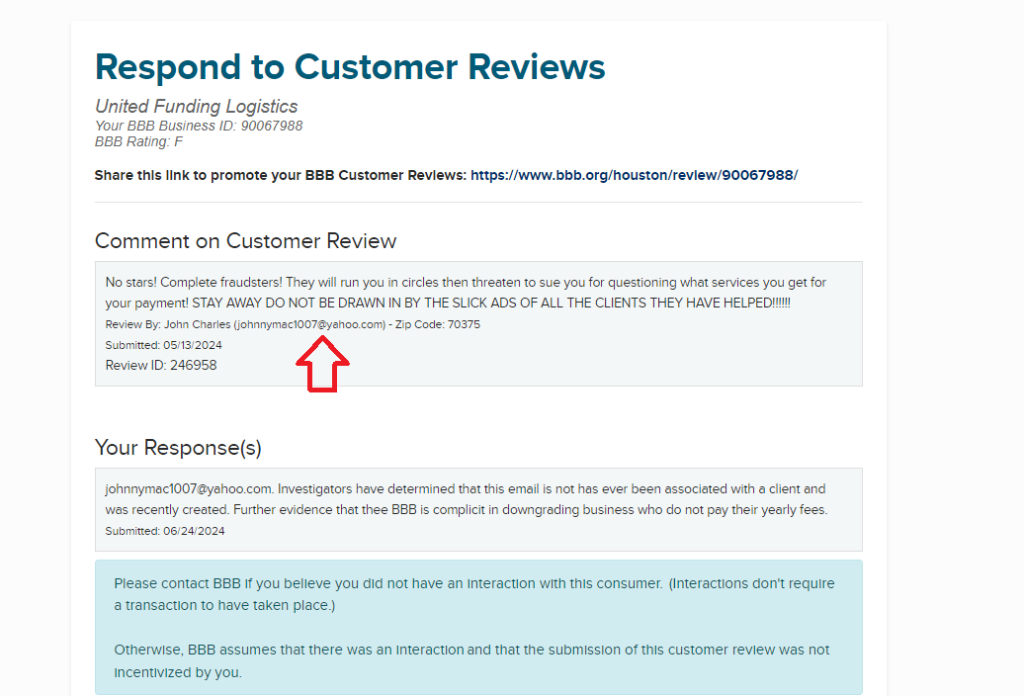
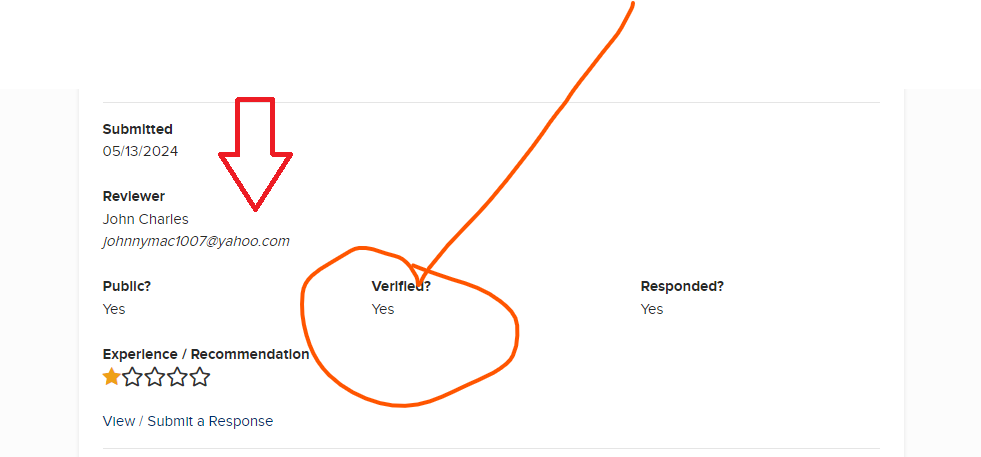
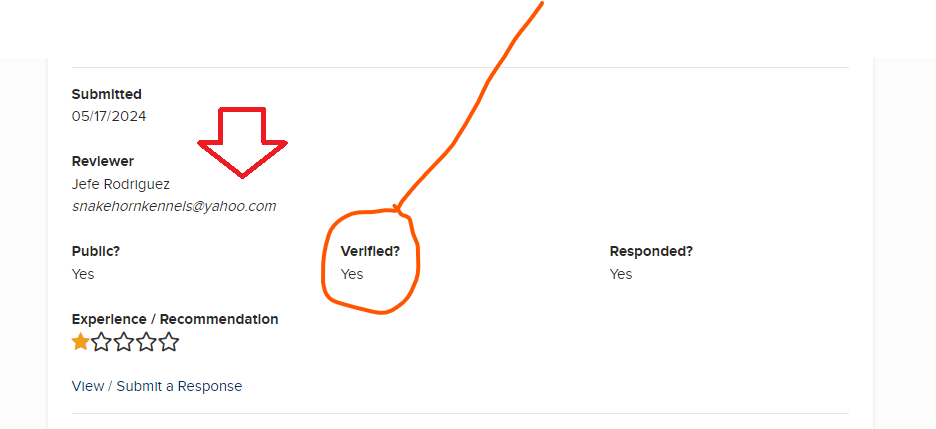
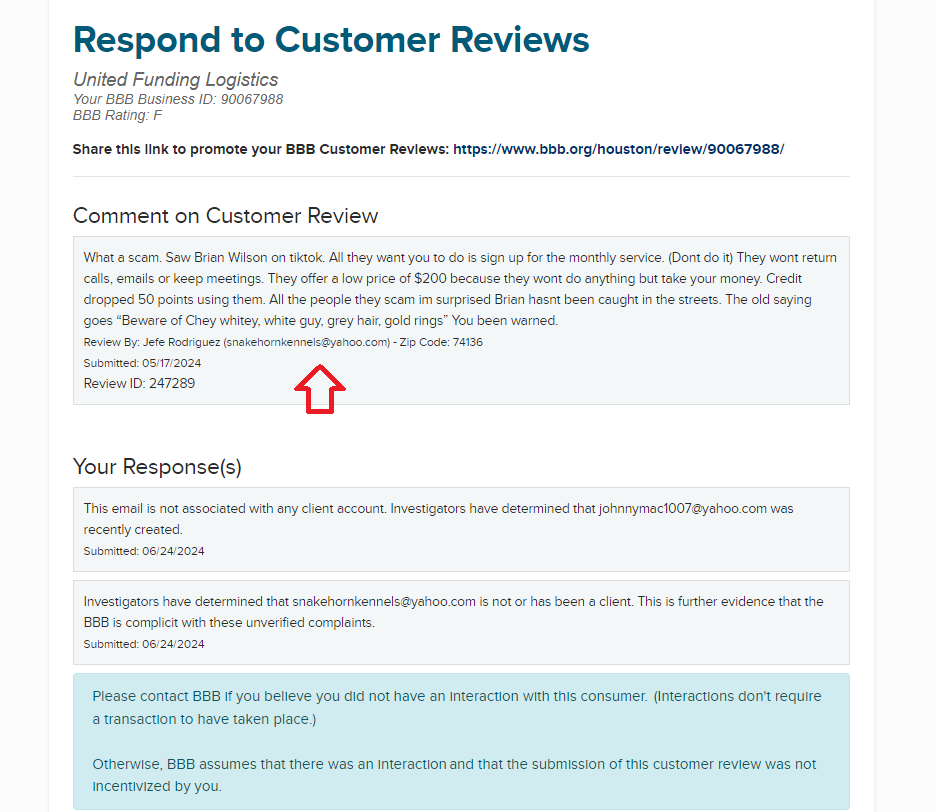
The strongest evidence in this investigation is the BBB's own portal. Wilson preserved screenshots from the BBB's "Respond to Customer Reviews" system for United Funding Logistics (Business ID 90067988). Two reviews stand out — both from emails Wilson's investigators determined were recently created and never associated with any actual UFL client account. Both were marked "Verified: Yes" by the BBB's own system.
— "Jefe Rodriguez," submitted 05/17/2024, Review ID 247289, Zip Code 74136. Marked by BBB: Public: Yes, Verified: Yes.
— "John Charles," submitted 05/13/2024, Review ID 246958, Zip Code 70375. Marked by BBB: Public: Yes, Verified: Yes.
Both fake reviews — from emails never tied to a real client, one containing a racial slur — were marked "Verified: Yes" by the BBB's own system. No proof of transaction was required. No marketplace interaction was checked. Meanwhile, real UFL clients who tried to leave positive reviews were subjected to a completely different standard.
The "Pattern of Complaints" Alert
The BBB published a "Pattern of Complaints" alert on Wilson's business profile. The alert stated:
The BBB alleged that UFL conditioned FCRA settlement payments on 5-star reviews, and used this allegation to justify removing all positive reviews from Wilson's profile. This is the BBB's claim, not a verified fact. No evidence has been presented to substantiate it. Wilson denies the allegation. This investigation has found no evidence in the reviewed materials to support or refute the BBB's specific claim. It is presented here for completeness, per NFA editorial standards: the reader deserves to know what the BBB said and that Wilson disputes it.
Real Client, Real Review — Blocked by the BBB
While fake reviews from non-customers were auto-verified, the BBB applied a very different standard to actual UFL clients who tried to leave positive reviews. Bryan Fitch was a real UFL client with a documented year-long service history — multiple dispute sessions with named UFL credit analysts "Brett" and "Yasmine" from December 2023 through April 2024. After watching one of Wilson's TikTok videos about the BBB, Fitch submitted "a very complimentary review" of Wilson and UFL.
The review was not posted. Instead, on June 23, 2024, the BBB emailed Fitch requesting "proof of your marketplace interaction" before his positive review could be published.
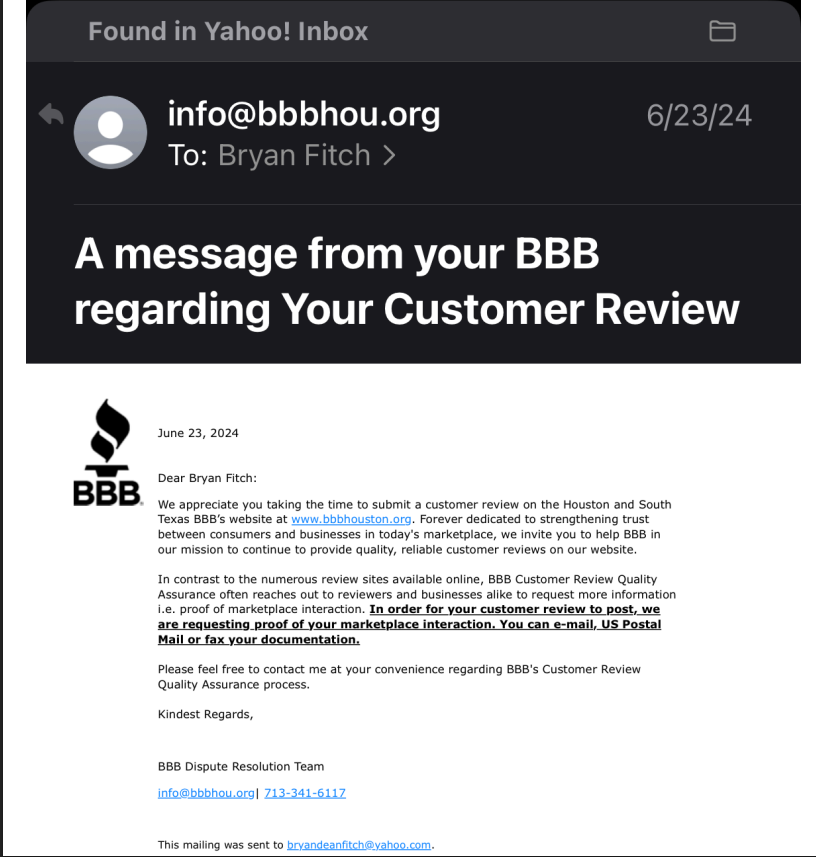
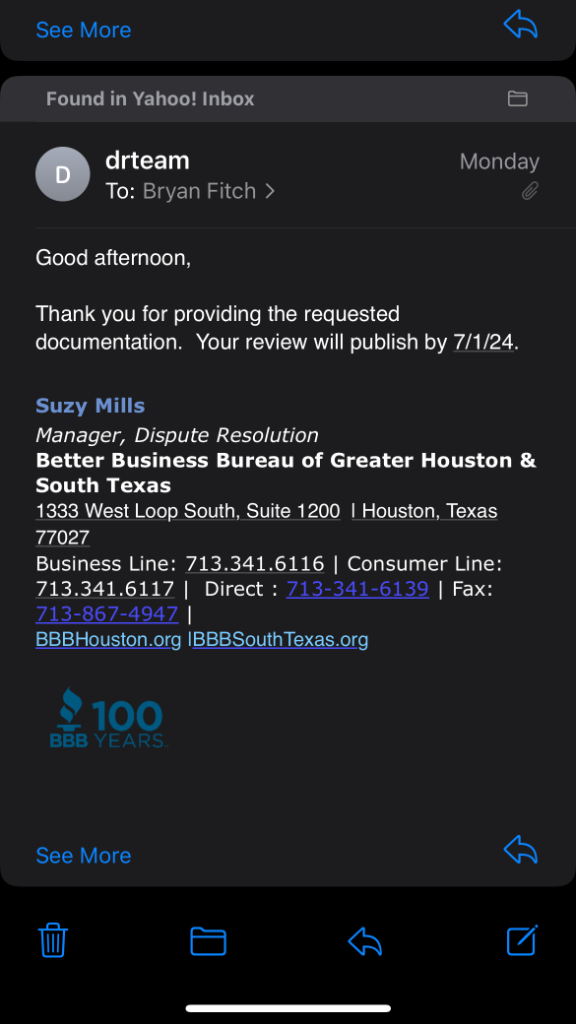
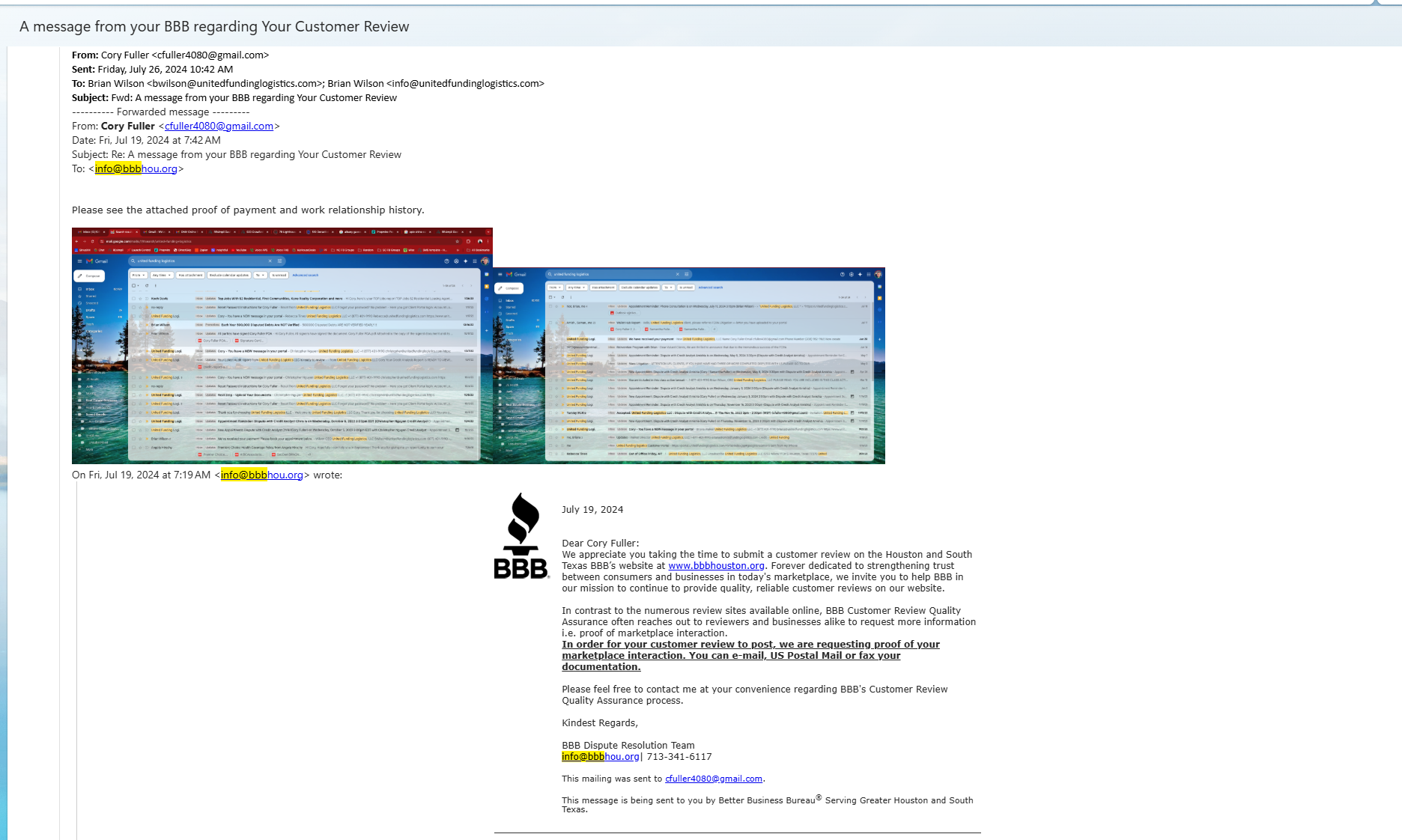
Fitch was not the only real UFL client forced to prove his client relationship just to leave a positive review. Cory Fuller, another documented UFL client, received the identical gatekeeping email from the BBB's Dispute Resolution team on July 19, 2024, requesting "proof of your marketplace interaction" before his review could post. Fuller responded the same day, forwarding screenshots of his Gmail inbox showing an extensive correspondence history with United Funding Logistics — appointment confirmations, dispute sessions, and client-portal access — along with proof of payment. He then re-forwarded the entire exchange to Wilson on July 26, 2024, documenting that the BBB had demanded documentation a real client should never have had to produce just to post a positive review.
According to Fitch, he called the BBB directly. Fitch says the representative "wouldn't give me information" and told him his review "was not inline with the majority of reviews" about UFL. Fitch pushed back:
"What proof do you need for me to leave a positive review and why?? I have used this businesses service for a year and left an honest review."
Fitch then sent BBB screenshots of his UFL appointment history — dispute sessions with named credit analysts, dated December 2023 through April 2024 — as proof of his client relationship. The BBB's Dispute Resolution team replied: "Thank you for providing the requested documentation. Your review will publish by 7/1/24." The review was signed off by Suzy Mills, Manager, Dispute Resolution.
Fitch's own words to Wilson after the ordeal:
"I really got the feeling they were singling out ANY positive reviews for your company... It kind of feels like they have you and your company flagged in their system... I just found it really sketchy."
Bryan Fitch is a named, real UFL client with a documented year-long service history who had to submit proof of his client relationship just to leave a positive review — and was initially told his review didn't match the "majority." Meanwhile, two fake reviews from freshly-created emails with no client history were auto-verified with zero documentation. One contained a racial slur. The BBB's own portal screenshots document both sides of this double standard.
Witnesses Under Fire — The Government Contacts Reviewers
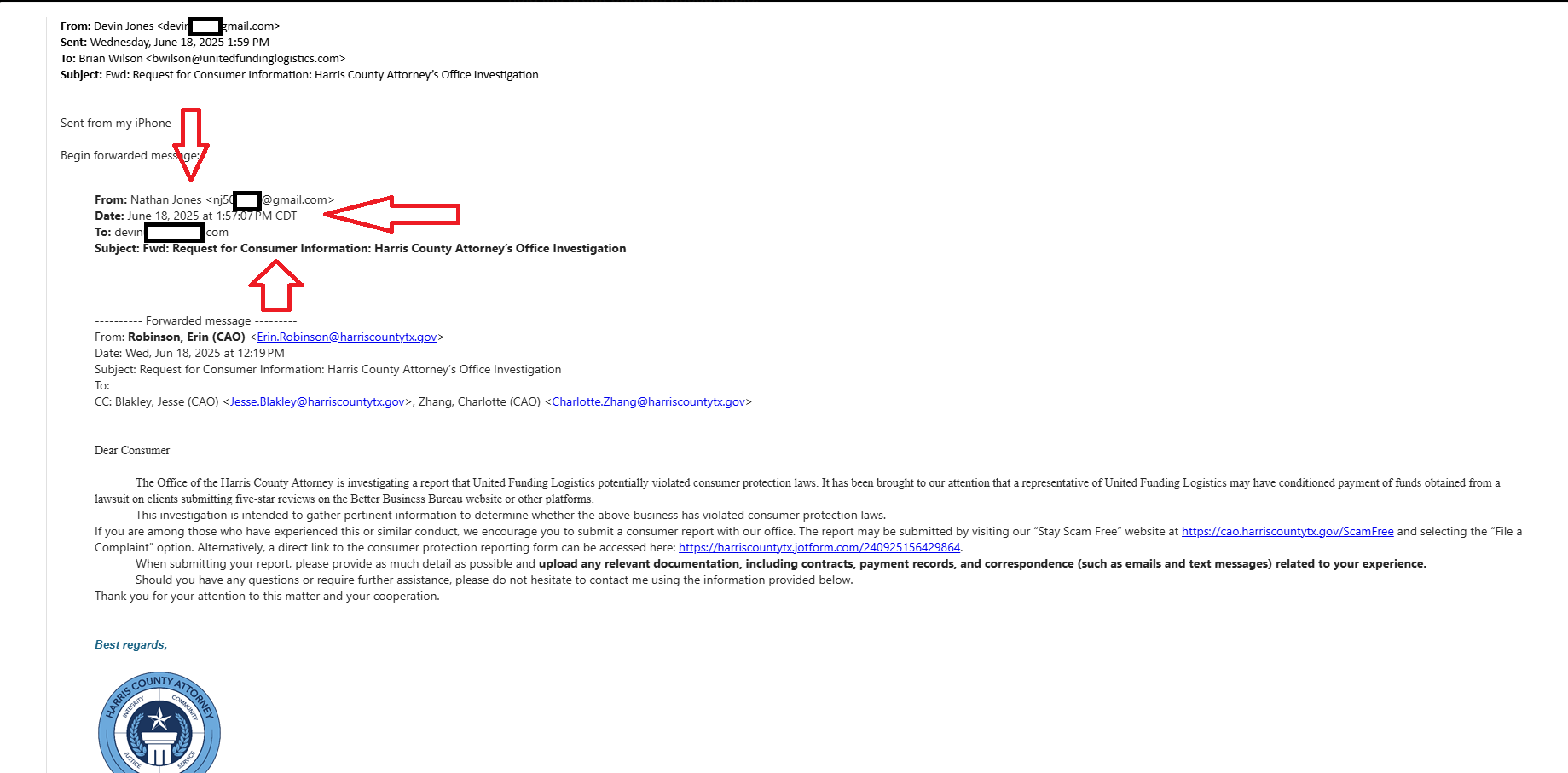
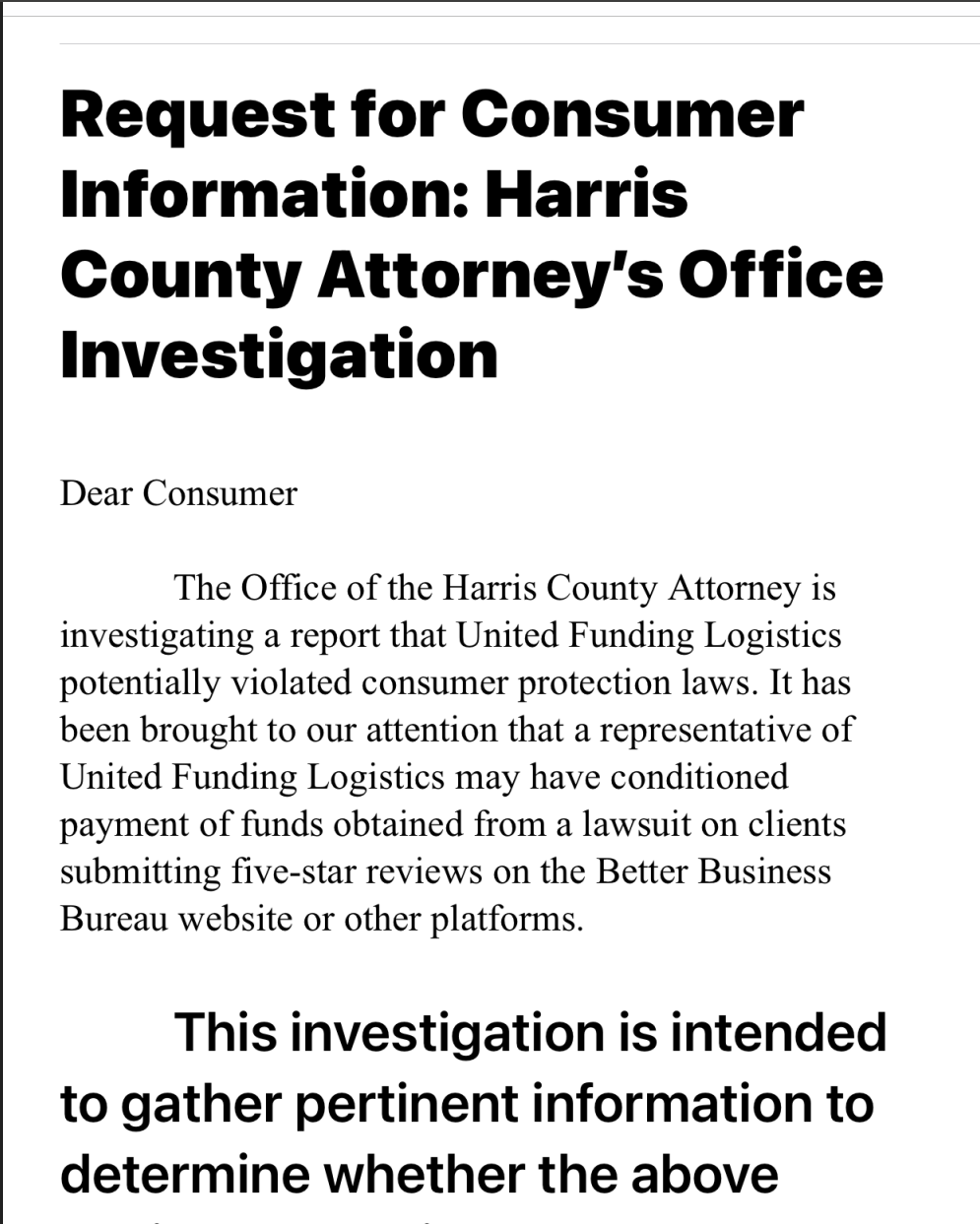
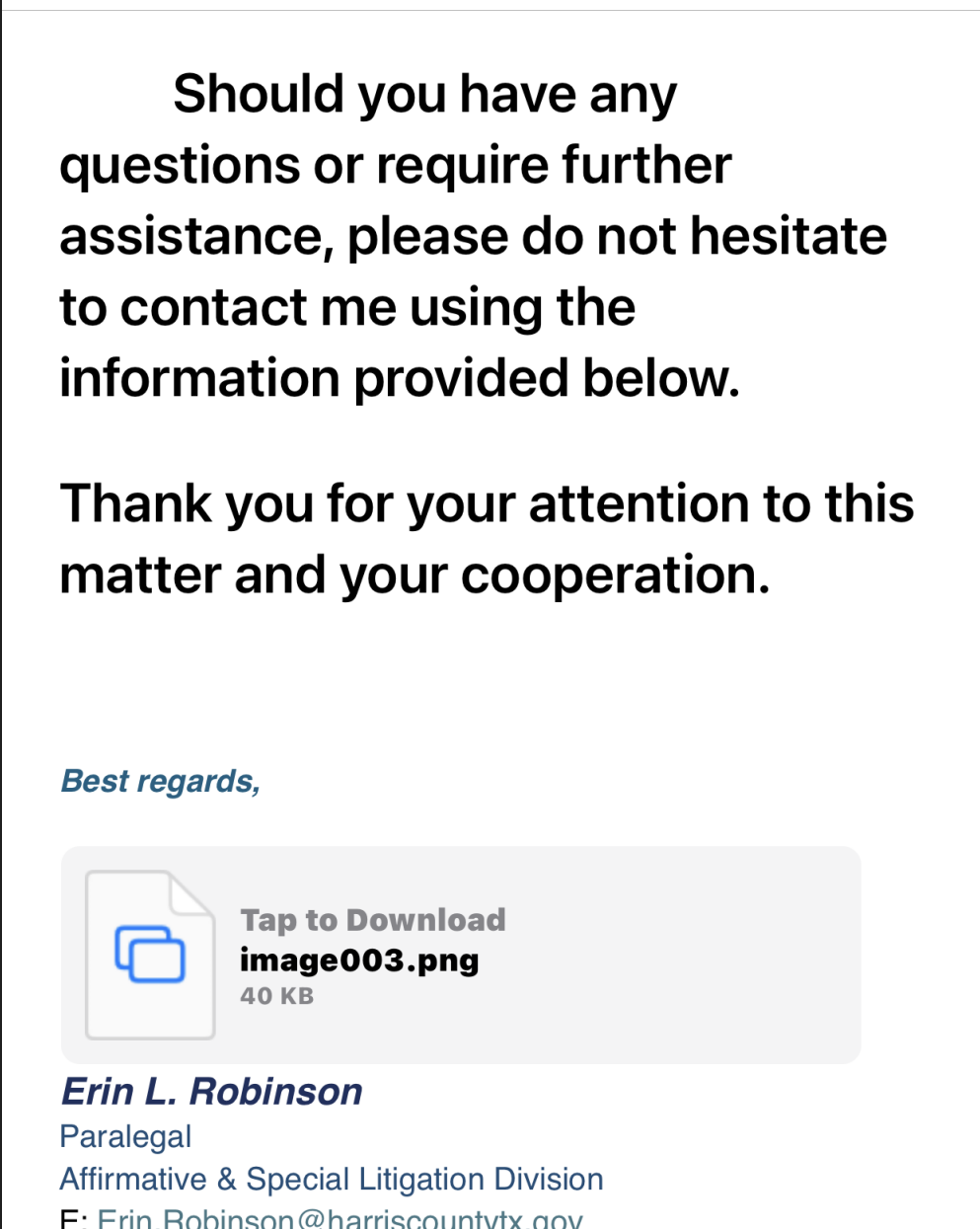
The BBB's gatekeeping of positive reviews didn't end at the review portal. Clients who submitted positive reviews about Wilson and UFL later received unsolicited emails from the Harris County Attorney's Office (HCAO) — the same agency that would go on to file a lawsuit against Wilson. The email, sent by paralegal Erin L. Robinson of the HCAO's Affirmative & Special Litigation Division, was titled "Request for Consumer Information: Harris County Attorney's Office Investigation" and informed recipients that the HCAO was investigating a report that UFL had "potentially violated consumer protection laws" — specifically that a representative of UFL had conditioned FCRA settlement payments on clients submitting five-star reviews on the BBB website.
Among those who received this email were Nathan Jones and Devin Jones — individuals who lived and worked alongside Wilson and had submitted what Wilson describes as deliberate "test" positive reviews on the BBB to document whether the platform would publish them. Their reviews went up; the HCAO came calling. Devin Jones forwarded the HCAO email to Wilson on June 18, 2025, including the forwarded chain from Nathan Jones who had received it first.
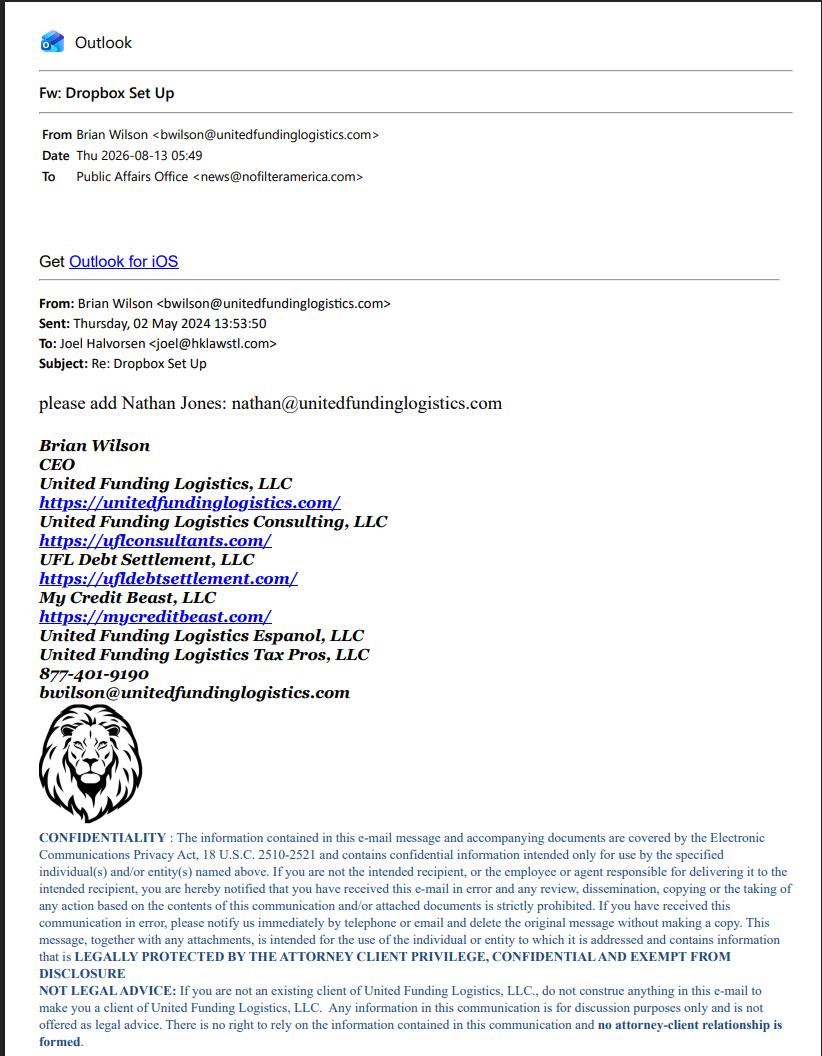
The significance of Nathan Jones appearing in this evidence chain runs deeper than a forwarded email. On May 2, 2024 — more than a year before the HCAO contacted him — Wilson had specifically designated Nathan Jones as the internal UFL coordinator for managing the Dropbox file transfer system set up by Wilson's FCRA litigation attorney, Joel Halvorsen of Halvorsen | Klote (St. Louis, MO). Wilson emailed Halvorsen instructing him to add Nathan Jones (nathan@unitedfundinglogistics.com) to the firm's Dropbox so that Jones could help transfer the massive volume of FCRA case files for attorney review. Nathan Jones was not a peripheral figure — he was an internal UFL employee operating at the center of Wilson's documented legal strategy to hold the credit bureaus accountable.
The HCAO contacted clients who left positive BBB reviews for Wilson — framing those reviews as potential evidence of a quid pro quo. Nathan Jones, one of those contacted, was simultaneously a named internal UFL coordinator on Wilson's FCRA litigation file transfers. The same people vouching for Wilson's character were being contacted by the government body prosecuting him. The pattern raises serious questions about the independence of the HCAO's investigative process and whether positive BBB reviews were being used as a roadmap to identify and contact Wilson's supporters.
The Review Removal
Whatever the justification, the result was the same: more than 90 positive client reviews were removed from Wilson's BBB profile. These were reviews from real clients who had received real debt relief — the same clients whose debt collector letters are documented in this investigation. Wilson states he previously preserved copies of all removed reviews and sent them to the Houston BBB as part of a demand package; recovery and cataloging of that complete historical record remains ongoing. The BBB removed them based on its own suspicion, without a hearing, without due process, and without providing Wilson an opportunity to respond before the removal.
The timing matters. Wilson had a wall of positive reviews. He had a $5,000,000 demand letter ready to send to Dan Parsons. And then the reviews were gone — all of them — replaced by an F rating and a "Pattern of Complaints" alert that invited anyone reading the profile to conclude that Wilson was running a scam.
Jefe Rodriguez — no client history, racial slur in text
John Charles — freshly created email, no client history
Proof required: None
BBB action: Verified: Yes, published immediately
Bryan Fitch — documented 1-year client, named credit analysts
90+ positive reviews — removed entirely
Proof required: Screenshots of appointment history
BBB action: "Not inline with majority" — blocked until proof submitted
The Motive — A Private Body Passing Judgment on a Law Firm's Client
Step back from the screenshots and the rating math and ask the question the BBB has never answered: why would an organization stamp two freshly-created, slur-laced reviews as "Verified: Yes" while demanding a year-long client produce appointment screenshots just to praise the business that helped him? The pattern only makes sense once you understand what the BBB believed — or chose to believe — about United Funding Logistics.
The BBB is not a government agency. It holds no charter, answers to no electorate, and operates no regulatory authority. It is a private, membership-funded corporation that sells accreditation, ratings, and dispute-resolution services to the very businesses it grades. Yet in Wilson's case, the BBB Houston branch behaved as though it were a consumer-protection regulator — manufacturing a profile for a business that never asked to be listed, populating that profile with complaints it never independently verified, and then using the self-generated record as the predicate for an F rating and a "Pattern of Complaints" alert.
Behind that posture was an assumption the BBB never bothered to verify: that Wilson was running a sham. BBB personnel operated on the belief that UFL had no lawyers and no real litigation pipeline — that a one-man credit-repair shop in Houston could not possibly be feeding a multi-state FCRA case file to outside counsel. That assumption was wrong. The Evidence Ledger in this report documents 53 third-party debt collector victory letters confirming real client results. FedEx records confirm Wilson's referral relationships with Halvorsen & Klote. Atlas Consumer Law's own case ledger confirms federal complaints filed on UFL referrals as early as 2022. Wilson's FCRA case was not aspirational — it was being assembled, attorney by attorney, client by client, while the BBB was telling the public he had no legal team at all.
Having decided Wilson had no lawyers and no real case, the BBB then applied that fiction retroactively to his profile. If a business has no legal infrastructure, the logic goes, then its positive reviews must be manufactured and its negative reviews must be real. So the BBB created the profile without consent, accepted unverified complaints from impersonation-fraud victims who were never UFL clients, auto-verified two reviews from freshly-created emails containing a racial slur, and quietly stripped more than 90 documented client reviews — not because it proved them fake, but because its own assumption about who Wilson was demanded they be fake. The rating wasn't derived from the evidence. The evidence was curated to support the rating.
The Better Business Bureau is a private, non-government corporation — not a regulator, not a consumer-protection agency, and not a court. In Wilson's case, the BBB Houston branch created a profile for United Funding Logistics without the owner's consent, published unverified complaints from impersonation-fraud victims as "Verified," auto-verified two fake reviews from freshly-created emails, and removed 90+ documented client reviews — all while operating on the unproven assumption that UFL had no lawyers and no active FCRA case. Documented referral relationships with Halvorsen & Klote, Atlas Consumer Law, and Sulaiman Law Group, plus a federal case ledger dating to 2022, confirm that assumption was false.
The Impersonation Army
While the BBB was building its case against Wilson, a separate operation was actively destroying his reputation from the outside. At least 90+ fake TikTok accounts used Brian Wilson's photograph, his business name, and variations of his identity to scam consumers across the platform. Wilson maintains that victims of these impersonation accounts—including individuals who were never UFL clients—filed complaints against his real business, and that BBB subsequently published some of those complaints as verified.
The Real Account — @oldsupermanusa
Before the clones, there was the original. Wilson's real TikTok account, @oldsupermanusa, had 1.2 million followers, 426 videos, and 10.6 million lifetime likes. His bio: "Fix Your Credit - Fix Your Life 💯" with links to unitedfundinglogistics.com. His content — credit repair tips, arbitration strategy, collection agency defense — reached hundreds of thousands of viewers per video. This is the account the impersonation swarm was built to imitate.
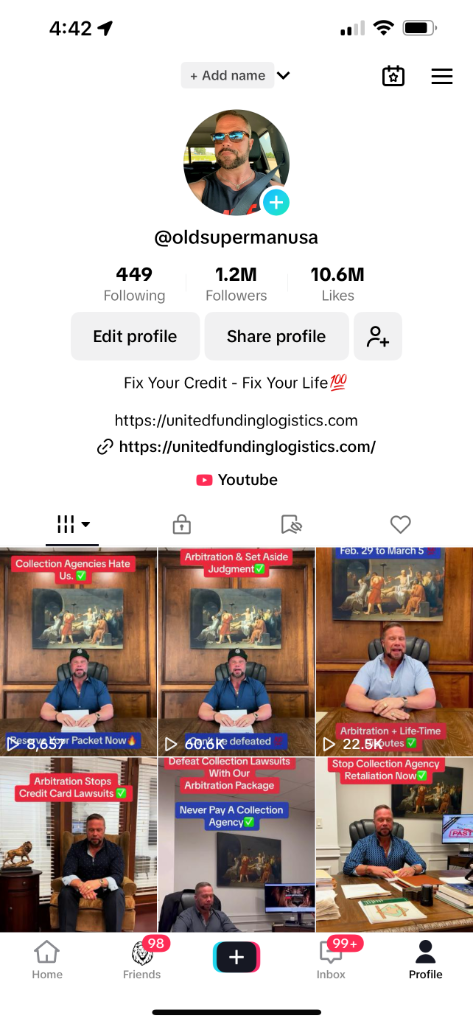
@oldsupermanusa is Wilson's authentic TikTok account, independently confirmed by his own app screenshots and by his August 2023 email correspondence with BBB staff (where he referenced the account). It has 1.2 million followers. The 90+ accounts documented below are impersonators using his photo, his name, and variations of his handle to scam consumers.
The Swarm — 90+ Fake Accounts, One Face
Wilson searched "oldsupermanusa" on TikTok and documented what he found. The results were a wall of near-identical fake accounts — all using his actual profile photo (the bearded man in sunglasses), all named "Brian Wilson" or a close misspelling ("Brain Wilson," "Brian willson"), and all marked "Blocked by you" — confirming Wilson personally identified and blocked each one.
The username variations follow a clear pattern of systematic generation: sequential numbers (oldsupermanusa06, 50, 20, 19, 51...), punctuation variants (underscores, periods, doubled letters), and "creator" / "fan" suffixes. This is consistent with either a bot farm mass-producing accounts or a single bad actor cycling through burner profiles faster than Wilson can block them.
Below is a selection of the impersonation swarm screenshots Wilson preserved. Every account shown uses his real photo and name. Every one is marked "Blocked by you."
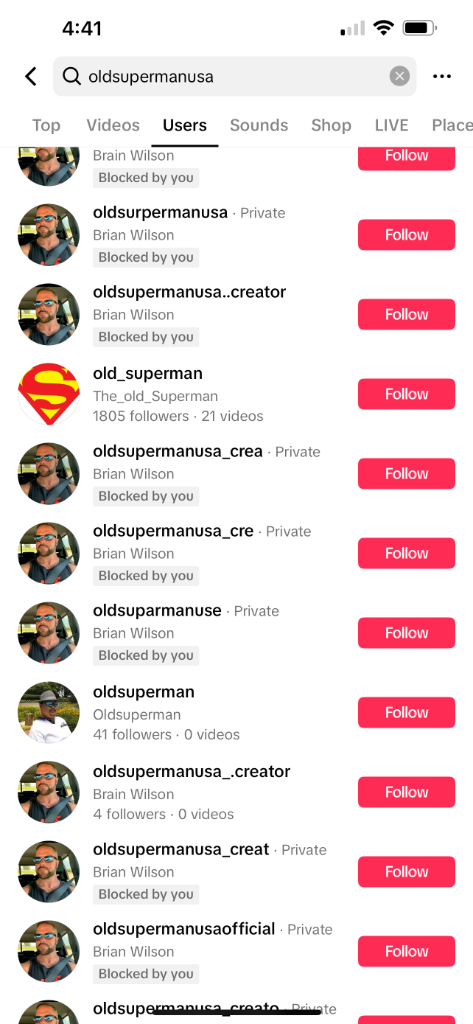
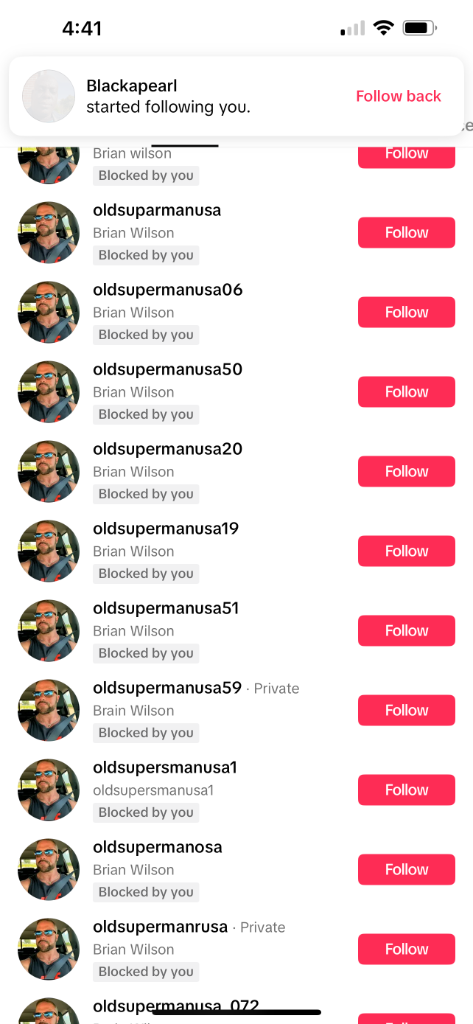
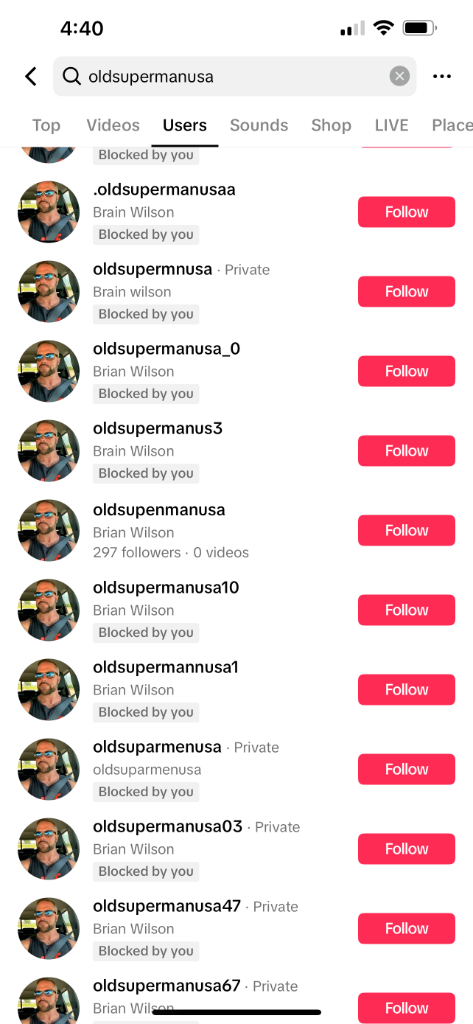
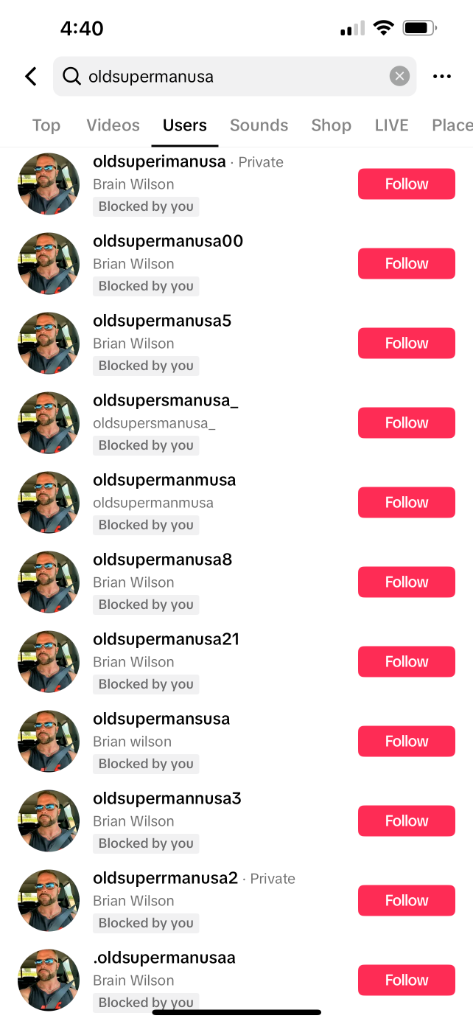
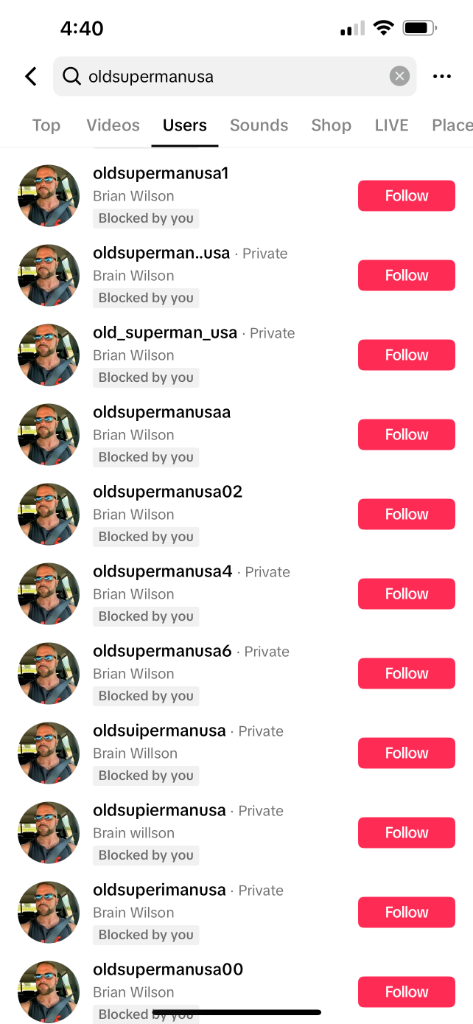
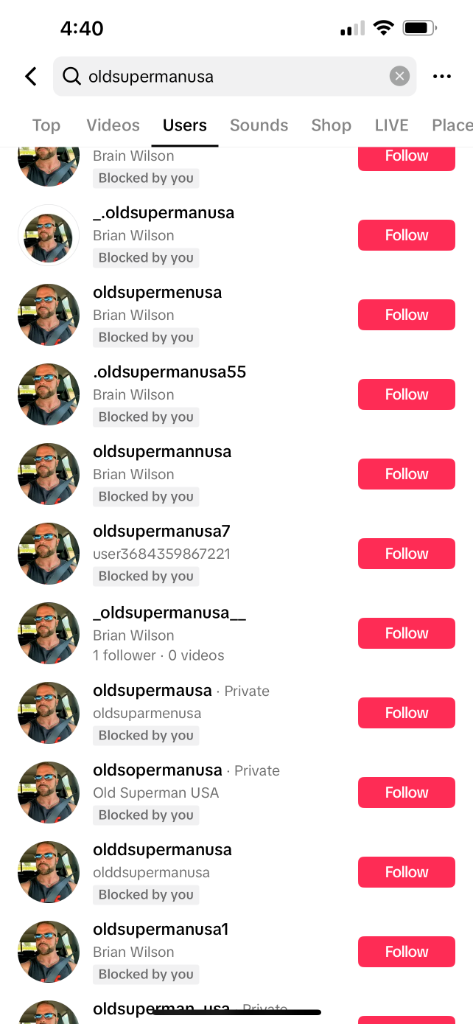
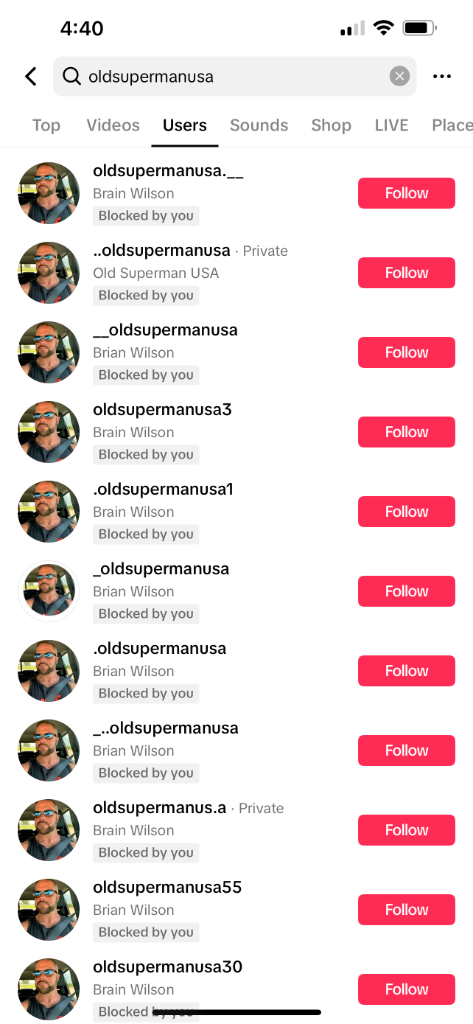
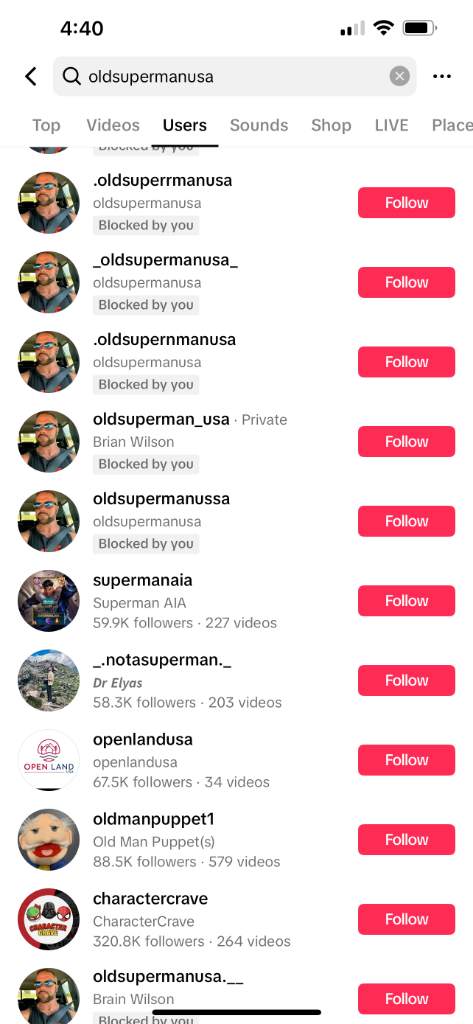
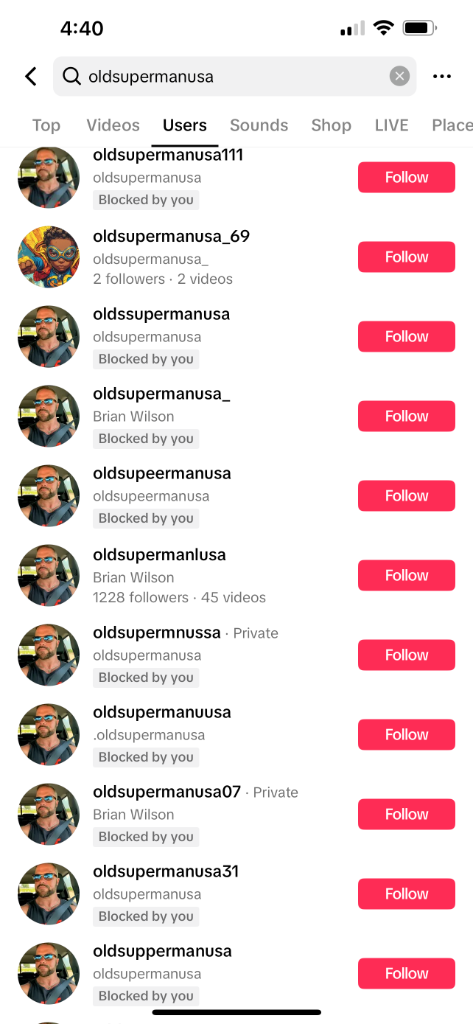
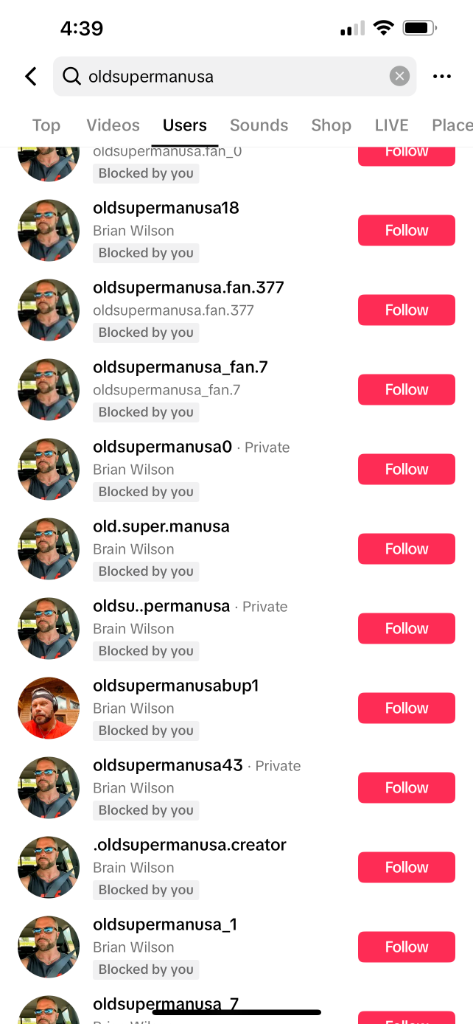
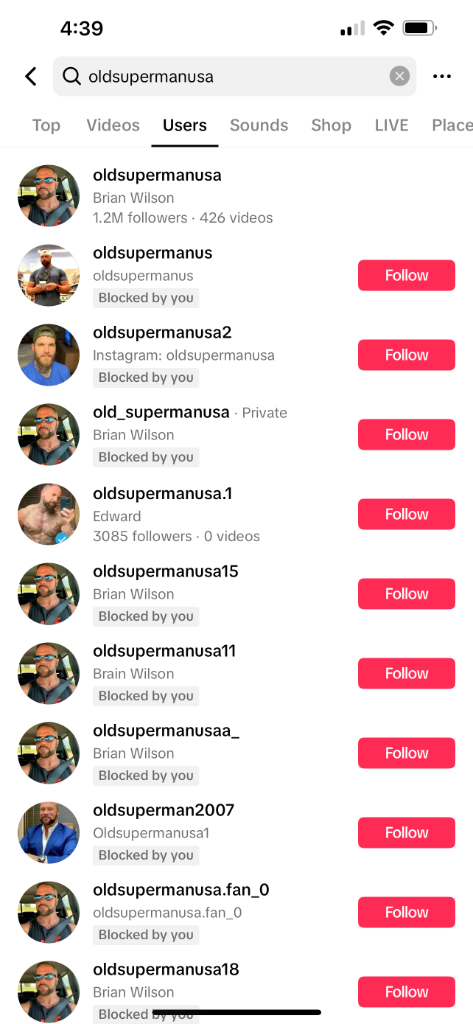
Across 11 screenshots of TikTok search results for "oldsupermanusa," NFA documented approximately 85–90 distinct impersonator accounts using Wilson's actual photo and name, all marked "Blocked by you." The published figure of "90+" is conservative. At least one impersonator (oldsupermanusa2) listed a matching fake Instagram handle in its bio, indicating the campaign extends beyond TikTok. At least one clone (oldsupermanlusa) had accumulated 1,228 followers and 45 videos — real traction with real potential victims.
Real Victims, Real Money — The Scam Operation Documented
The impersonation accounts were not a nuisance. They were a revenue operation. Real people lost real money — and then filed complaints against Wilson's real business, believing the scammer was him.
Victim 1: Shelley Herman — $275 via CashApp


This consumer paid $275 via Cash App to a personal account ($siselrosha) after being told the fee was for “a lifetime of services.” The consumer subsequently filed complaints with the Better Business Bureau. United Funding Logistics (UFL) had nothing to do with this transaction. UFL provided its services to this family at no cost; the $275 payment went to an outside party, not to UFL.
A mother trying to help her unemployed daughter — a woman with three children and no income — contacted someone she believed was Brian Wilson on Telegram. The scammer used Wilson's real pricing language to sound legitimate:
"The fee is $275 and it's for a lifetime of services."
The victim grew suspicious: "Are you an attorney? I know you advertise a lot about midland lawsuits but I've never seen a phone number or anything." The scammer's response was designed to project authority without providing verifiable credentials:
"I have lawyers who are ready to die for your daughter."
The victim paid $275 via CashApp to a handle registered as $siselrosha. After growing suspicious, she confronted the scammer directly: "Found out you're a thief and I am filing criminal theft charges against you."
Wilson has never had a Telegram account. "I have never had a telegram in my life," he states. Any communication from "Brian Wilson" on Telegram is categorically fraudulent — there is no legitimate Telegram account to compare it to. Telegram was used consistently as the second-stage platform by the impersonation operation, moving victims off more visible platforms (Facebook, TikTok) into a less traceable channel before requesting payment.
Victim 2: A Mother's Facebook Plea — The Same Script

A second victim — another mother trying to help her daughter with Capital One and Buckle debt, sued by Midland Credit Management — contacted someone she believed was Wilson on Facebook Messenger. The scammer used a Facebook account with Wilson's photo, the exact handle @oldsupermanusa, and 2,476 followers. After building trust, the scammer pushed the victim toward Telegram: "Are you available on telegram let's proceed?" The victim didn't know what Telegram was.
When the victim asked whether Wilson could stop her daughter's lawsuit, the scammer gave a response that should be read side by side with Victim 1's experience:
"I have lawyers ready to die for her case."
The phrase "I have lawyers ready to die for [her/your daughter's] case" appears in two independent scam conversations, with two different victims, on two different platforms (Telegram and Facebook Messenger), targeting two different family debt situations. This is not a coincidental turn of phrase — it is the same unusual, distinctive sentence used across multiple fake accounts. This confirms a shared script or template is being used across the impersonation operation — either by a single bad actor running multiple fake accounts or by a coordinated group using a common scam toolkit built around Wilson's stolen identity. This moves the evidence from "many disconnected impersonators" to "one operation, one playbook, multiple accounts and victims."
Victim 3: Ken McBryde — When the Scammer Uses Wilson's Real Address
A third documented case shows an even more sophisticated level of impersonation. A victim named Ken McBryde was communicating with a Telegram scammer posing as Wilson. When Ken asked where the office was located, the scammer gave him Wilson's actual real business address: "No, Houston, 8203 Willow Pl Dr S." When Ken asked for a phone number, the scammer provided Wilson's real business phone number: "You can reach me at 877-401-9190."
But when it came time for payment, the scammer gave a different CashApp handle: $MKellar567 — an account registered to a name, "Mary Kellar."
Ken grew suspicious and asked the question directly: "Yes but I want to make sure I'm not being scammed by someone on TikTok pretending to be Brian Wilson." The scammer deflected smoothly: "I'm personally handling your case, but if you choose to go through the means you want to, one of my secretaries will assist you."
This is the first documented instance where the scammer used Wilson's real, verifiable business address and real business phone number to establish credibility — while substituting a fraudulent CashApp handle for payment. The impersonation operation did real research on Wilson's actual business details and grafted a fraud channel onto it. The CashApp handle $MKellar567 (registered to "Mary Kellar") is the first named lead toward a specific identity behind the fraud. A $175 payment receipt to this same handle for "credit repair" has been documented.
The Oregon Detective — A Third Law Enforcement Dead End
Wilson didn't just report to Houston Police and the FBI. He also worked with a detective in Bend, Oregon — contacted after a victim in that jurisdiction reported being scammed by someone claiming to be Brian Wilson. The detective, saved in Wilson's phone as "Oregon," received the fake TikTok handle @oldsupermanusai — Wilson's real handle with a single letter tacked on the end — plus a traced Wells Fargo ACH routing number (121000248) from the fraud transaction chain.
Wilson was actively working the case. In iMessage exchanges dated February 4-26, 2024, he forwarded evidence, offered to assist in a sting operation, and asked the detective to act. The detective's response, February 26, 2024:
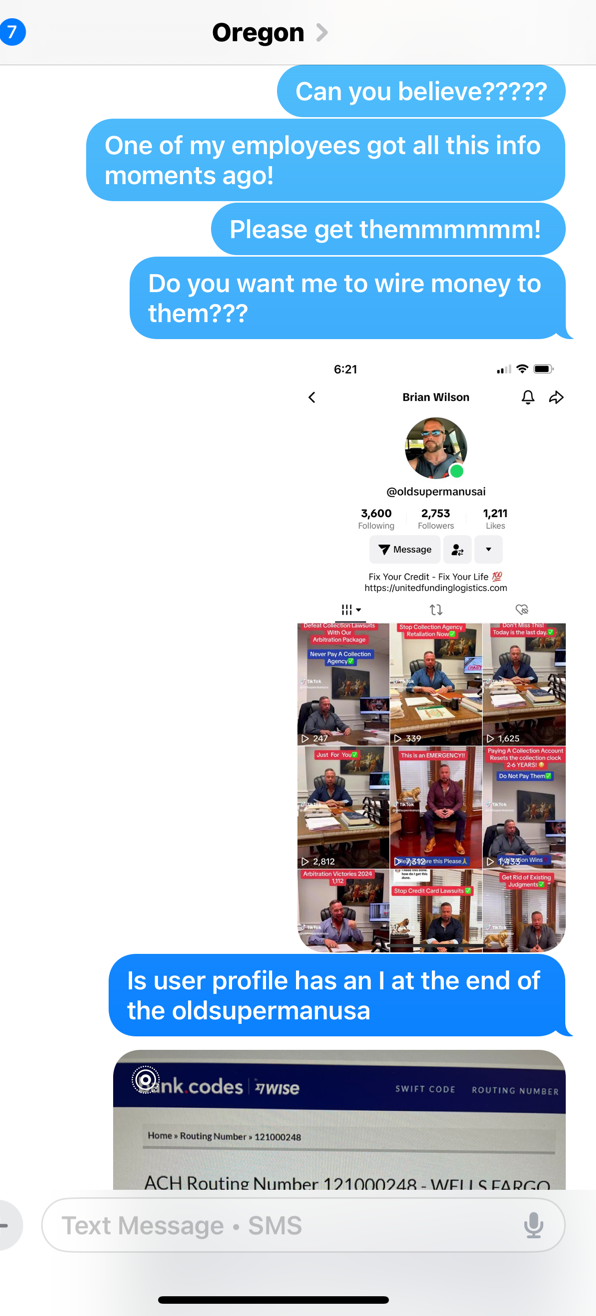
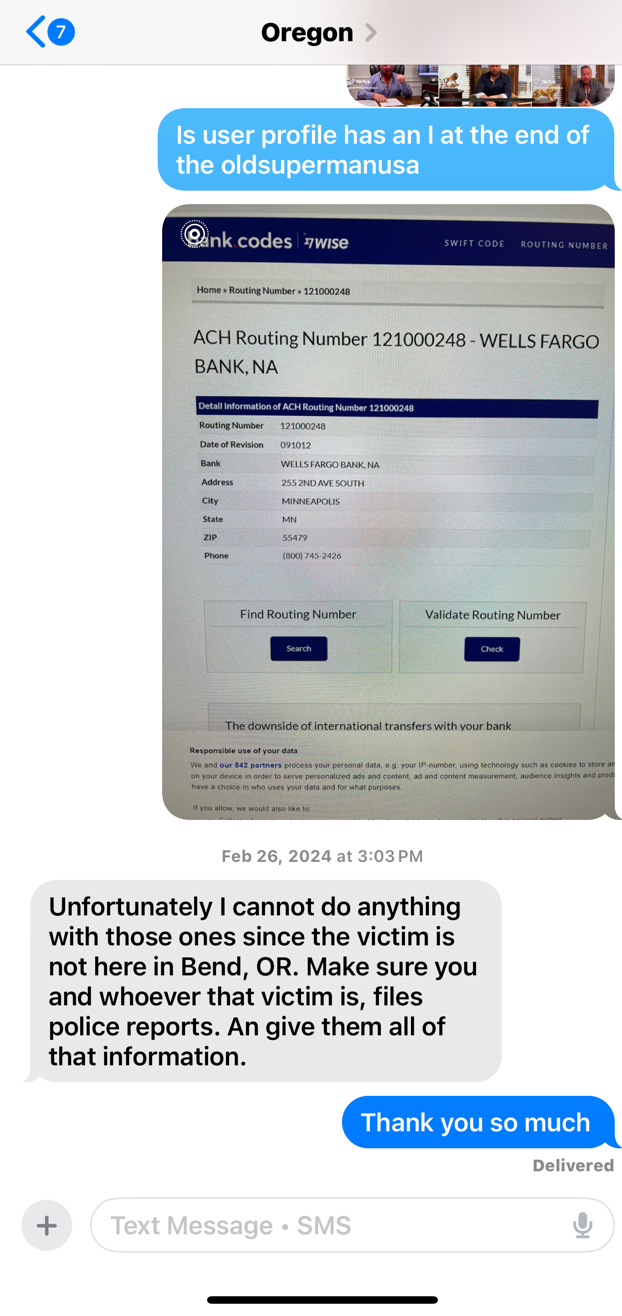
"Unfortunately I cannot do anything with those ones since the victim is not here in Bend, OR. Make sure you and whoever that victim is, files police reports. And give them all of that information."
HPD took the report. No arrest. The FBI took the complaint. No agent called. The Oregon detective took the evidence — a fake account handle, a bank routing number, Wilson's offer to help — and said she couldn't act because the victim wasn't physically in Bend, Oregon. Three agencies. Three dead ends. The scam continued.
As of September 2023, Wilson documented to Cash App Support that over $14,000 in fraud losses had been identified, with 80+ potential victims defrauded at $175 ("Individual Lifetime Services") or $275 ("lifetime Services") per victim — amounts matching UFL's real pricing structure. Two specific CashApp handles have been documented: $siselrosha (Shelley Herman scam) and $MKellar567 (Ken McBryde scam, registered to "Mary Kellar"). The $275 figure matches exactly across both the September 2023 fraud report and the February 2024 Shelley Herman scam — confirming a consistent scam operation using UFL's real service-tier language.
The Fraudulent BBB Accreditation Application
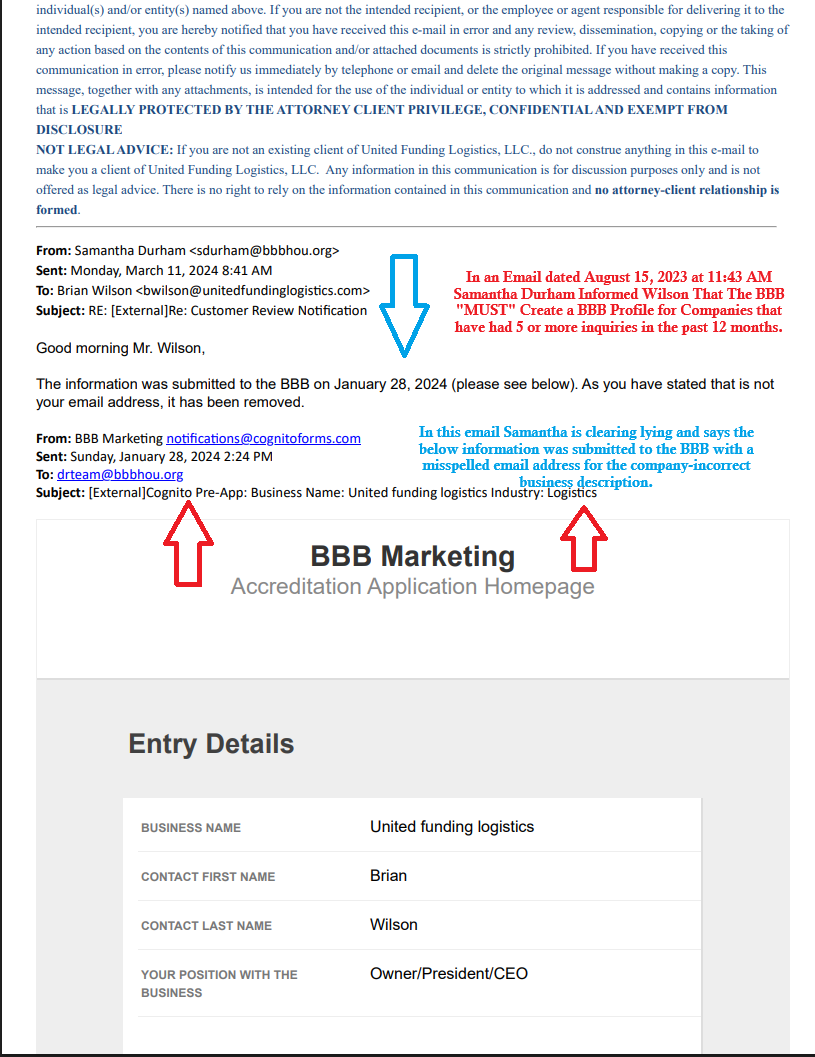
The impersonation wasn't limited to social media. On January 28, 2024, someone submitted a fraudulent accreditation application to the BBB — not through any official Wilson contact, but through Cognito Forms, an external third-party online form builder (the submission arrived from notifications@cognitoforms.com to drteam@bbbhou.org, tagged "[External]"). The application is demonstrably fake: the contact email was misspelled ("unitiedfundinglogistic" — not even Wilson's company domain), the business was misclassified as "Logistics" when UFL is a credit repair and debt settlement company, and Wilson had never used that email account. Yet the application also listed Wilson's real P.O. Box mailing address — information UFL had never provided to the BBB. The BBB accepted the fraudulent application and updated Wilson's profile anyway.
Address: P.O. Box 690928, Houston, TX 77269 — this IS Wilson's real mailing address. UFL never provided this address to the BBB, so how the applicant obtained it remains unexplained.
Phone: (877) 409-9190 — Wilson's real number with two digits transposed (409 vs. 401)
Email: unitiedfundinglogistic@gmail.com — misspelled ("unitied" instead of "united," missing the "s" in "logistics"). Wilson has never used this account. A misspelled company email is proof the application is fake — Wilson would never misspell his own business name.
Submitted via: Cognito Forms — an external third-party online form builder (cognitoforms.com). The submission arrived from notifications@cognitoforms.com to drteam@bbbhou.org, tagged "[External]." Wilson never sent anything; the application came in through an outside form service, not from Wilson.
Industry listed: "Logistics" — wrong. United Funding Logistics is a credit repair and debt settlement company. The real Wilson would never classify his own business as "Logistics." Another proof the application is fake.
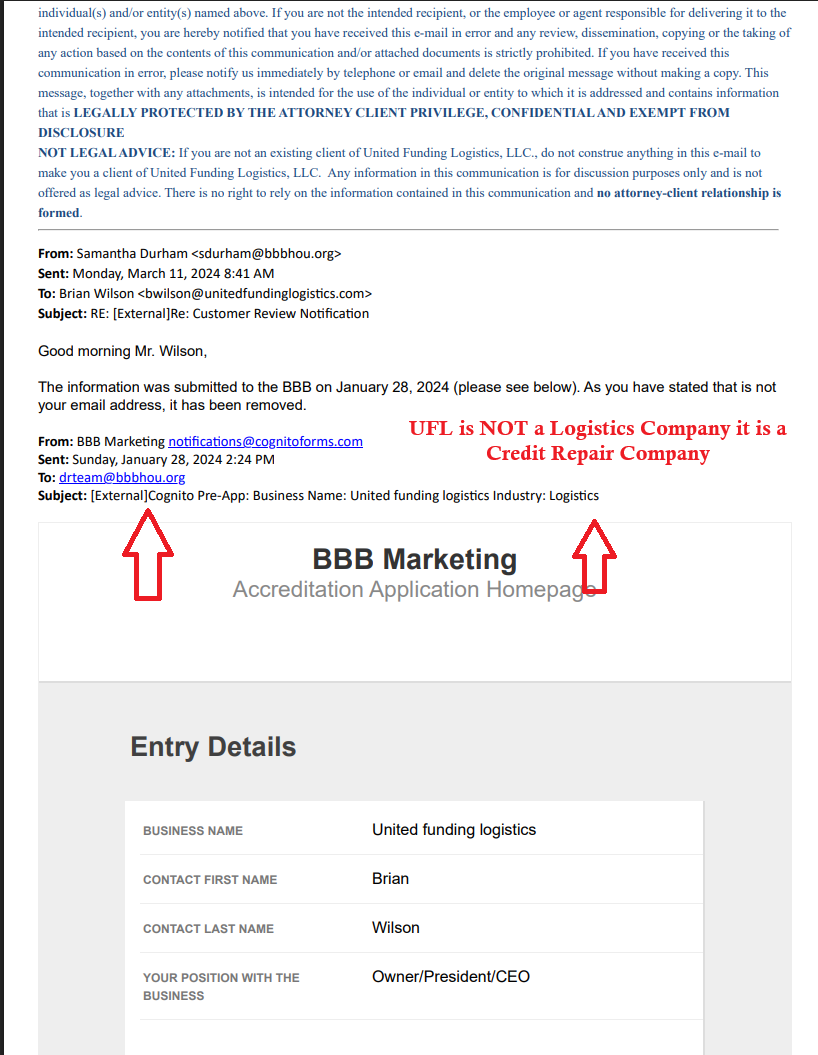
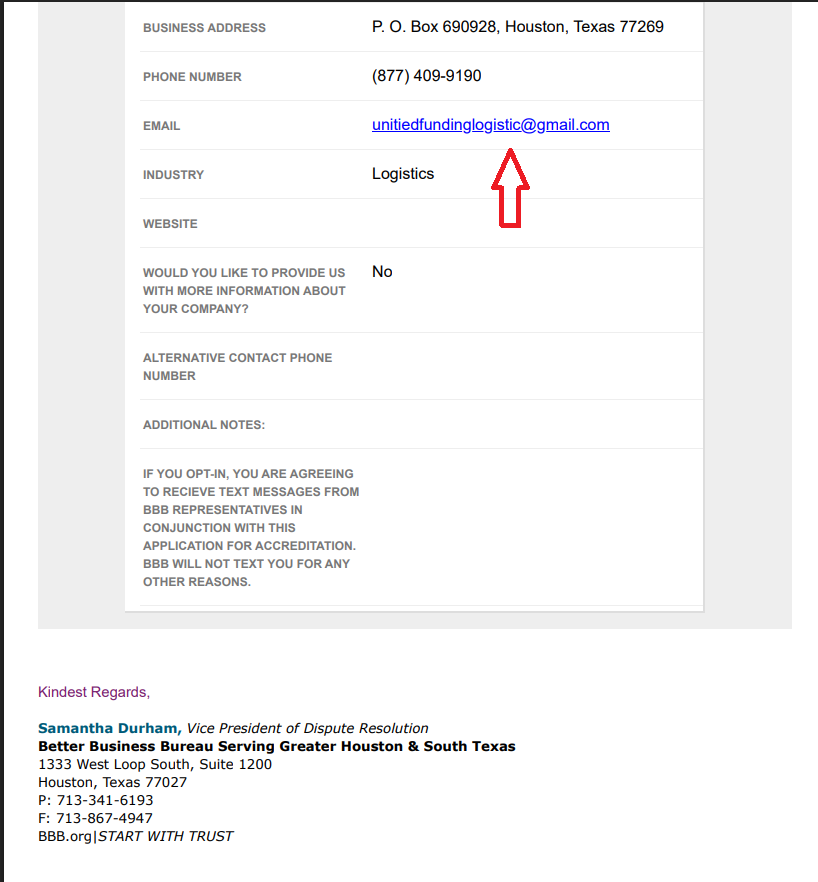
The application was submitted through Cognito Forms — an external online form builder (cognitoforms.com) the BBB used for its accreditation "Pre-App" intake. The submission did not come from Wilson; it arrived as an automated email from notifications@cognitoforms.com to drteam@bbbhou.org, tagged "[External]" to signal it originated outside the BBB. The word cognito shares the same Latin root as incognito — "having one's identity hidden, disguised, or kept secret so people do not recognize you." The irony is exact: a form named after hiding one's identity was the very vehicle used to file a fraudulent application in Wilson's name — and the BBB accepted it and applied it to his real business profile without verifying his identity.
Wilson's response to Durham, March 8, 2024:
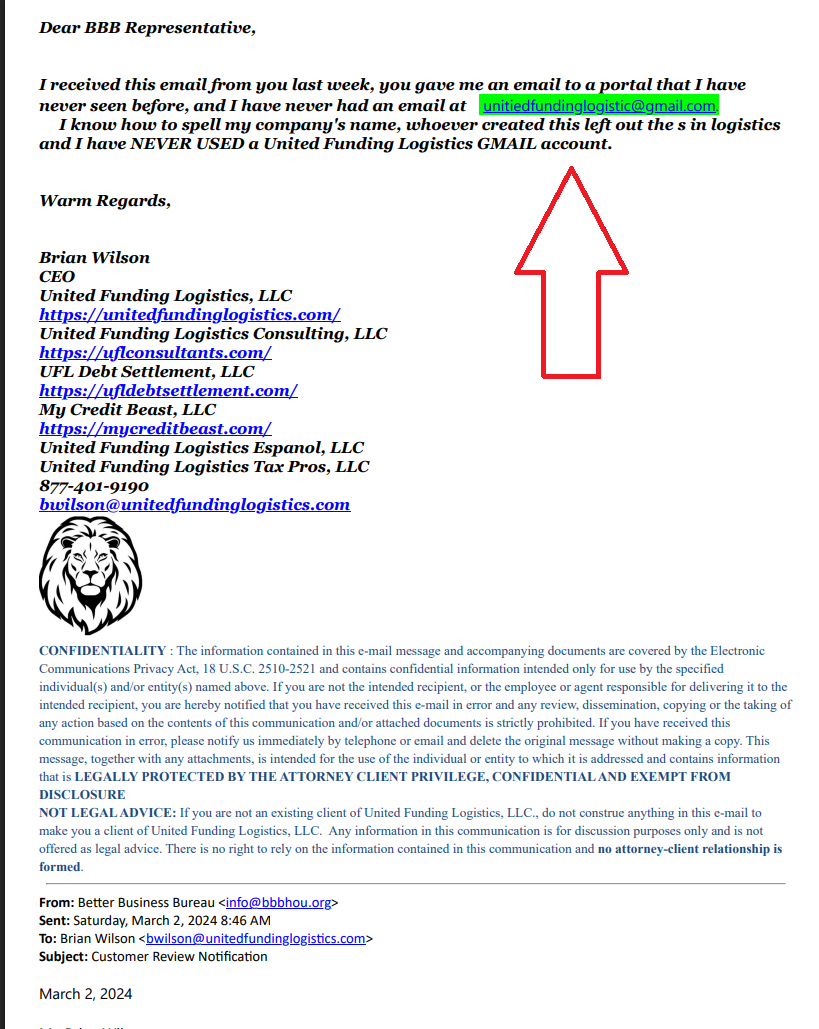
"I have never had an email at unitiedfundinglogistic@gmail.com. I know how to spell my company's name. Whoever created this left out the s in logistics and I have NEVER USED a United Funding Logistics GMAIL account."
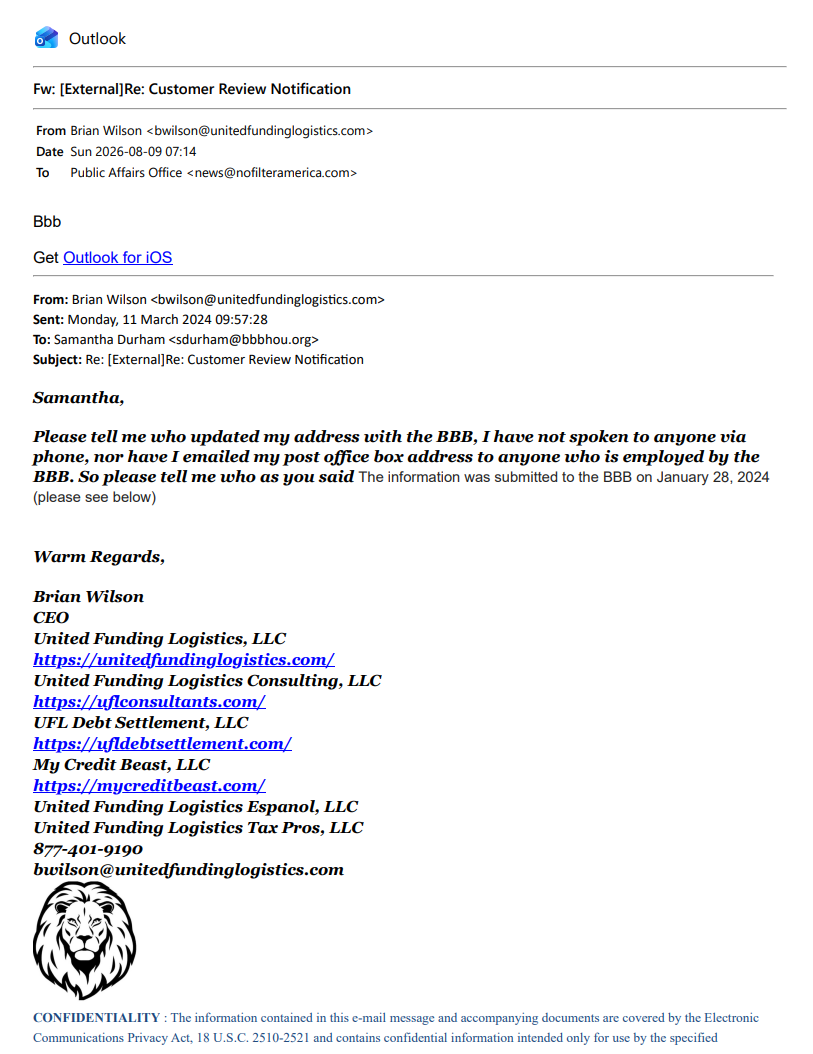
Wilson followed up on March 11: "Please tell me who updated my address with the BBB, I have not spoken to anyone via phone, nor have I emailed my post office box address to anyone who is employed by the BBB. So please tell me who."
Durham's response: "The information was submitted to the BBB on January 28, 2024. As you have stated that is not your email address, it has been removed."
The fraudulent email was on Wilson's BBB profile for approximately six weeks before he caught it. During that window, whoever controlled unitiedfundinglogistic@gmail.com may have had access to BBB's customer review notification system — potentially receiving review submissions, login credentials, or other BBB-facing communications intended for Wilson. Durham's response removed the email but did not identify the submitter, did not address the fraudulent P.O. Box address, and did not explain how BBB accepted an unverified third-party submission and applied it to Wilson's real business profile without verifying his identity.

The BBB's Two Stories — Mandatory Profile or Unauthorized Application?
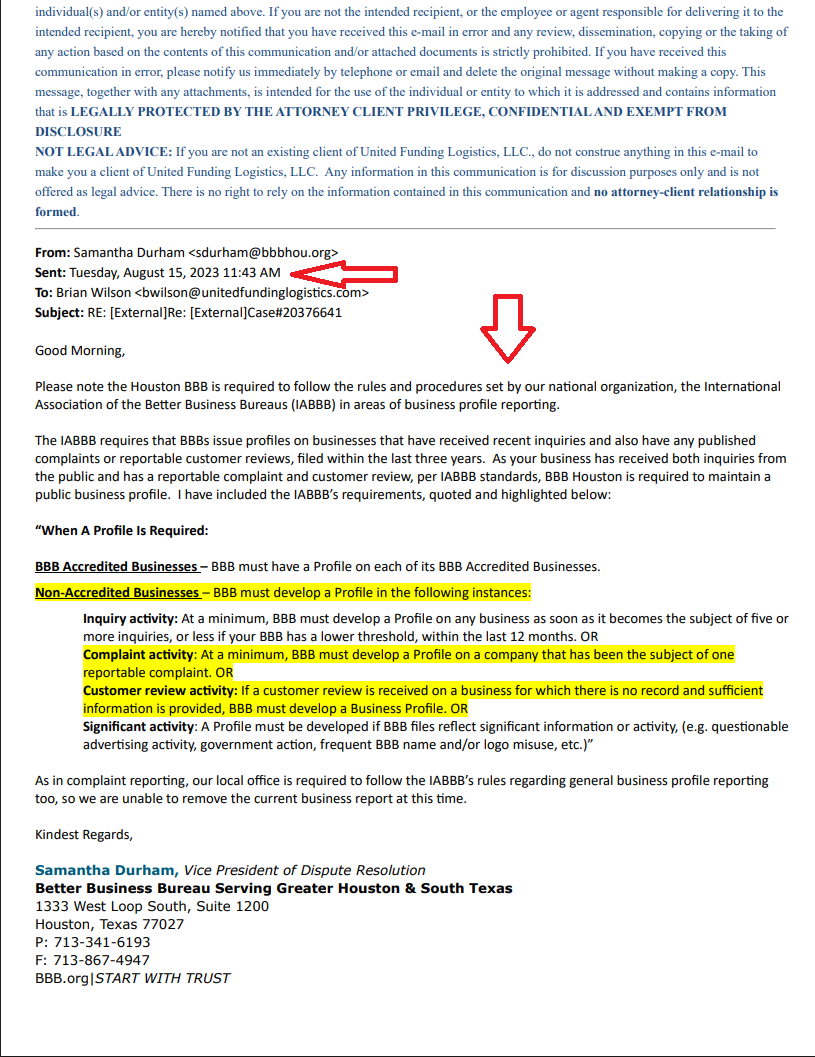
On August 15, 2023, at 11:43 AM, Samantha Durham — the BBB's Vice President of Dispute Resolution — told Wilson in writing that the BBB had no choice. Under the rules of its national body, the International Association of the Better Business Bureaus (IABBB), the Houston BBB was required to create and maintain a public business profile on United Funding Logistics because the business had received five or more public inquiries and a reportable complaint within the prior twelve months. She wrote that the BBB was “unable to remove the current business report at this time.” The profile, per the BBB's own words, was mandatory — not applied for, not requested, and unable to be removed.
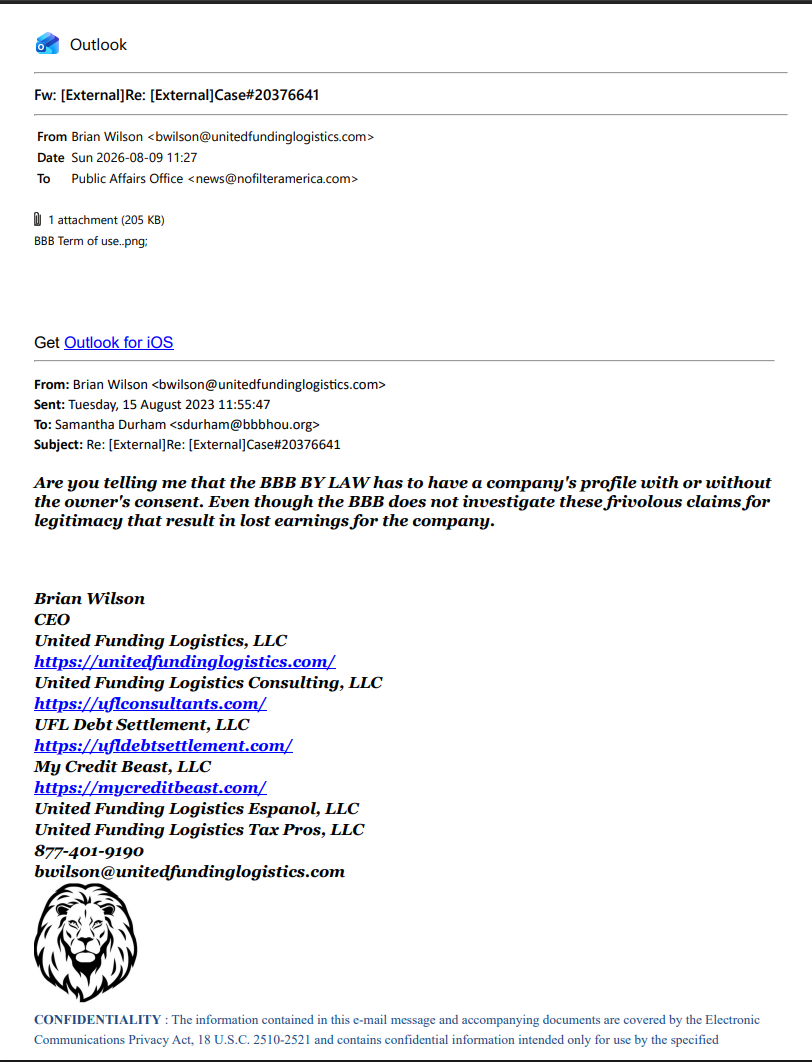
Twelve minutes later, Wilson replied with the question that would hang over the next three years: “Are you telling me that the BBB BY LAW has to have a company's profile with or without the owner's consent. Even though the BBB does not investigate these frivolous claims for legitimacy that result in lost earnings for the company.”
Then, five months later, the BBB's story changed.
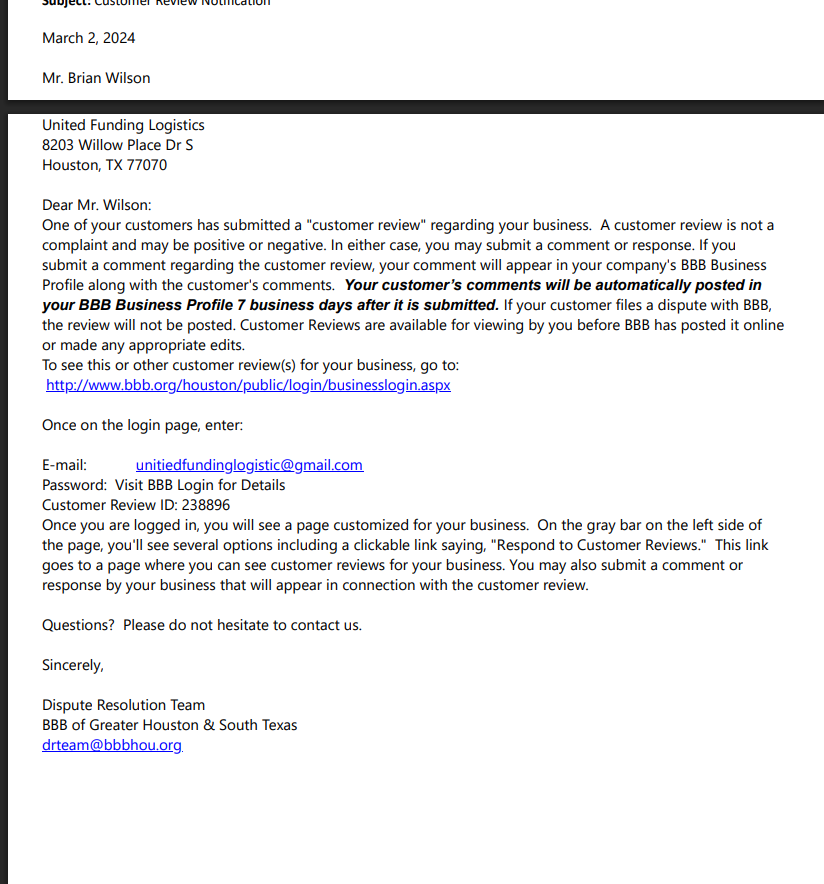
On January 28, 2024, an automated submission arrived at the BBB's drteam@bbbhou.org inbox from “BBB Marketing” via Cognito Forms — a third-party online form builder. It was a “BBB Marketing Accreditation Application.” The business name on the form was “United funding logistics” (lowercase, informal, missing the “s” in “logistics”). The contact email was unitiedfundinglogistic@gmail.com — a Gmail address Wilson had never used and had never given the BBB. The industry was listed as “Logistics” — wrong for a credit-repair and debt-settlement firm.
On March 2, 2024, Wilson received a “Customer Review Notification” from the BBB referencing that portal and that misspelled email. He replied the same day, writing point-blank: “I have never had an email at unitiedfundinglogistic@gmail.com. I know how to spell my company's name, whoever created this left out the s in logistics and I have NEVER USED a United Funding Logistics GMAIL account.”
On March 11, 2024, Durham wrote back: “The information was submitted to the BBB on January 28, 2024 (please see below). As you have stated that is not your email address, it has been removed.”
That single sentence is the contradiction at the center of this file. In August 2023, the BBB told Wilson the profile was mandatory — created by the BBB under IABBB rules because of inquiry volume, not because Wilson asked for it, and unable to be removed. In March 2024, the BBB told Wilson the profile data came from “information [that] was submitted to the BBB” — a voluntary accreditation application Wilson did not submit, bearing a misspelled company name and a Gmail address Wilson had never used. The BBB cannot have both explanations. If the profile was mandatory, no application was needed. If the application is what populated the profile, then the “mandatory” letter was a pretext — and the BBB accepted an unverified, misspelled, third-party submission and applied it to Wilson's real business profile without verifying his identity.
Durham removed the email. She did not identify who submitted the application. She did not explain how the BBB accepted it. And she did not reconcile her August 2023 letter — which said the profile was required and could not be removed — with her March 2024 letter, which said the profile rested on a submission Wilson says was not his.
Credit Beast — The Alabama Impersonator
Footage: Brian Wilson dials 855-506-9175 — the number advertised on the fake MYCREDITBEAST.COM — and reaches a live operator in Alabama posing as "Credit Beast." The recording proves the impersonation hotline is active, staffed by third parties, and operating under Wilson's stolen brand without his knowledge or consent. The video appears to be an original iPhone recording of a man seated at a desk using a computer, while another person records what is happening. Importantly, the MOV metadata reports an original QuickTime creation date of May 25, 2023 at 2:50:20 PM -05:00. This places the recording squarely in the period when other evidence says the Credit Beast/UFL impersonation activity was occurring.
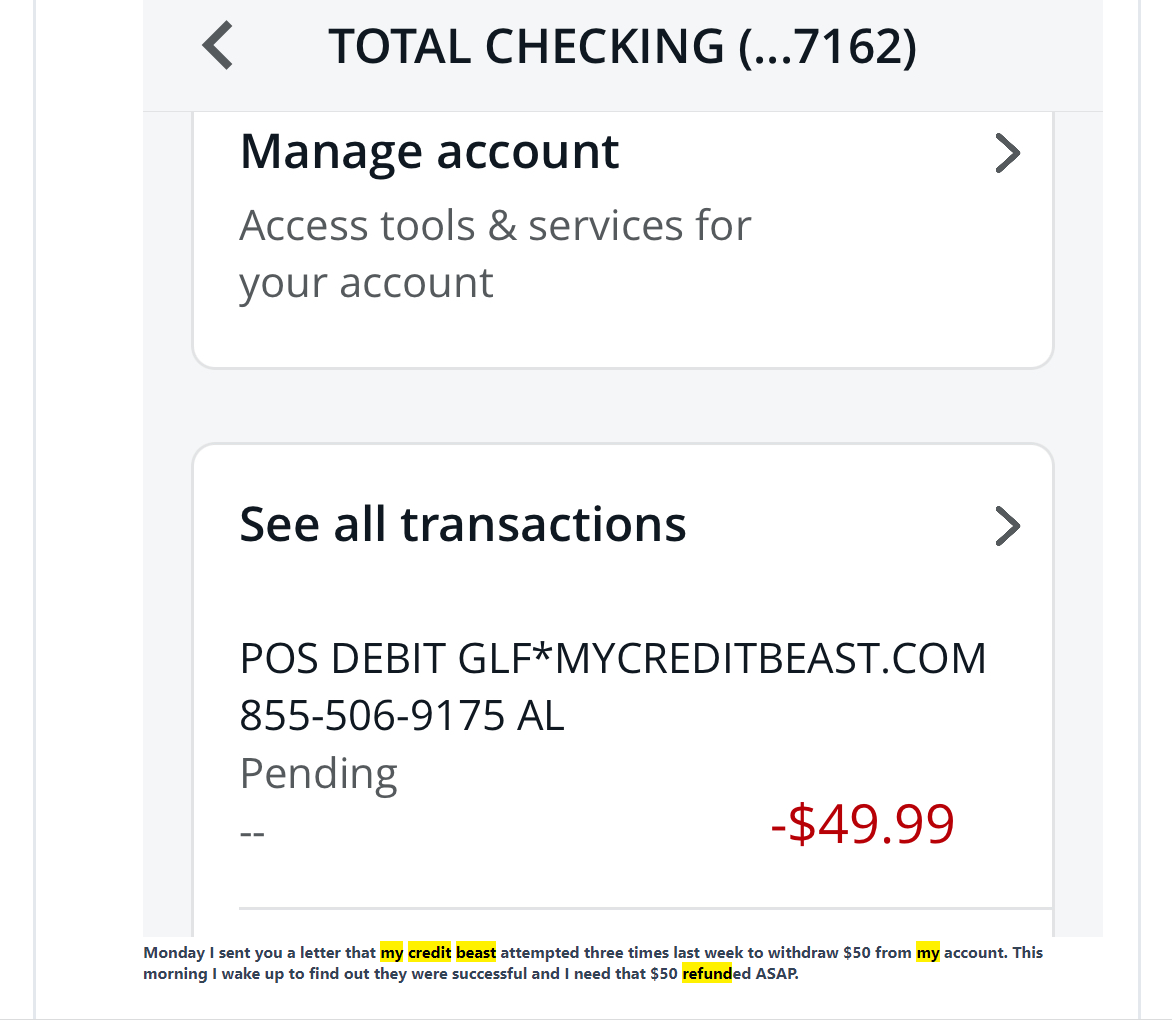
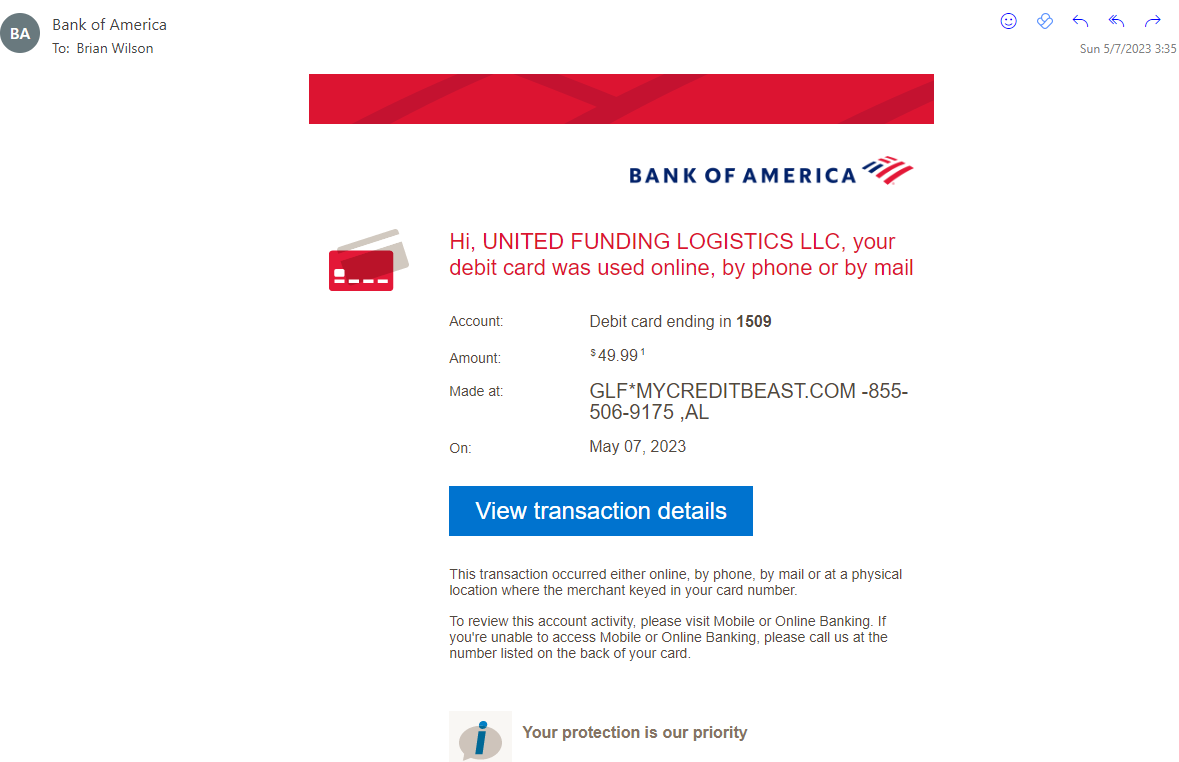
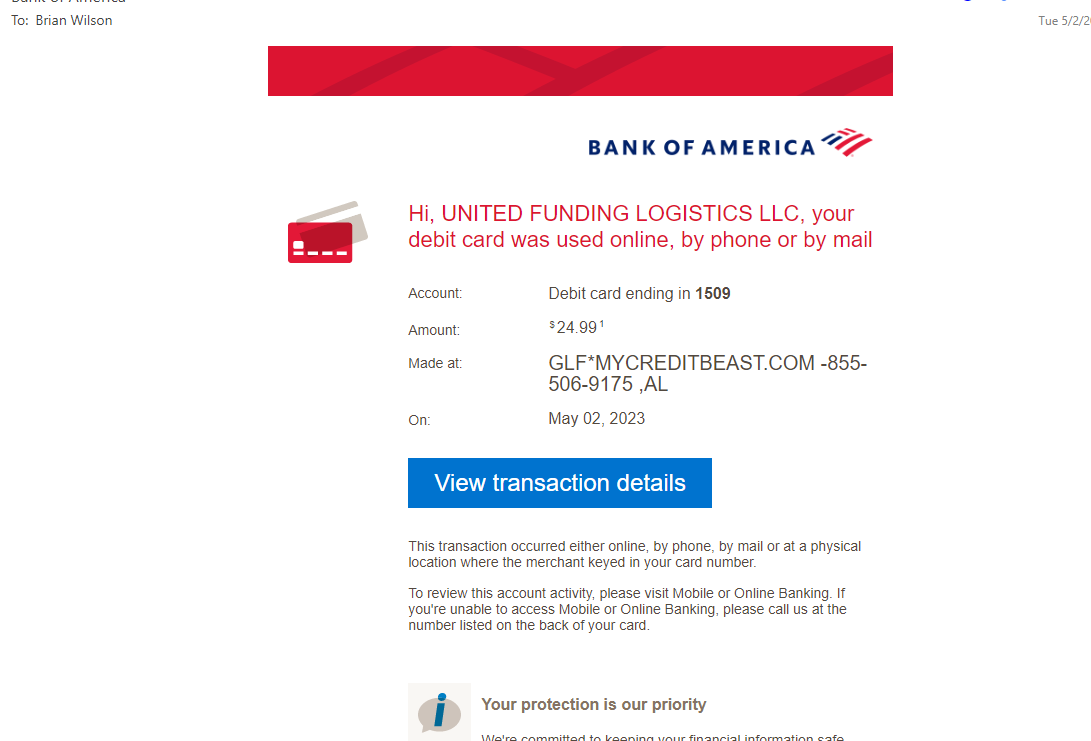
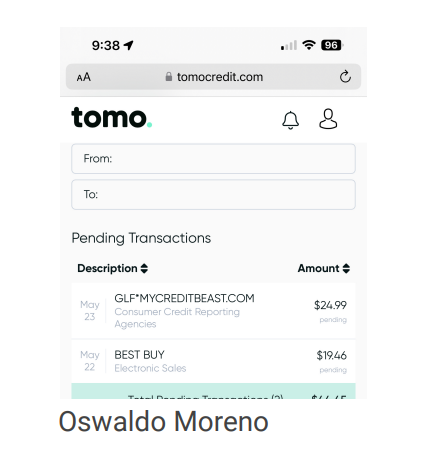
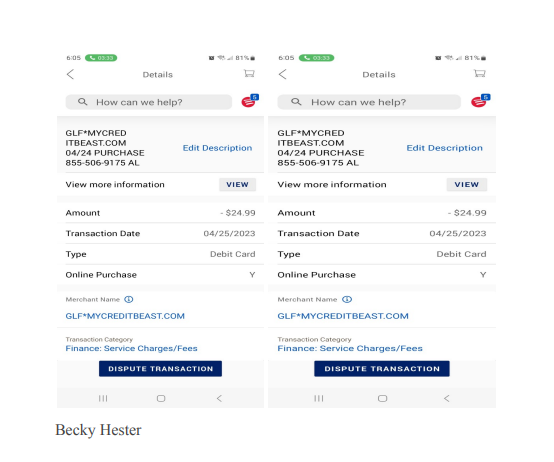
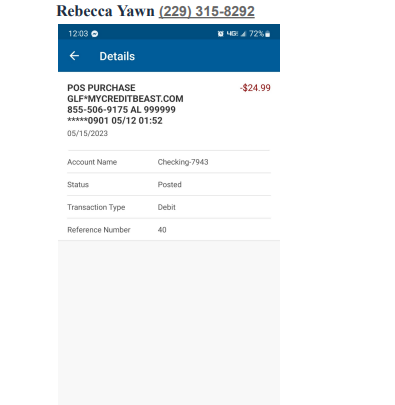
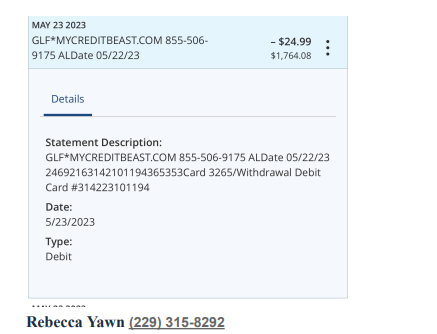
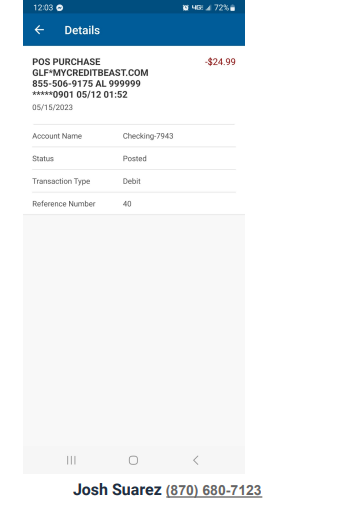
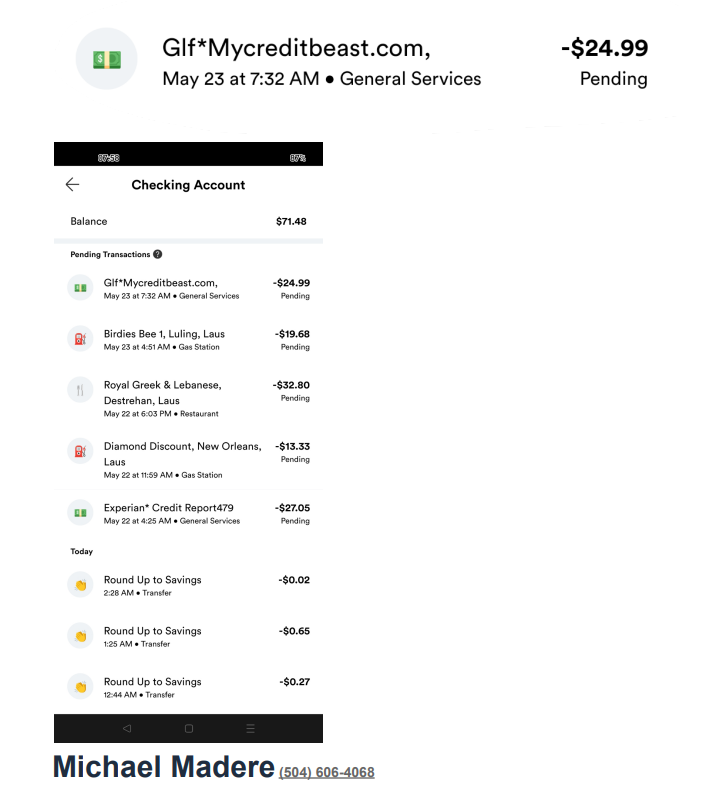
Separate from the phishing operation, a commercial entity was billing Wilson's clients under a similar name. On May 7, 2023, Wilson's own business debit card — United Funding Logistics LLC, card ending 1509 — was charged $49.99 by a merchant identified as GLF*MYCREDITBEAST.COM — 855-506-9175, AL.
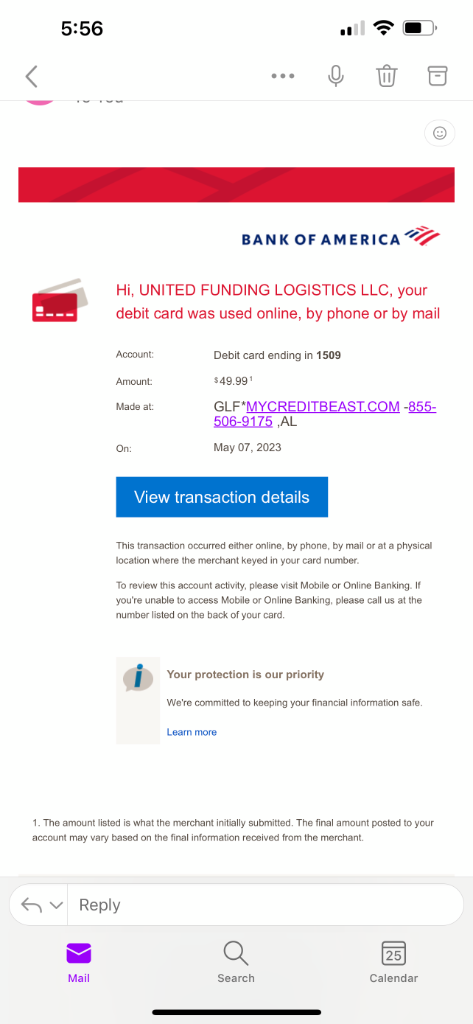
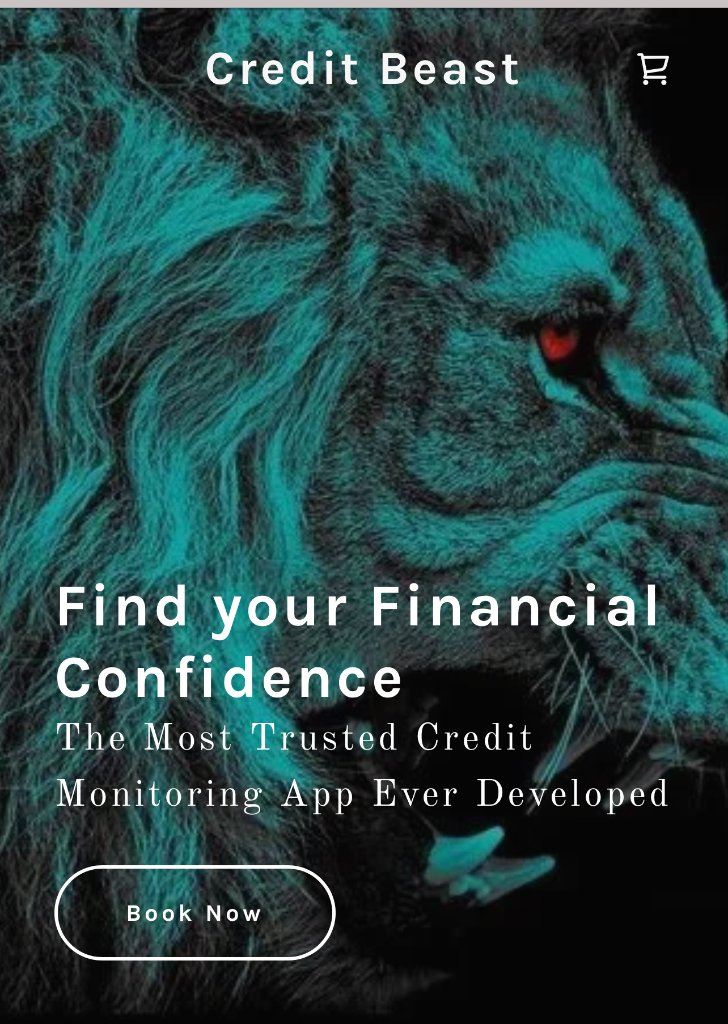
MyCreditBeast.com operated from Alabama (merchant code "AL"). United Funding Logistics operated from Houston, Texas. The Bank of America fraud alert documenting a $49.99 charge to UFL's debit card from this Alabama merchant is physical proof that the two entities are separate. Wilson did not own, operate, or control MyCreditBeast.com.
The Phishing Infrastructure
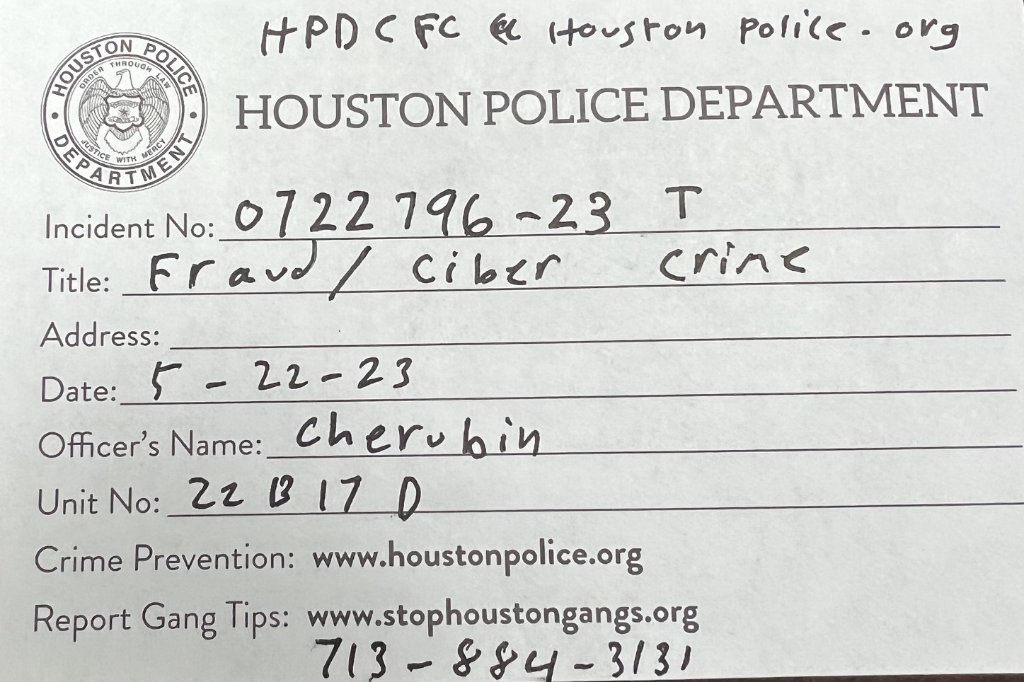
On May 22, 2023, Wilson reported the identity theft to the Houston Police Department. Officer Cherubin, Unit 22B17D, took the report under Incident No. 0722796-23 T, categorized as "Fraud / Cyber crime." The case file included a spreadsheet documenting a credential-harvesting operation of significant scope.
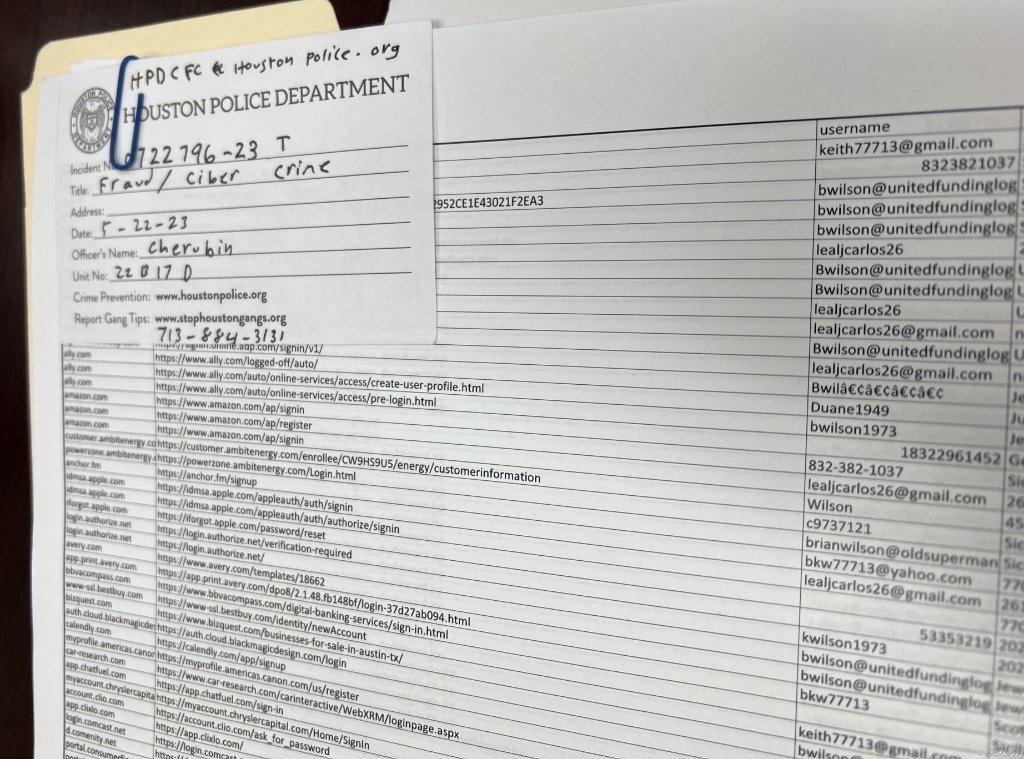
The phishing targets identified in the visible rows include:
- Apple — Apple ID sign-in, password reset pages
- Amazon — Sign-in and registration pages
- Comcast — Account password recovery
- Ally Bank — Online banking sign-in
- Best Buy — Digital banking services sign-in
- Authorize.net — Payment processing verification
- Clio — Legal practice management platform
- Calendly, Avery, Canon, Chatfuel — Additional targets
The impersonation was layered: fake TikTok accounts using Wilson's face, a phishing operation harvesting credentials across the internet, a copycat credit services website operating from a different state, and someone feeding fraudulent contact information directly into the BBB's own system in Wilson's name — all creating confusion that funneled complaints back to Wilson's real business profile at the BBB.
Every Door Closed
Wilson did what a victim is supposed to do. He called the police. He filed with the FBI. He documented everything. He even tried to work with the BBB itself. And every door closed.
"With or Without the Owner's Consent"
In August 2023, Wilson discovered that the BBB had created a business profile for United Funding Logistics without his knowledge or consent. He hadn't applied for accreditation. He hadn't requested a profile. The BBB had built one anyway — and was using it to collect and publish complaints against him.
Wilson demanded the profile be removed. The response came from Samantha Durham, Vice President of Dispute Resolution at the BBB of Greater Houston & South Texas:
The BBB creates business profiles without the business owner's consent. Once created, the BBB states it cannot remove the profile. This means a business can be rated, reviewed, and complained about by the BBB — and the business owner cannot opt out. Wilson never applied for BBB accreditation. He never requested a profile. The BBB built one anyway, and when he asked them to remove it, they refused.
The Meeting That Never Happened
In March 2024, after another complaint (Case #21342239) was closed as "No Response" — a designation Wilson disputes — he requested an in-person meeting with BBB staff so they could, in his words, "educate us on how to respond 'appropriately.'" The request went to Cassandra Marquez, Dispute Resolution Specialist at BBB Houston. No meeting was scheduled.
Wilson's March 1, 2024 email to BBB referenced the case (Frederick, Leigh & Brian Wilson) and requested the meeting with his "legal team" present. The sarcastic framing — "educate us on how to respond 'appropriately'" — echoed the BBB's own language back at them. No meeting resulted.
Houston Police Department — May 22, 2023
Officer Cherubin took the report. Incident No. 0722796-23 T. The case file included the phishing spreadsheet, Wilson's identification, and the initial list of six known victims. Wilson reported that his identity had been stolen, his credentials harvested, and his business name used to defraud consumers.
The HPD took the report. No arrest followed. No investigation was communicated to Wilson. The report exists in a file.
FBI Internet Crime Complaint Center — May 2023
Days after the HPD report, Wilson escalated to the FBI. He filed a formal complaint with the IC3, the bureau's online crime reporting portal. The complaint is specific, detailed, and signed under federal penalty of perjury.
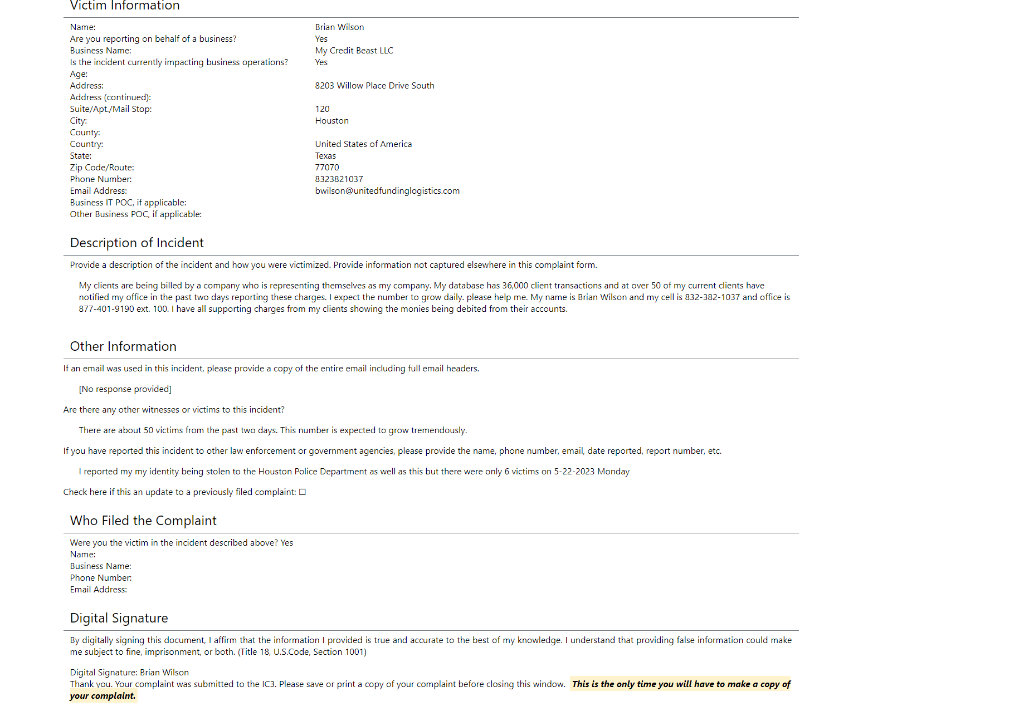
The FBI took the complaint. No agent called. No investigation was communicated. The form exists in a database.
Wilson reported the impersonation and billing fraud to two separate law enforcement agencies — Houston Police Department (Incident No. 0722796-23 T, May 22, 2023) and the FBI Internet Crime Complaint Center (filed shortly after, May 2023). Neither investigation produced an arrest, a charge, or a communicated resolution. The impersonation continued.
Meanwhile, despite Wilson's reports, accounts he had identified remained accessible, and additional impersonation activity continued. MyCreditBeast.com continued operating from Alabama. The phishing infrastructure continued harvesting credentials. Someone submitted a fraudulent accreditation application to the BBB in Wilson's name. And complaints continued flowing to the BBB. Wilson maintains that many of those complainants were victims of impersonation operations — people who believed they were dealing with him but were not. The BBB published them as "Verified" complaints against Wilson's real business.
Wilson documented and reported conduct he believed constituted identity theft, fraud, and impersonation to multiple agencies. Official reports were created by the Houston Police Department and the FBI Internet Crime Complaint Center. Neither investigation produced an arrest, a charge, or a communicated resolution. The reports Wilson filed did not produce the response he sought from any agency.
The $5,000,000 Demand
Wilson didn't just report the fraud. He fought back against the institution he believed was enabling it.
He sent a formal demand letter to Dan Parsons, president of the BBB Houston chapter, demanding $5,000,000.00 in damages. The demand was Wilson's response to what he viewed as a coordinated campaign: the BBB publishing unverified complaints from impersonation victims, removing his positive reviews, and using its institutional authority to brand his legitimate business a fraud — while the actual fraudsters operated with impunity.
On August 20, 2026, NFA obtained and inspected the original demand letter. The document is dated July 17, 2024, printed on United Funding Logistics, LLC letterhead, signed by Brian Wilson, and addressed to the Better Business Bureau at 1333 West Loop S, Ste 1200, Houston, Texas 77027. It demands $5,000,000.00 in damages and the immediate posting of legitimate five-star reviews blocked by the BBB, with a 15-day response window. The figure and the letter's existence — previously reported on Wilson's account — are now independently verified by NFA from the primary-source document. Both pages are reproduced below.
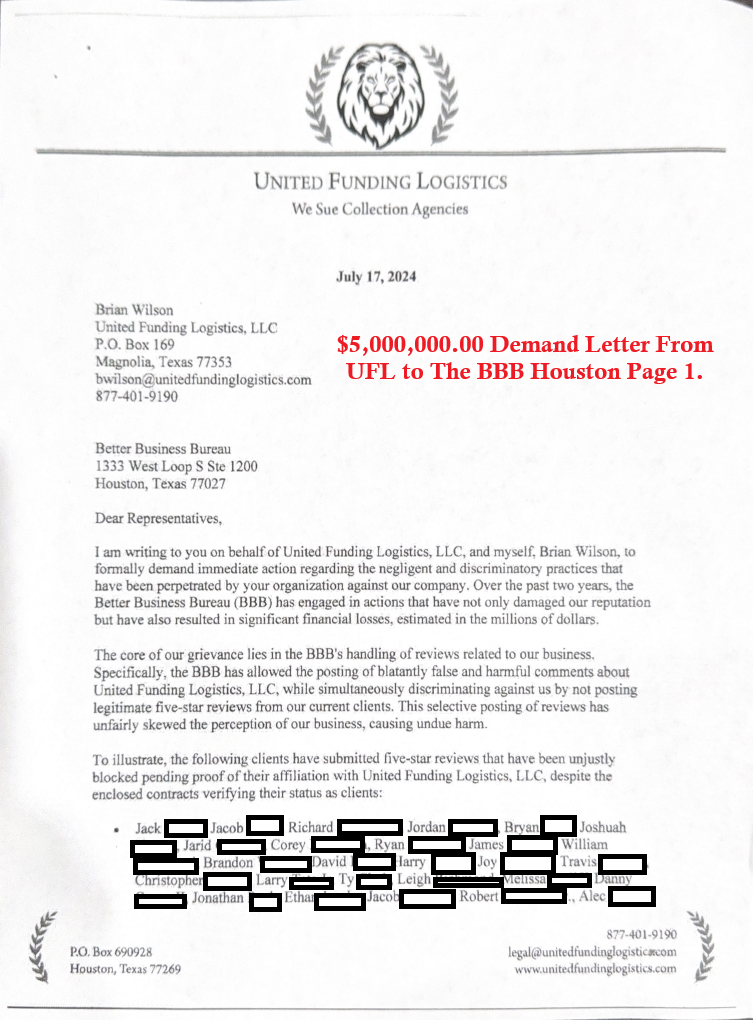
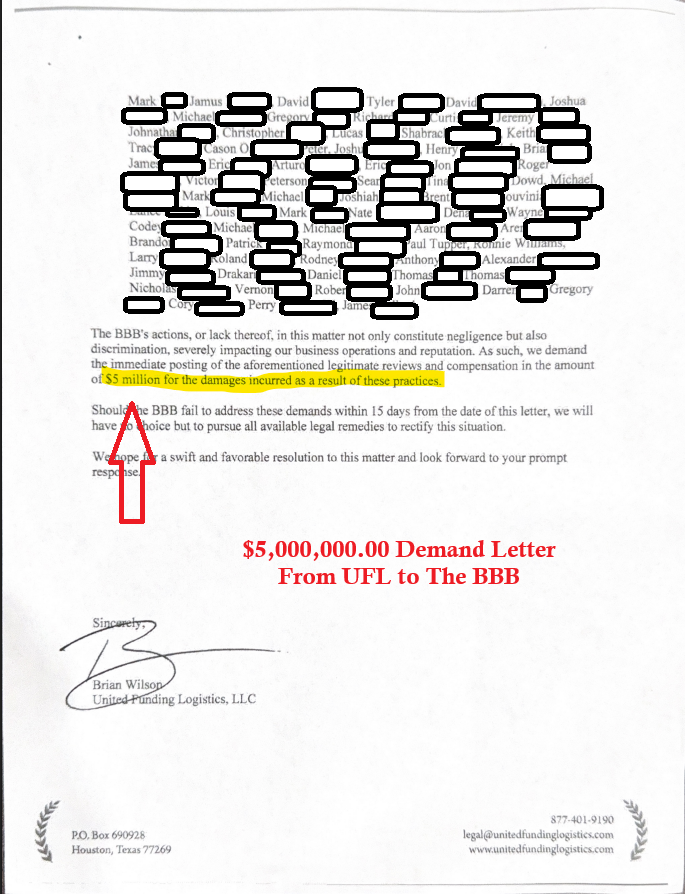
The demand letter was not a lawsuit. It was a warning shot — a formal claim that Parsons and the BBB had caused measurable damage to Wilson's business, reputation, and livelihood through a pattern of conduct that Wilson believed amounted to institutional fraud. NFA has now inspected the original signed document. It exists. It is dated. It is real.
Wilson alleges that Parsons had previously threatened to sue him for millions over karenbuster.com. Now Wilson was the one making the demand. The dynamic had shifted — and the BBB's response would be to remove his positive reviews, lower his rating to F, and publish a "Pattern of Complaints" alert. That alert later became relevant to the Harris County Attorney's Office civil enforcement case.
The institution that grades businesses on how they handle complaints responded to a $5,000,000 demand by making the complainant's rating worse.
Lawfare — The UPLC Files
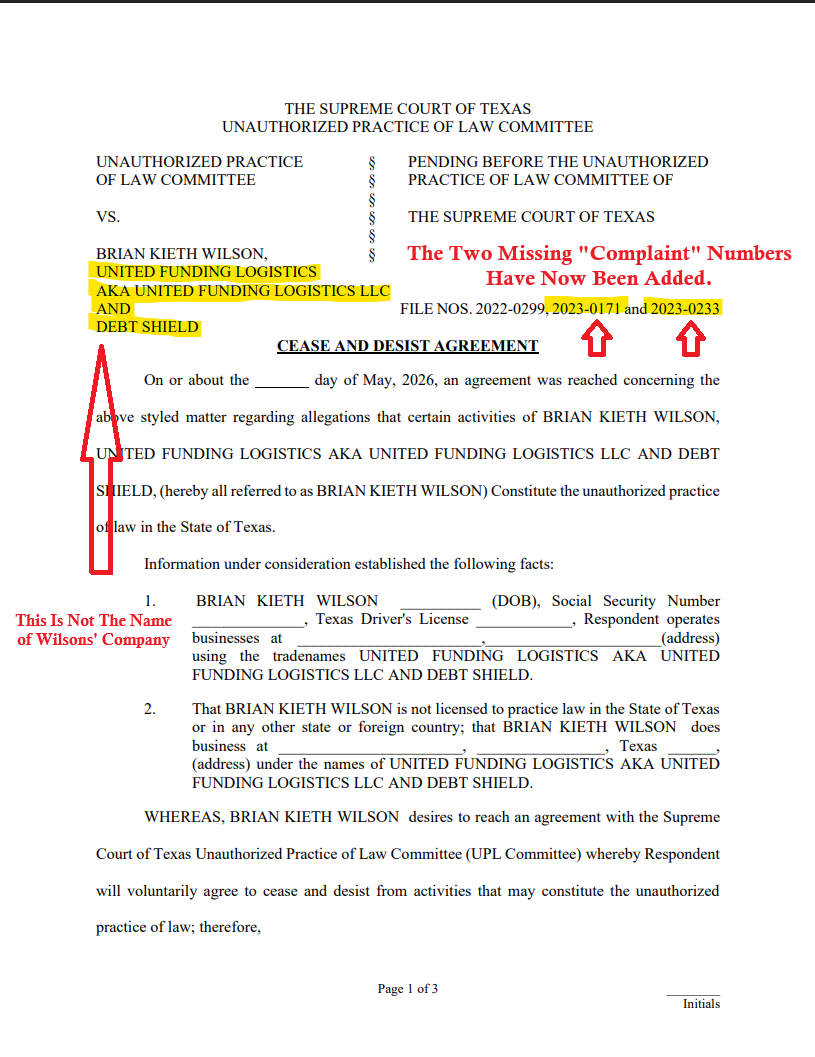
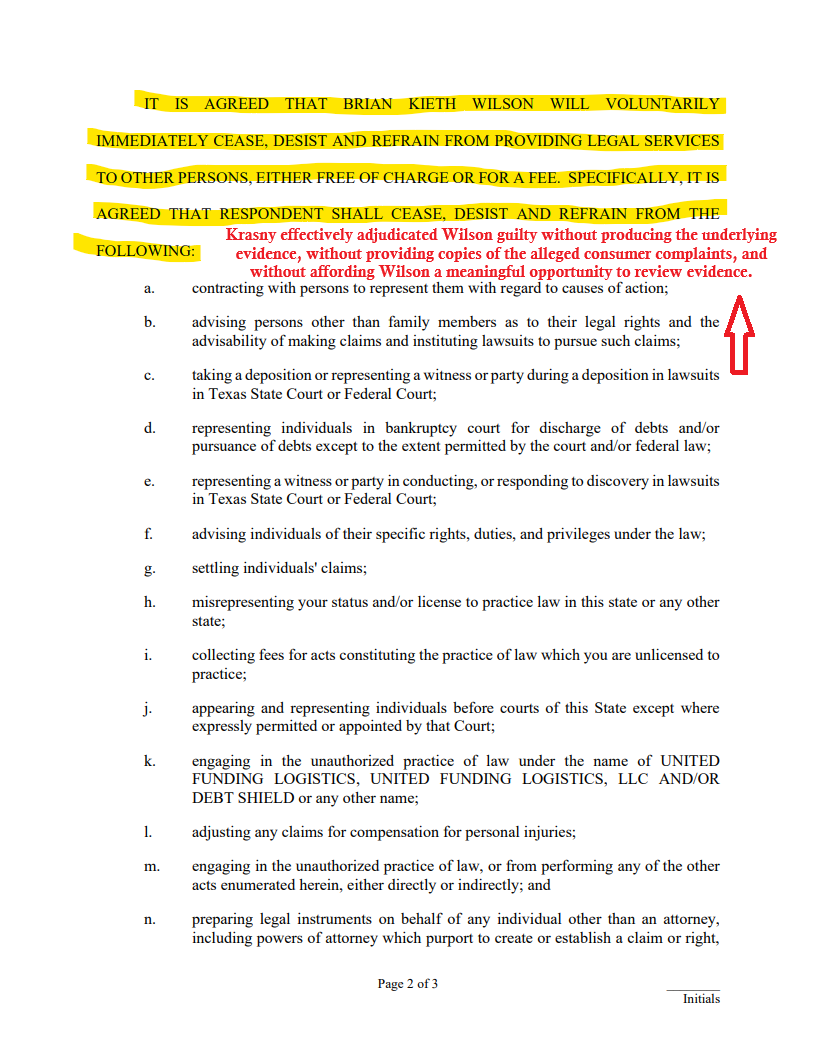
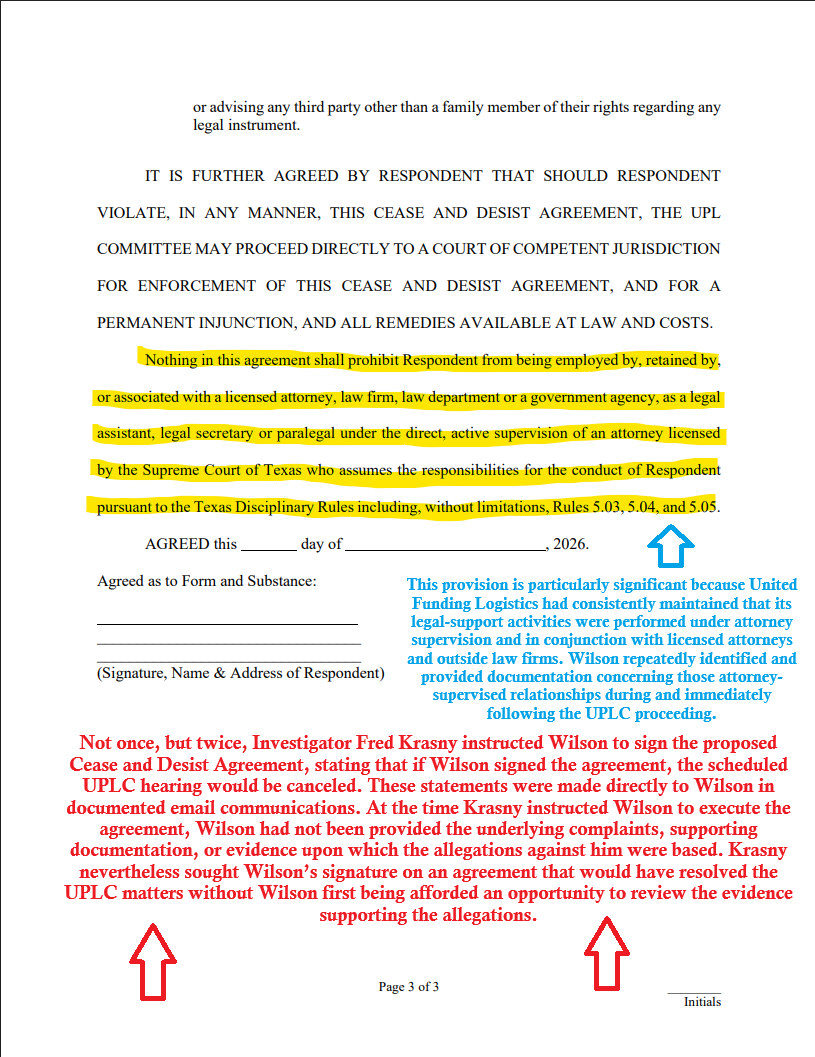
"Lawfare" is this investigation's editorial characterization of the events described in this chapter — legitimate governmental and regulatory processes that, in NFA's editorial view, compounded the reputational damage already inflicted on UFL. Whether those agencies were influenced by incomplete or distorted information is one of the questions the evidence raises. The facts of what happened are documented below; the characterization is editorial.
While Wilson was fighting the BBB and reporting impersonation to law enforcement, the state of Texas was building its own case — against him.
The Unauthorized Practice of Law Committee (UPLC), a state body that investigates non-lawyers practicing law without a license, opened three separate files on United Funding Logistics: File Nos. 2022-0299, 2023-0171, and 2023-0233. Three complaints. Three files. One hearing.
The Initial Notice
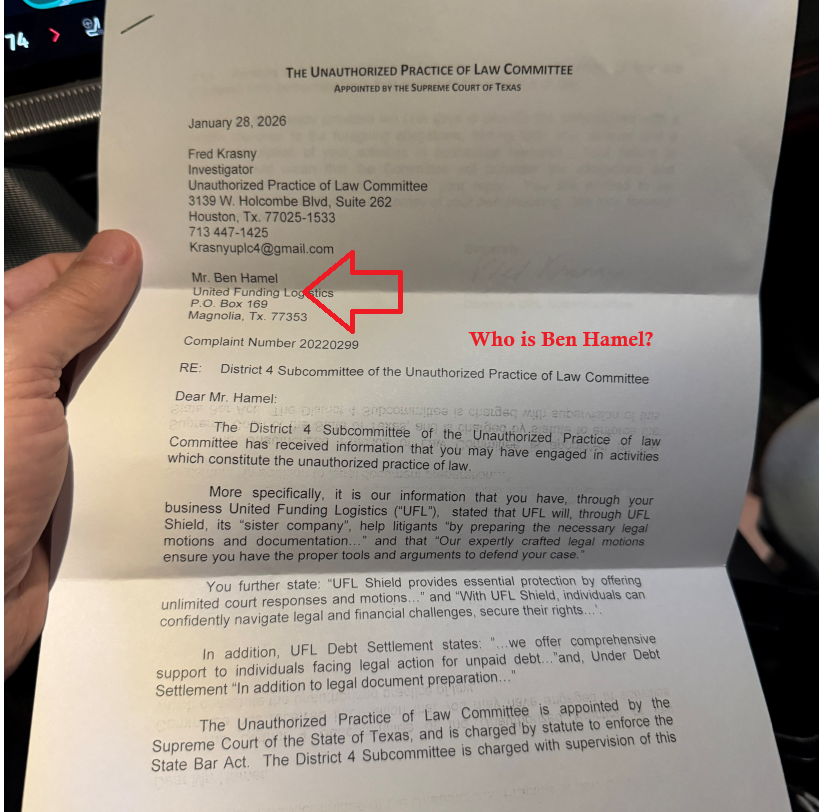
The first notice, dated January 28, 2026, was addressed not to Brian Wilson but to "Mr. Ben Hamel" at United Funding Logistics. The notice quoted marketing language from UFL's website — UFL Shield offering "expertly crafted legal motions," "unlimited court responses and motions," and UFL Debt Settlement offering "comprehensive support to individuals facing legal action for unpaid debt" — as the basis for the unauthorized practice of law allegation.
The marketing language the UPLC quoted is the specific text the state believes crosses the line into legal practice. Wilson's defense, documented in his correspondence, is that UFL operated under attorney supervision — employing licensed Texas attorneys who supervised, consulted, and prepared documents, and maintaining relationships with outside consumer law firms for client representation. The UPLC's own Cease and Desist agreement explicitly permits working as a legal assistant/paralegal under direct attorney supervision, citing Texas Disciplinary Rules 5.03, 5.04, and 5.05.
The UPLC's case rests on specific marketing language used by UFL/UFL Shield. Whether that language was accurate given UFL's documented attorney relationships — or whether it overstated what UFL actually did — is a question that has not been adjudicated. The UPLC hearing was conducted without Wilson's counsel present.
18 Hours to Decide
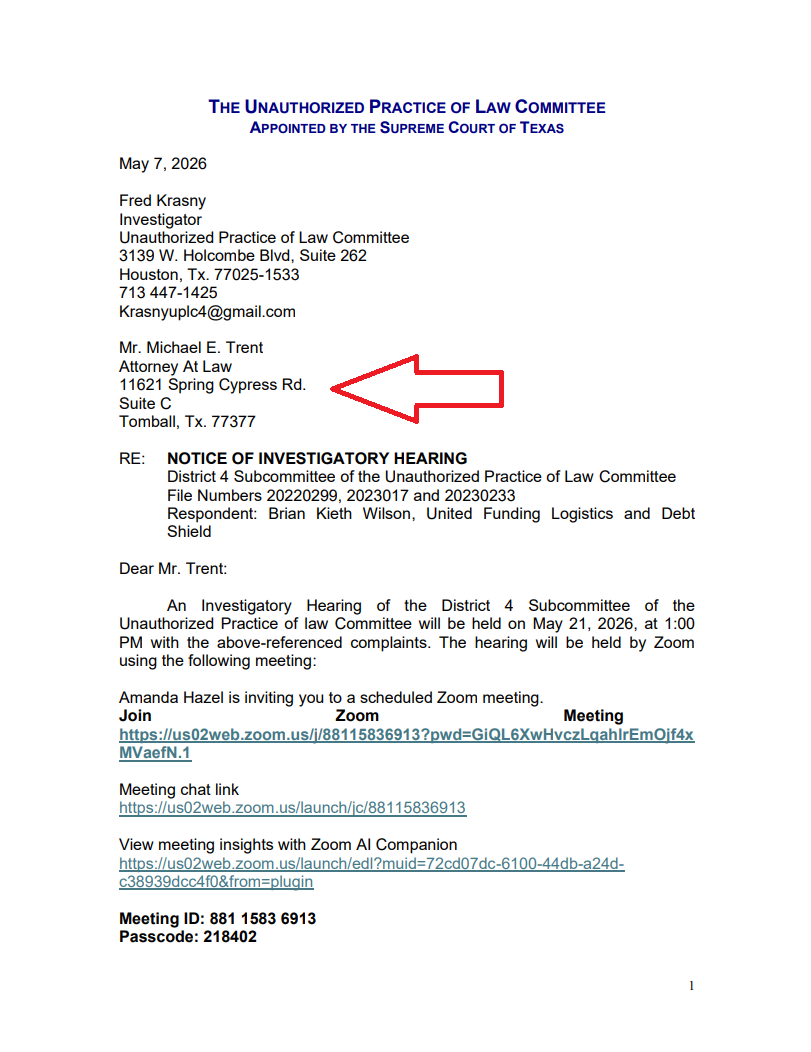
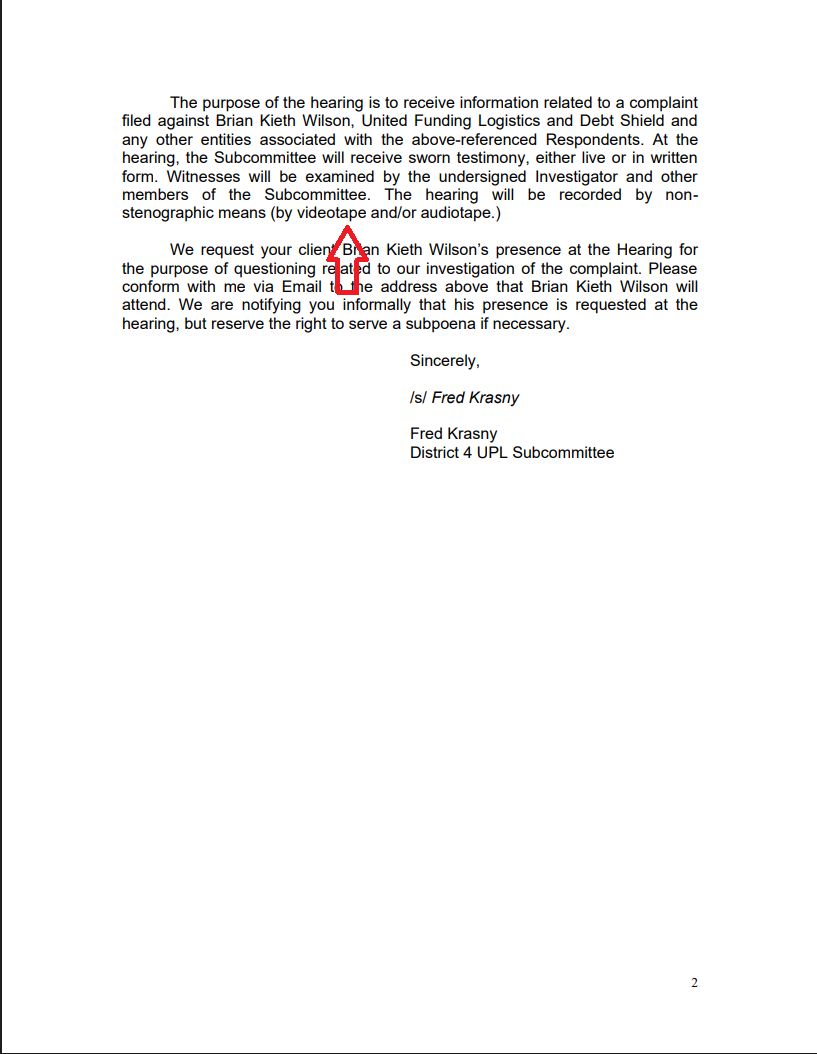
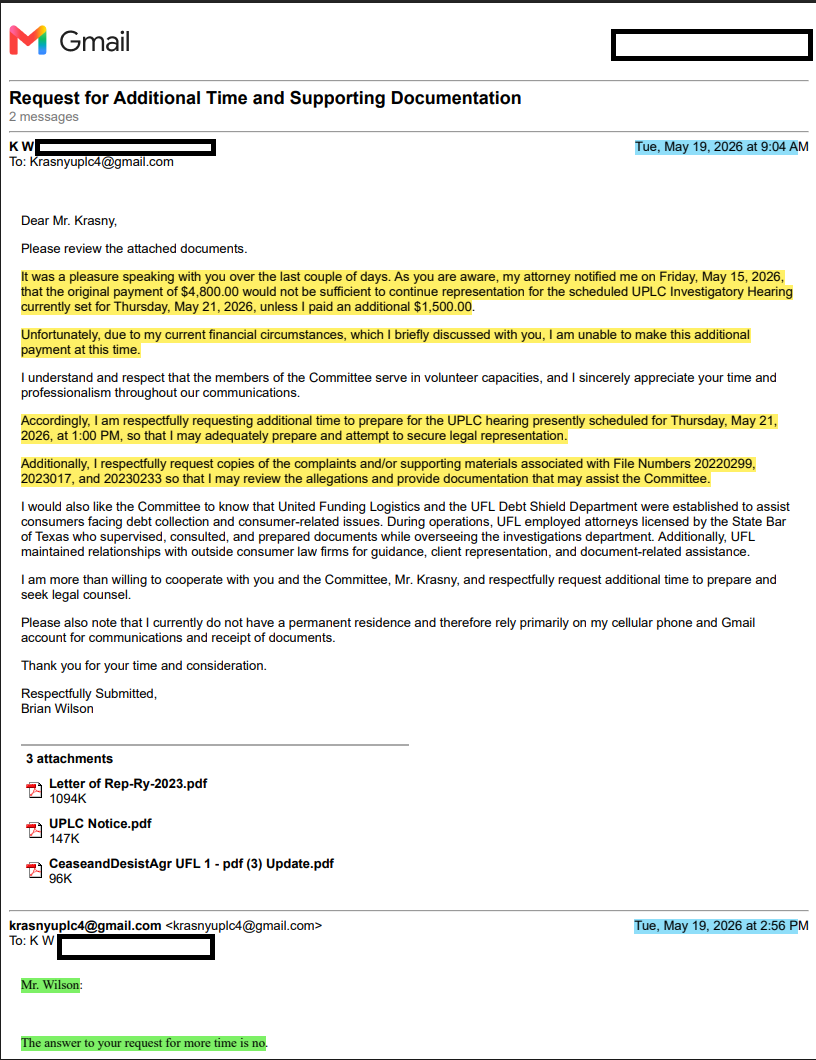
The UPLC scheduled a hearing for May 21, 2026, at 1:00 PM via Zoom. The hearing notice, dated May 7, 2026, was sent to Wilson's then-attorney, Michael E. Trent. It explicitly stated: "The hearing will be recorded by non-stenographic means (by videotape and/or audiotape.)"
On May 18, Wilson emailed investigator Fred Krasny requesting a copy of the Cease and Desist agreement. Krasny sent it and asked Wilson to sign and return it "so I may cancel the Investigatory Hearing." Wilson noticed the C&D only referenced File No. 2022-0299, while the hearing notice referenced three files. He flagged the discrepancy.
Krasny's response, at 4:52 PM on May 18:
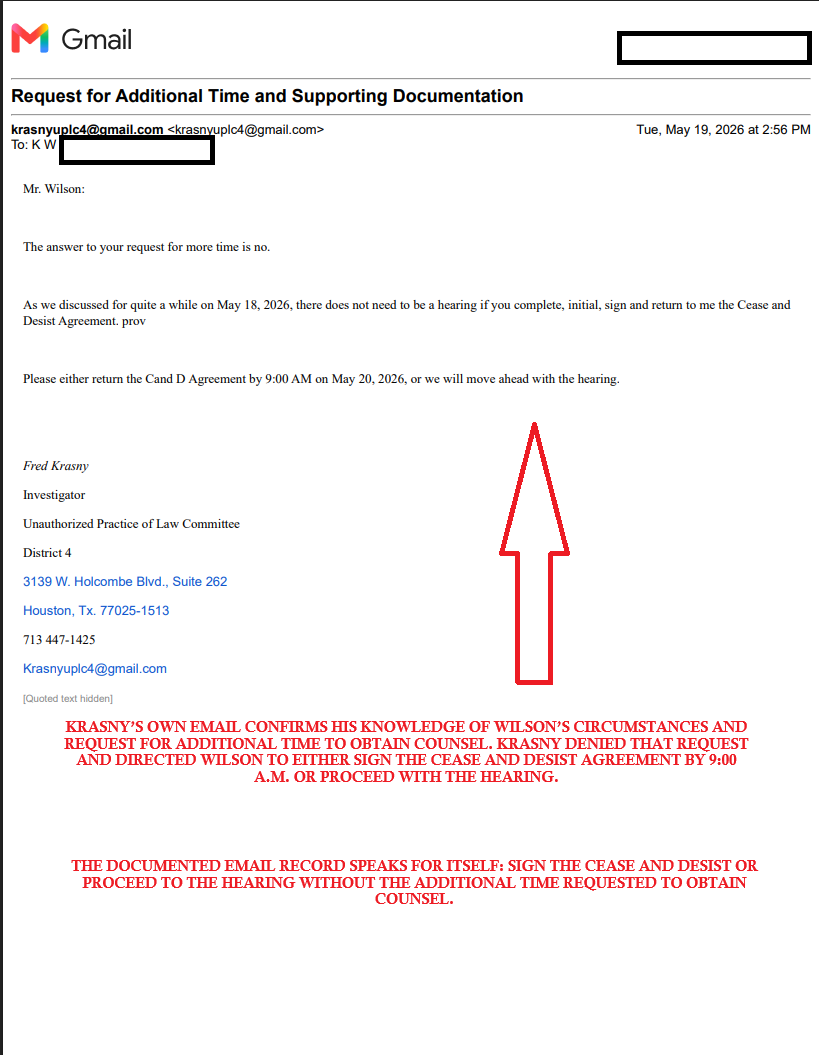
The next day, May 19, Wilson requested additional time to retain counsel. He had already paid his attorney $4,800. The attorney said he would need an additional $1,500 to represent Wilson at the hearing — money Wilson didn't have.
Krasny's response, at 2:56 PM on May 19:
The Hearing — May 21, 2026
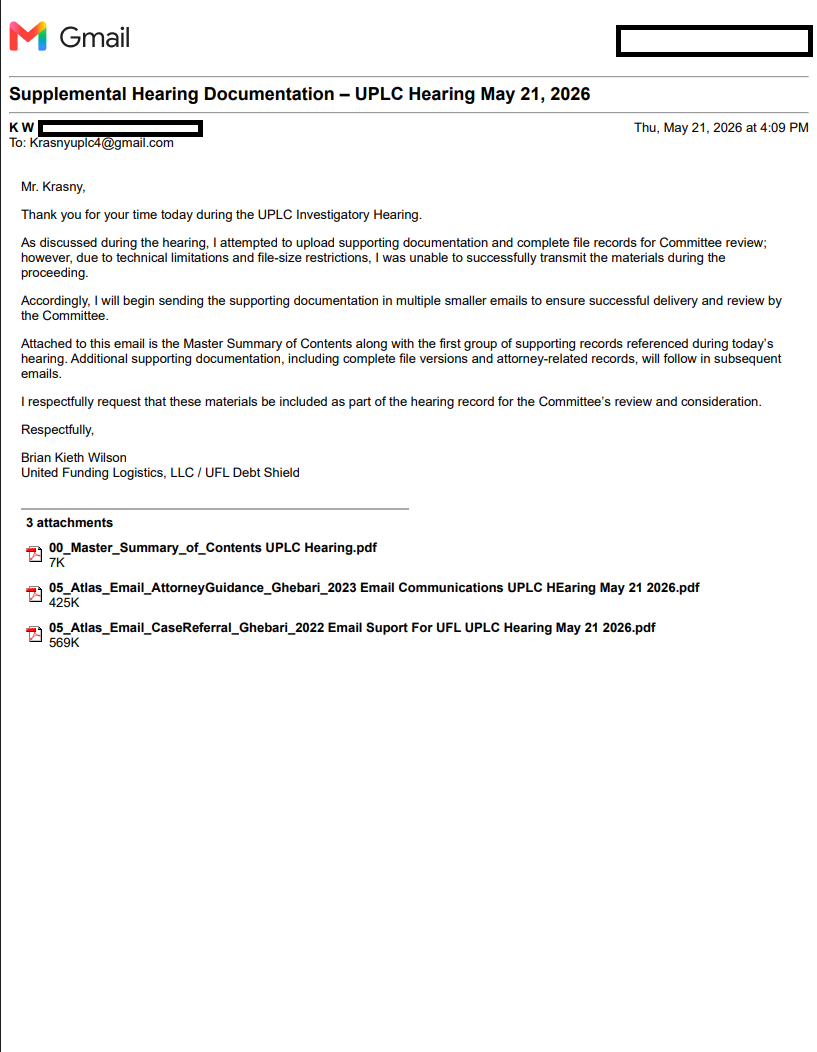
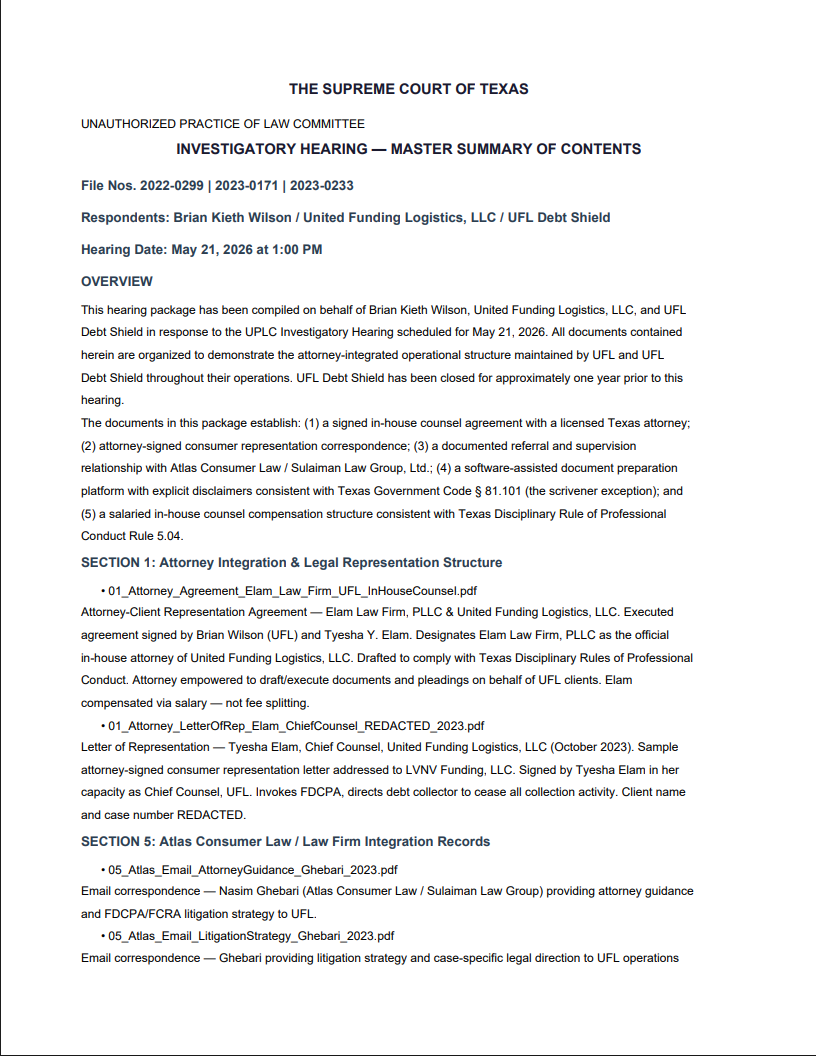
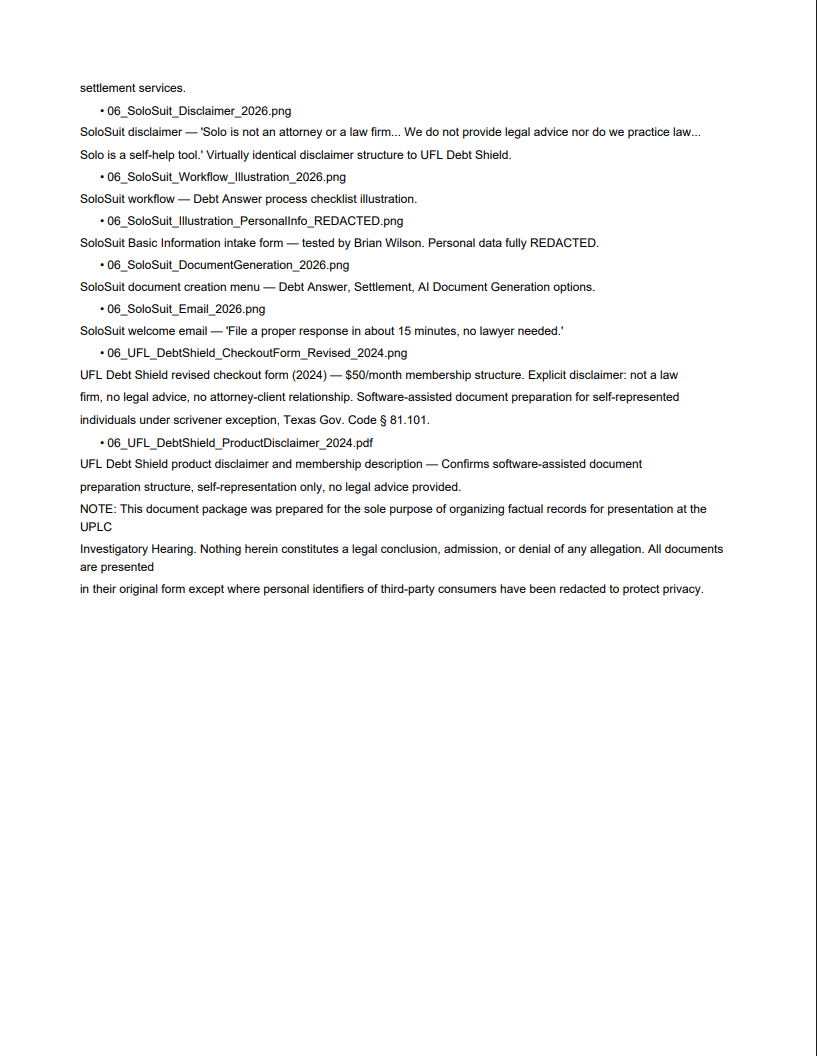
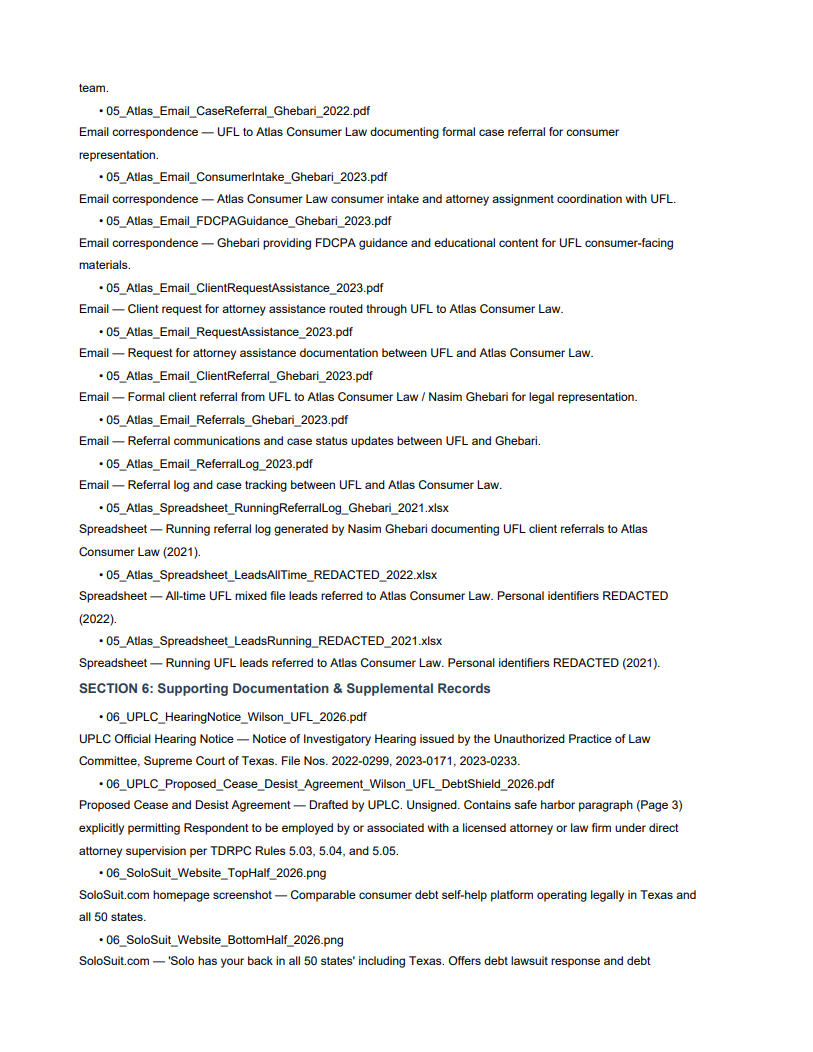
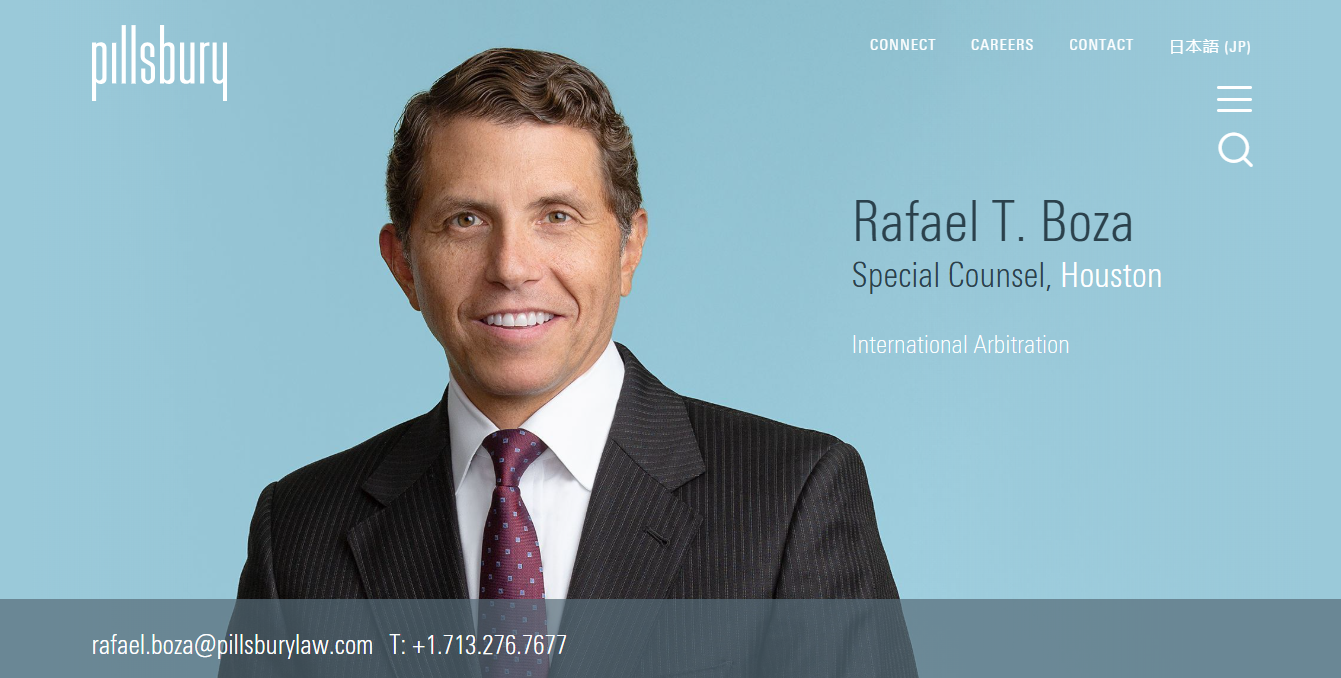
The Questioner Identified. After 90 days of dead ends — during which Wilson was given no names when he asked — No Filter America has identified one of the four attorneys who questioned Wilson at the May 21, 2026 hearing: Rafael T. Boza, Special Counsel, Pillsbury (Houston), International Arbitration (rafael.boza@pillsburylaw.com · 713.276.7677). According to Wilson, four attorneys questioned him during the hearing. During the hearing, Boza told Wilson directly: “We will have a second hearing, so send all of your documentation to Krasny and stay in touch for the next hearing.” His identity was never disclosed to Wilson by the UPLC.
Wilson attended the hearing without counsel. The hearing lasted approximately 80 minutes. During the hearing, the following exchange occurred — documented by Wilson in a contemporaneous statement sent at 6:51 PM that same evening:
Wilson was told he could leave to get a lawyer. When he pointed out he'd already asked for that and been denied, he was told he could leave — but they'd decide without him.
During the hearing, Wilson experienced a technical failure uploading evidence. Over the next 24 hours, he submitted five separate evidence packages — Atlas Consumer Law documentation, a spreadsheet, his contemporaneous statement about the counsel exchange, the Elam Law Firm attorney-client representation agreement, and credit bureau responses — all timestamped between 4:09 PM on May 21 and 5:40 PM on May 22.
82 Days of Silence
On May 22, 2026, at 9:29 AM, Wilson formally requested the hearing recording and transcript. The hearing notice had explicitly promised one. The UPLC's own documentation stated it would exist.
As of August 12, 2026 — 82 days later — Wilson has received no recording. No transcript. No acknowledgment. No substantive response. The record of what happened in that hearing exists, according to the UPLC's own notice, and it has not been produced.
The May 7, 2026 hearing notice stated: "The hearing will be recorded by non-stenographic means (by videotape and/or audiotape.)" Wilson requested the recording on May 22, 2026. As of August 12, 2026 — 82 days later — no recording, transcript, or substantive acknowledgment has been provided.
The Investigator: Fred Krasny — A Family Law Attorney With No Investigations Credentials
The man who denied Wilson's request for time to obtain counsel, conducted the 80-minute hearing without a lawyer present, and sent the corrected Cease and Desist covering all three files was Fred Krasny — identified in UPLC correspondence as the investigator assigned to Wilson's case.
Wilson states he searched extensively for Krasny's professional background. What he found raises a question this investigation is compelled to document.
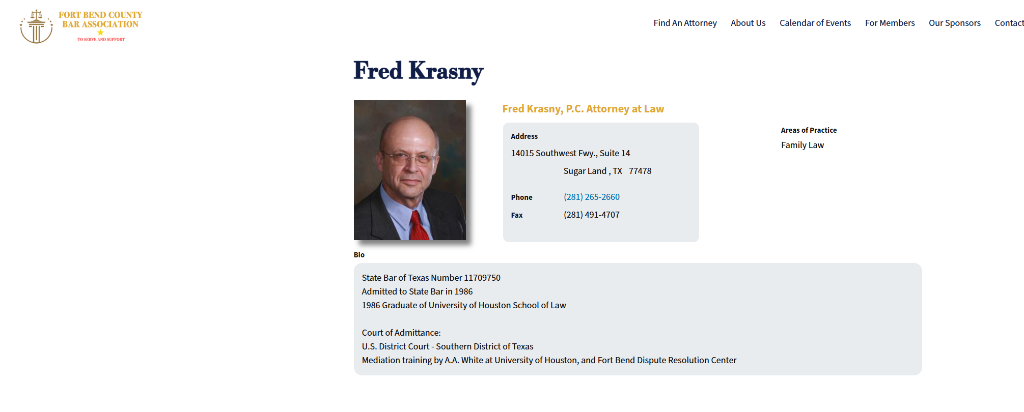
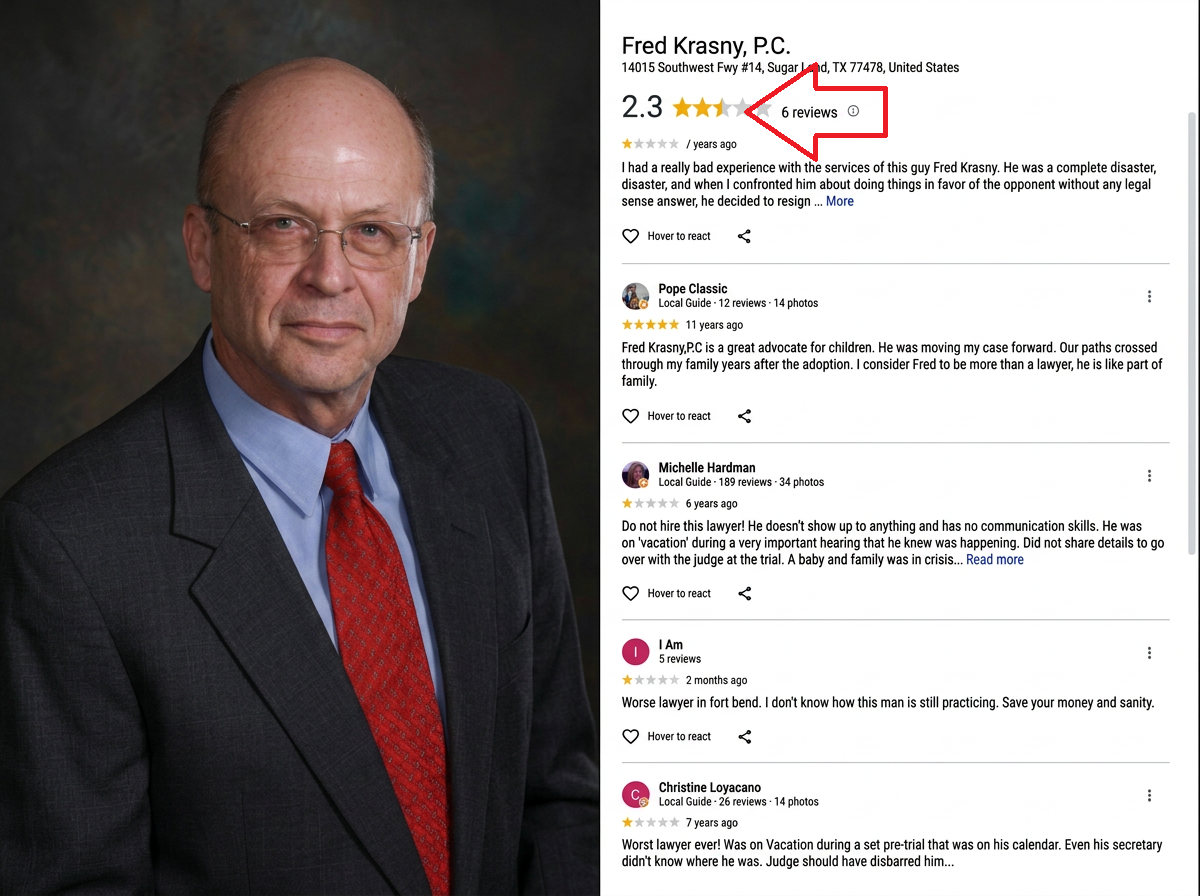
The Fort Bend County Bar Association "Find an Attorney" directory independently confirms Fred Krasny's professional profile, shown in Exhibit N above: admitted to the State Bar of Texas in 1986, University of Houston School of Law graduate. His sole listed area of practice: Family Law. His listed address — 14015 Southwest Fwy, Suite 14, Sugar Land, TX 77478 — and phone number — (281) 265-2660 — match exactly to his Google Business Profile, providing independent third-party confirmation beyond Google alone. His documented professional training consists exclusively of family law and mediation (A.A. White mediation training, Fort Bend Dispute Resolution Center). No investigations credential, UPL enforcement training, or comparable qualification is listed anywhere in his official bar association record.
Google Business Profile: "Temporarily Closed"
Krasny's practice, Fred Krasny, P.C., shows as "Temporarily closed" on Google. His rating: 2.3 stars across 6 Google reviews.
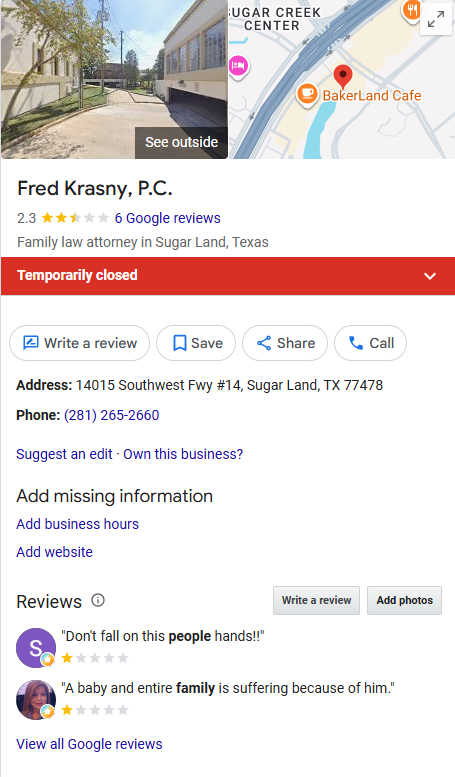
— 1 star (visible in Exhibit O preview)
— 1 star, 7 years ago, "Super Super" (Local Guide, 27 reviews)
— 1 star, 6 years ago, "Michelle Hardman" (Local Guide, 189 reviews)
— 1 star, 2 months ago, "I Am" (5 reviews)
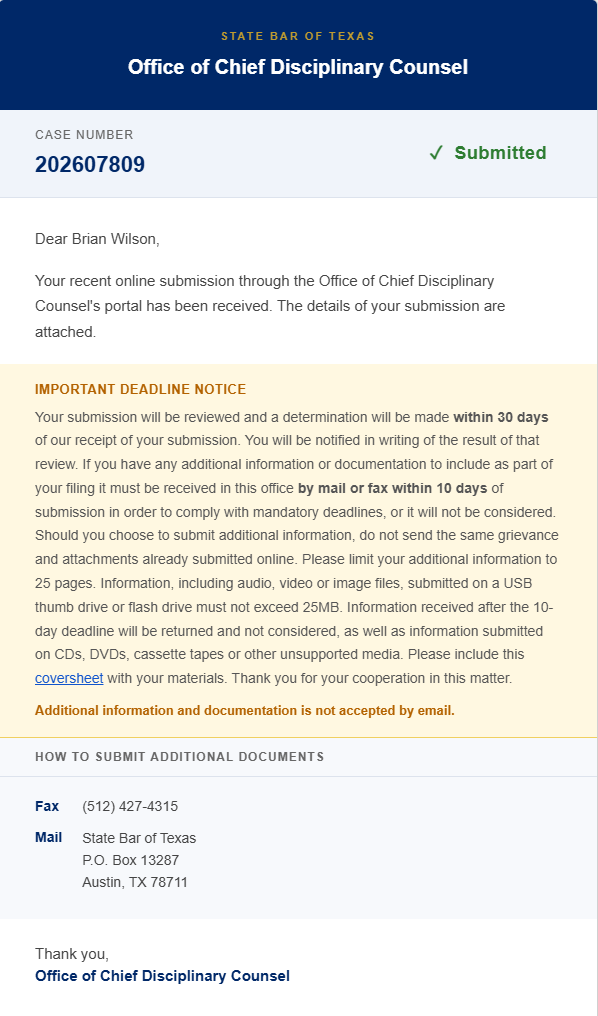
What qualifies a family law attorney — whose own practice shows "Temporarily closed" on Google, with a 2.3-star rating and a majority of visible reviews describing missed hearings, lack of case knowledge, and general unfitness — to serve as the investigator who denies a respondent's request for time to obtain counsel, and then conducts an 80-minute hearing without one? His official bar association record lists no investigations credential of any kind. His documented training is exclusively family law and mediation. This is a documented question, not a proven conclusion of wrongdoing. It is raised because the evidence compels it: the person who exercised authority over Wilson's right to counsel has no documented qualification for the role he was performing, and his own professional record is, at minimum, deeply troubled.
The Lawsuit — A Fraud Victim Named as Defendant
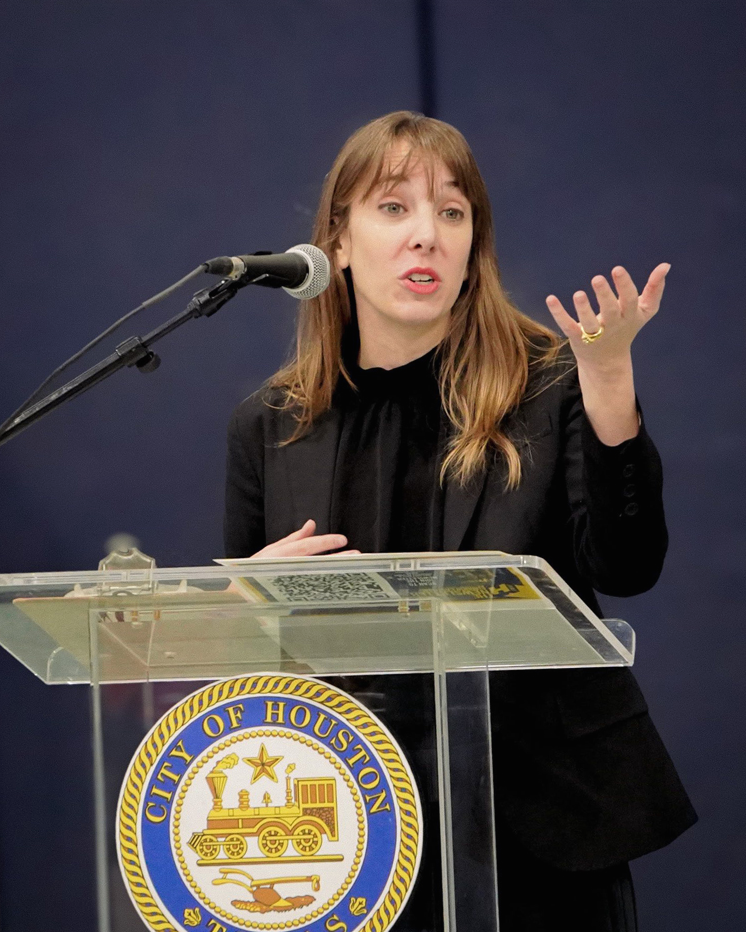
On July 10, 2026, the Harris County Attorney's Office filed a civil enforcement petition. Among the defendants was "Credit Beast LLC" — the same entity Wilson had reported to the FBI as a fraud victim in May 2023.
This is not a minor detail. Wilson's FBI IC3 complaint was filed on behalf of a business being victimized by impersonation. He documented 50+ victims within two days. He named the impersonating entity. He provided his database of 36,000 client transactions as context for the scale of the operation. And then the state of Texas named that same entity as a defendant in a fraud case.
Wilson's FBI IC3 complaint (filed May 2023) documented that a company was "representing themselves as my company" and billing his clients. The Harris County Attorney's civil enforcement petition (filed July 2026) named "Credit Beast LLC" as a co-defendant. MyCreditBeast.com — the entity charging Wilson's debit card — operated from Alabama, not Houston. The geographic and organizational separation is documented by the Bank of America fraud alert showing the merchant code "AL."
The BBB's F rating and "Pattern of Complaints" alert later became relevant to the Harris County Attorney's investigation. What remains disputed is how much weight investigators placed on BBB complaints and reviews, whether those records included people affected by impersonation, and whether the review population accurately represented UFL's actual customer base. Wilson contends that complaints from impersonation victims — people he maintains were never his clients — were among those the BBB published as "Verified," and that those complaints became part of the record associated with his business.
Before any trial. Before any verdict. Before any hearing where Wilson could present his evidence.
The Rebuttal — "Never Employed a Legal Team"
The HCAO petition alleges, in ¶37, that "Defendants never could provide consumers with the promised legal services because they never employed a 'legal team' or 'in-house counsel.'" It further alleges, "upon reason and belief, Wilson or other Defendants forged signatures of attorneys on documents."
"Defendants' egregious conduct is further exemplified by the following. Faced with an overwhelming number of complaints and negative reviews with the Better Business Bureau and online review sites, Defendants further misled and threatened customers. The purpose was to manipulate them into submitting online reviews, or remove negative reviews, of Defendants. One or more Defendants solicited fake positive reviews from their employees."
The HCAO's footnote 3 claims employees were solicited to write fake positive reviews. This specific claim does not appear in the BBB's own "Pattern of Complaints" alert. The BBB's alert stated that the business conditioned FCRA settlement payments on 5-star reviews — a different and narrower claim. The County Attorney's version adds "employees solicited fake positive reviews" with no citation in the footnote. Every piece of evidence in this investigation shows the review-manipulation problem running in the opposite direction: fake negative reviews auto-verified by BBB (Exhibits B, C), real positive reviews blocked by BBB (Exhibit E). No document in this evidence file supports the claim that UFL employees wrote fake positive reviews.
The petition states "upon reason and belief" that Wilson or other Defendants forged attorney signatures. This is an inference — not a specifically cited forged document. No specific forged document or attorney identity has been shown in the materials provided to NFA. Wilson disputes this allegation and states he wants to formally respond to it. This investigation presents the documented evidence below.
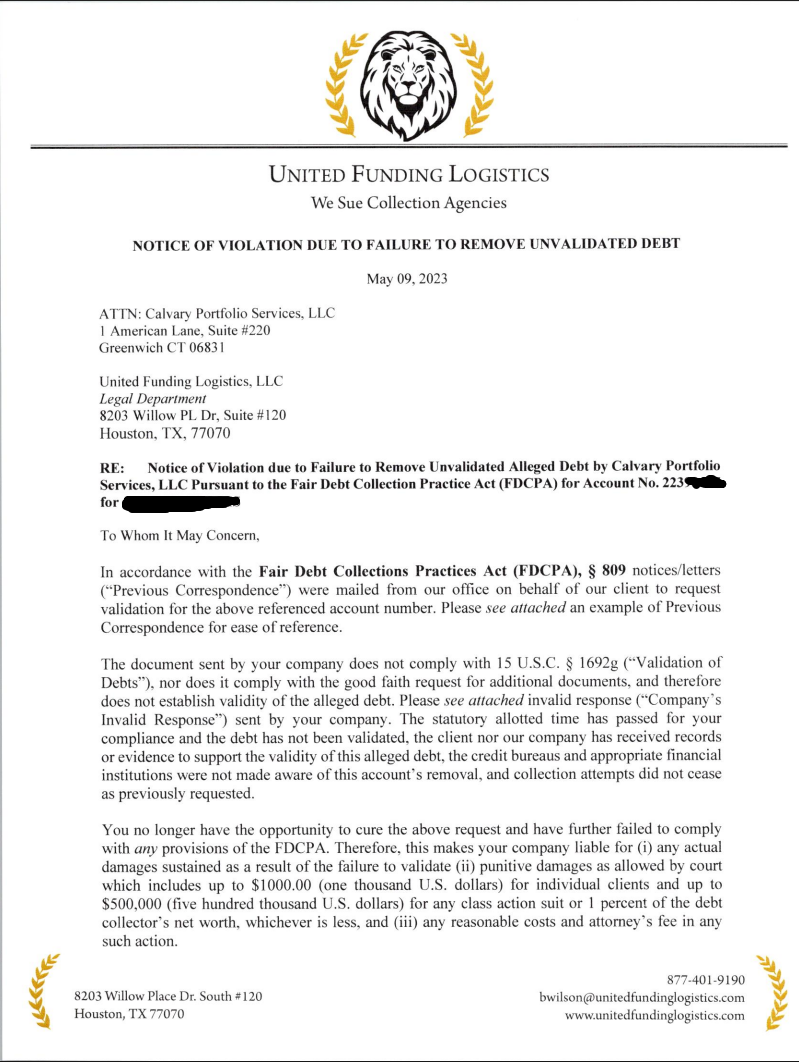
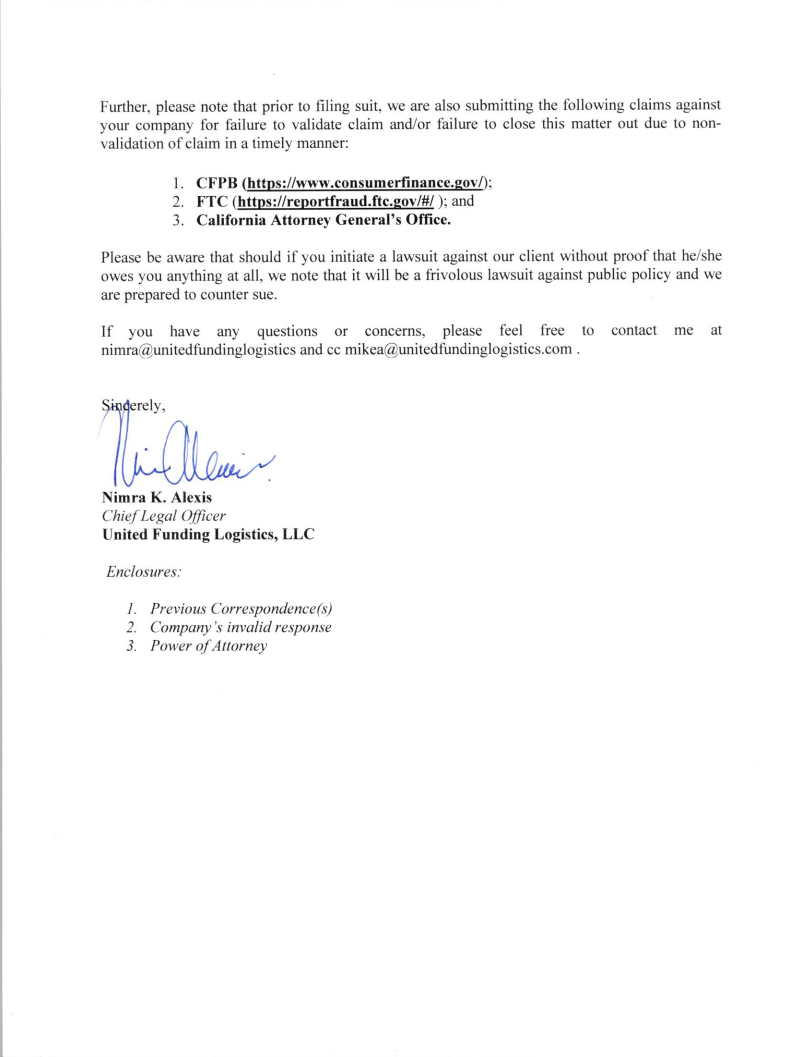
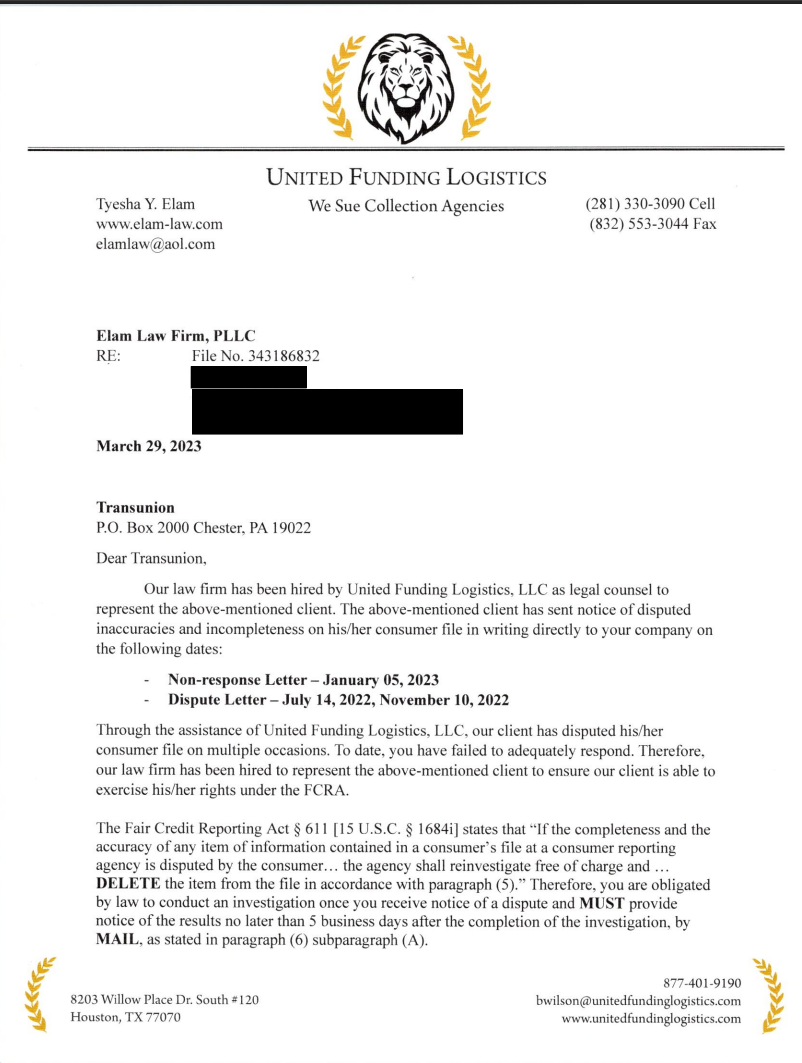
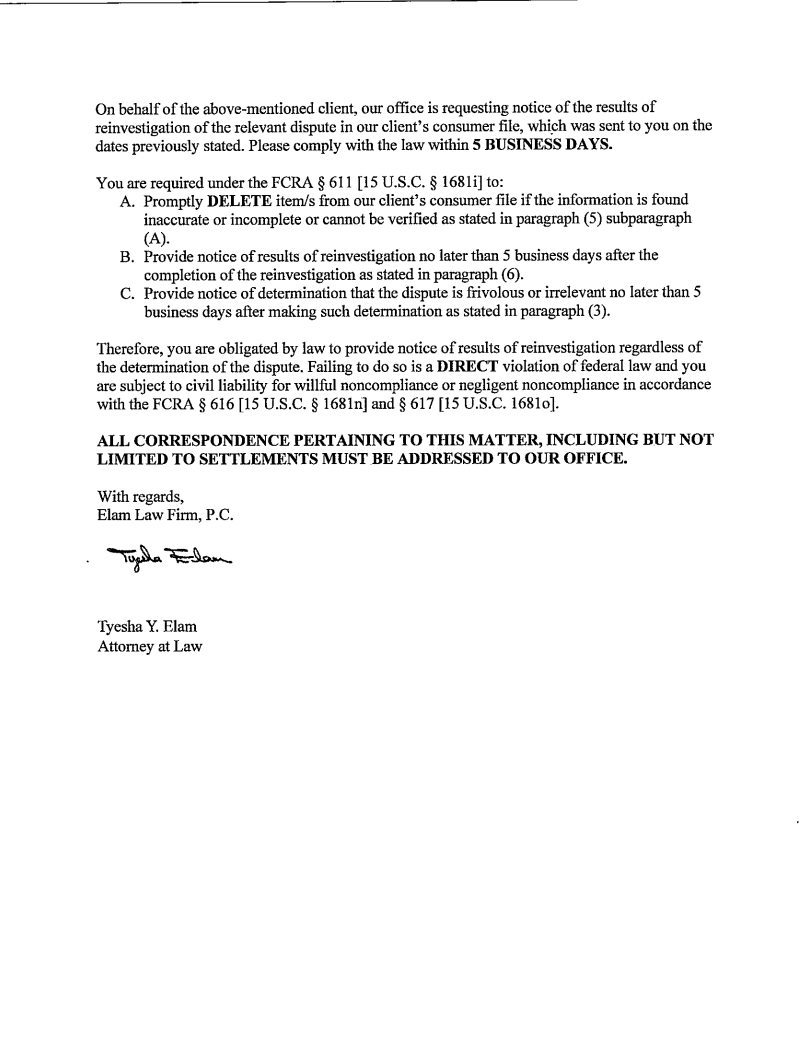
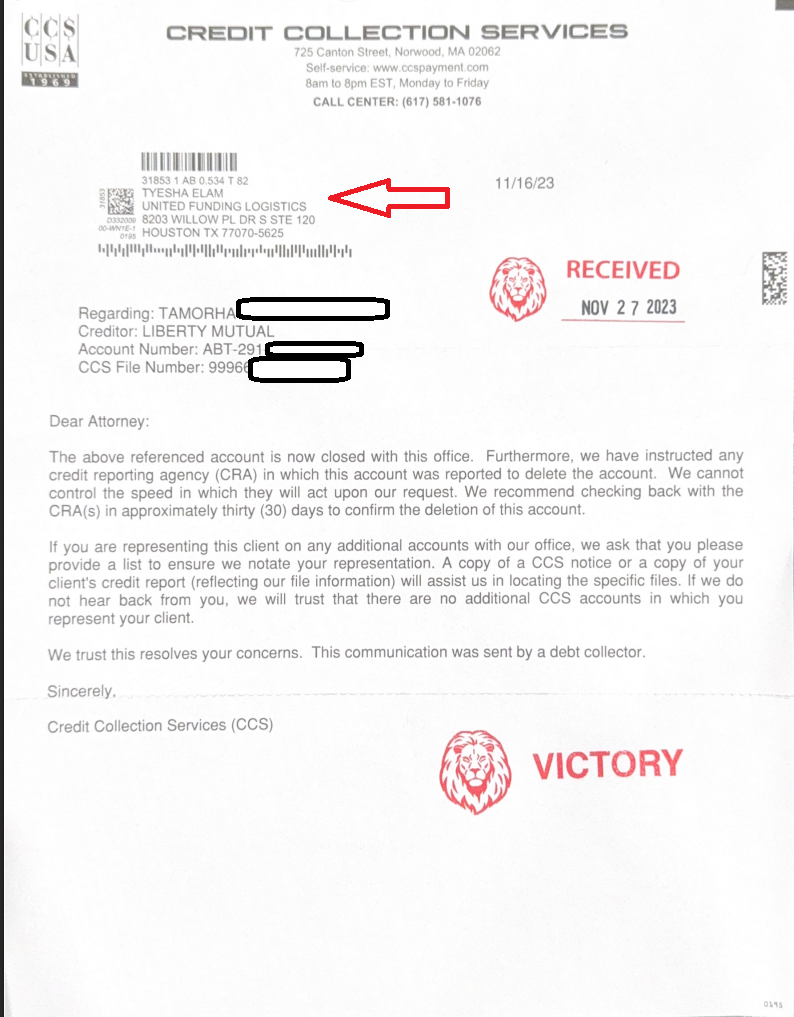
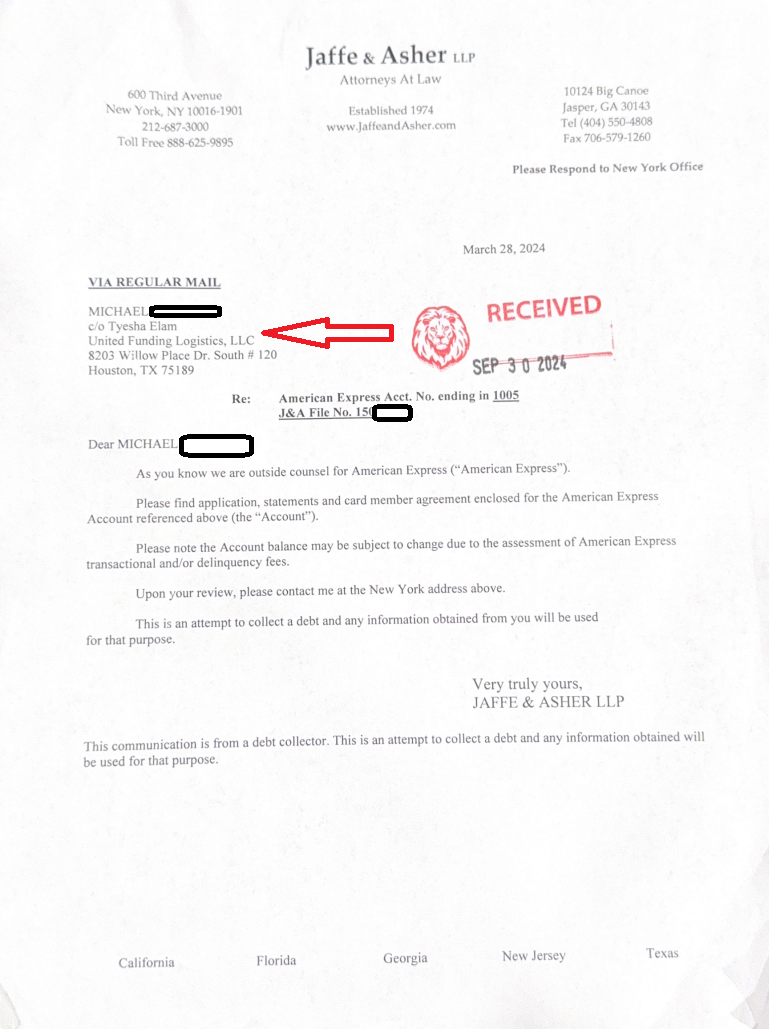
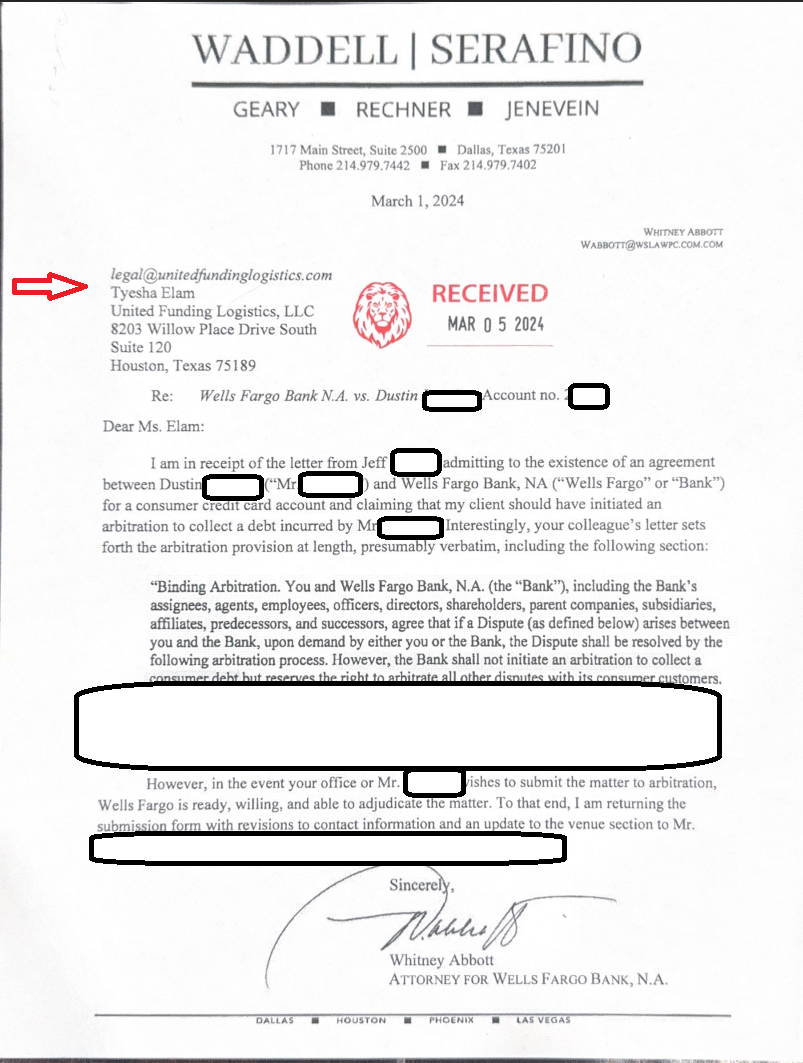
The above letters — on UFL letterhead and through outside counsel — directly rebut the allegation that Wilson "never employed a legal team or in-house counsel."
Law Firm #1: Atlas Consumer Law — December 2021 Through May 2025
Atlas Consumer Law is a division of Sulaiman Law Group, Ltd. — a real, independently identifiable consumer protection law firm at 2500 Highland Avenue, Suite 200, Lombard, IL 60148, specializing in FCRA/FDCPA litigation. Primary contact: Nasim Ghebari, Director, Investigation Division. This relationship is documented from December 2021 through May 2025 — over three years, predating the BBB dispute, the HCAO lawsuit, and every allegation in this case.
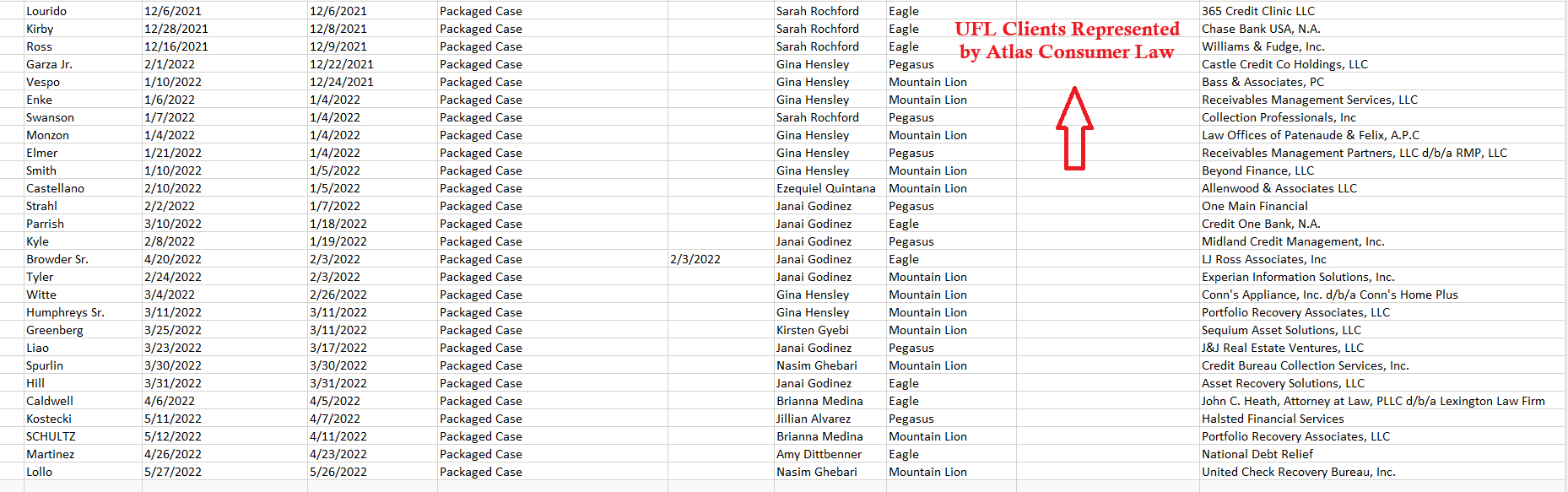
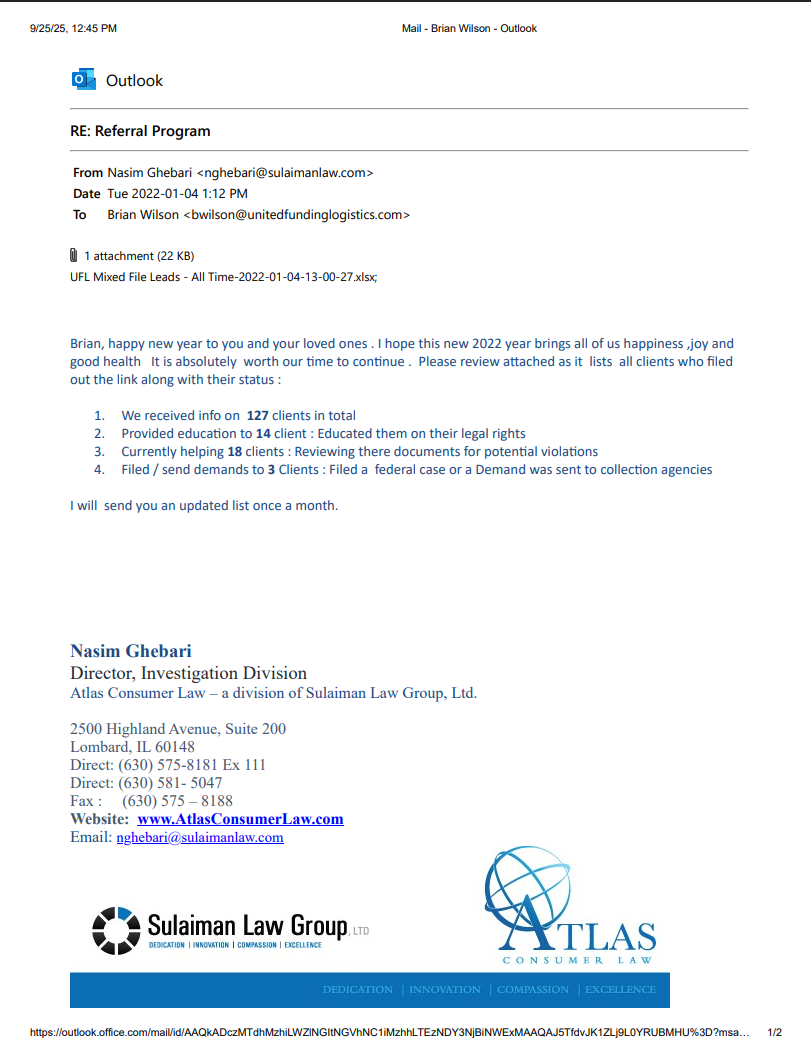
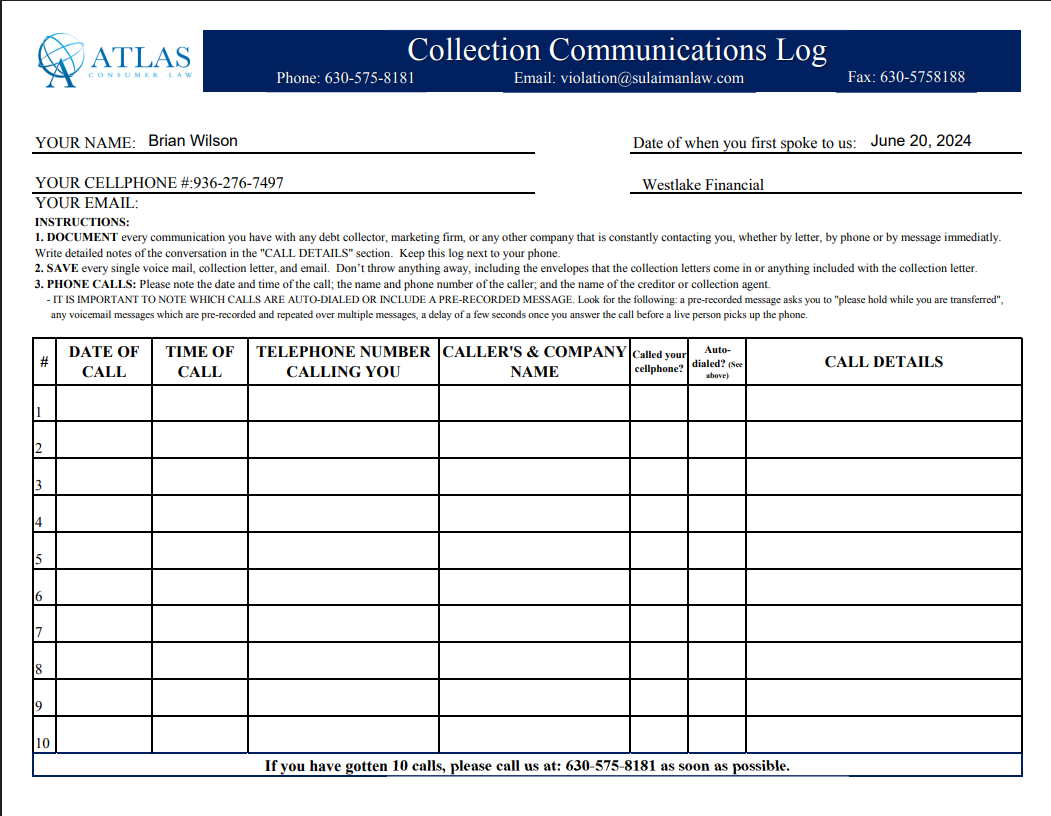
The above records — an attorney's email, client education sheets, FDCPA violation guides, and a completed call log — document a multi-year attorney referral relationship, not the absence of one.
The two emails below are the opening exchange of 2022 — Wilson asking whether the referral program is "worth your time to continue," and Nasim Ghebari's reply attaching the full client-status ledger. Read together, they establish three facts: (1) Wilson initiated and maintained the attorney relationship; (2) Atlas was actively processing real UFL client files; and (3) by January 4, 2022, Atlas had already filed federal cases or sent demands on behalf of UFL clients.
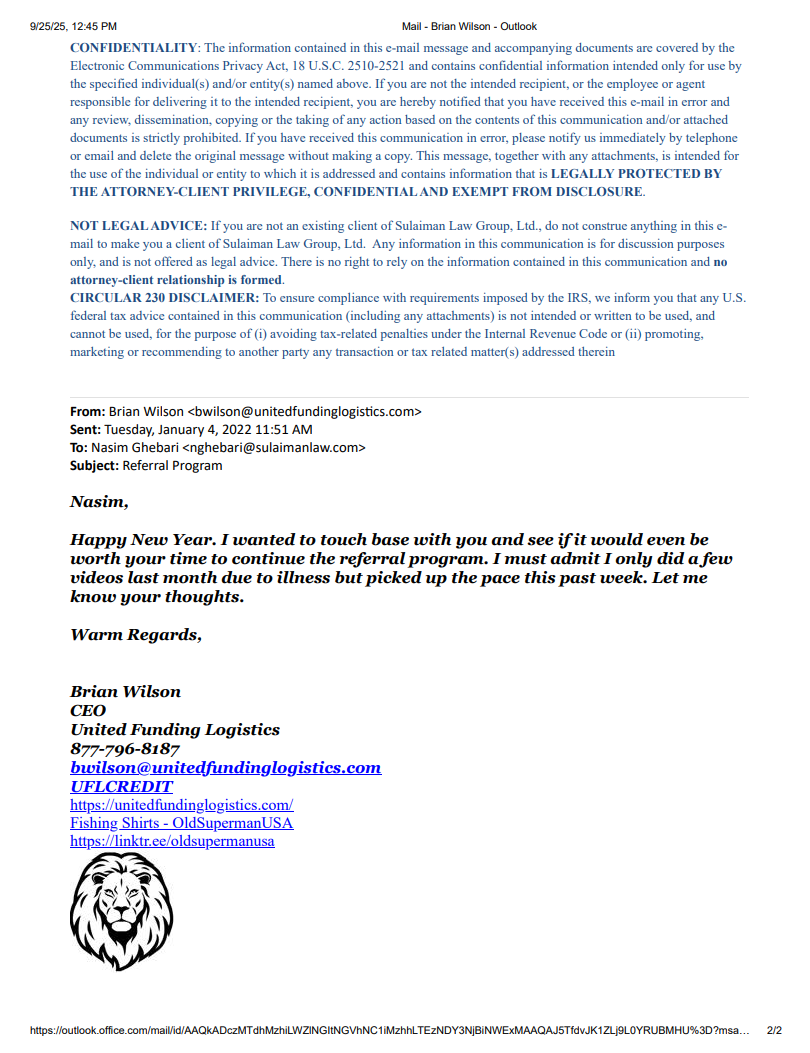
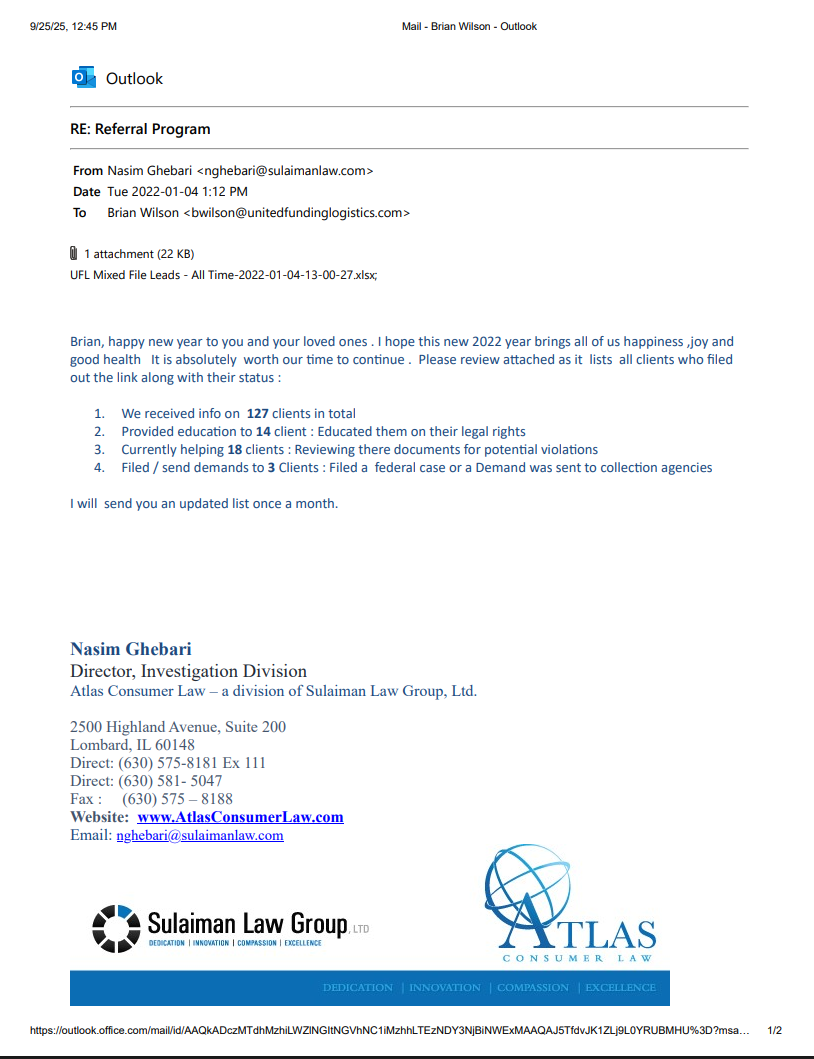
By January 4, 2022, Atlas Consumer Law had already filed federal cases or sent demands on behalf of 3 UFL clients — with 18 more under active document review. This predates the HCAO civil enforcement petition (July 2026) by more than four years and the UPLC hearing (May 2026) by over four years. HCAO ¶49 asserts Wilson "never arranged for any lawsuits to be filed on their customers' behalf." The attorney's own January 2022 ledger — sent directly to Wilson — contradicts that claim on its face.
Wilson referred real clients to Atlas Consumer Law. One documented case: Kristine Heald v. KeyBank National Association, Case No. 32D05-2212-CC-001574, Hendricks Superior Court 5 (Indiana), filed December 7, 2022. This is a real, publicly searchable court case — any reader can verify it at public.courts.in.gov. The case involved a collection suit by Weltman, Weinberg, Reis Co. for $8,609.74. During the case, UFL's own staff flagged that the court filing exposed Heald's unredacted Social Security Number in a public court record — a genuine privacy risk that Atlas Consumer Law addressed.
Additional documented Atlas Consumer Law clients include Mitchell Lourindo (retained December 2021) and Nathan Campbell (collection letter review, August 2022). Wilson's staff included Stephan Mandziuk (stephan@unitedfundinglogistics.com) who coordinated case referrals directly with the firm. Ghebari provided Wilson with substantive legal research on FCRA/FDCPA violations, state debt-collector licensing requirements, and litigation strategy — not generic marketing boilerplate.
Law Firm #2: Halvorsen & Klote — January Through July 2024
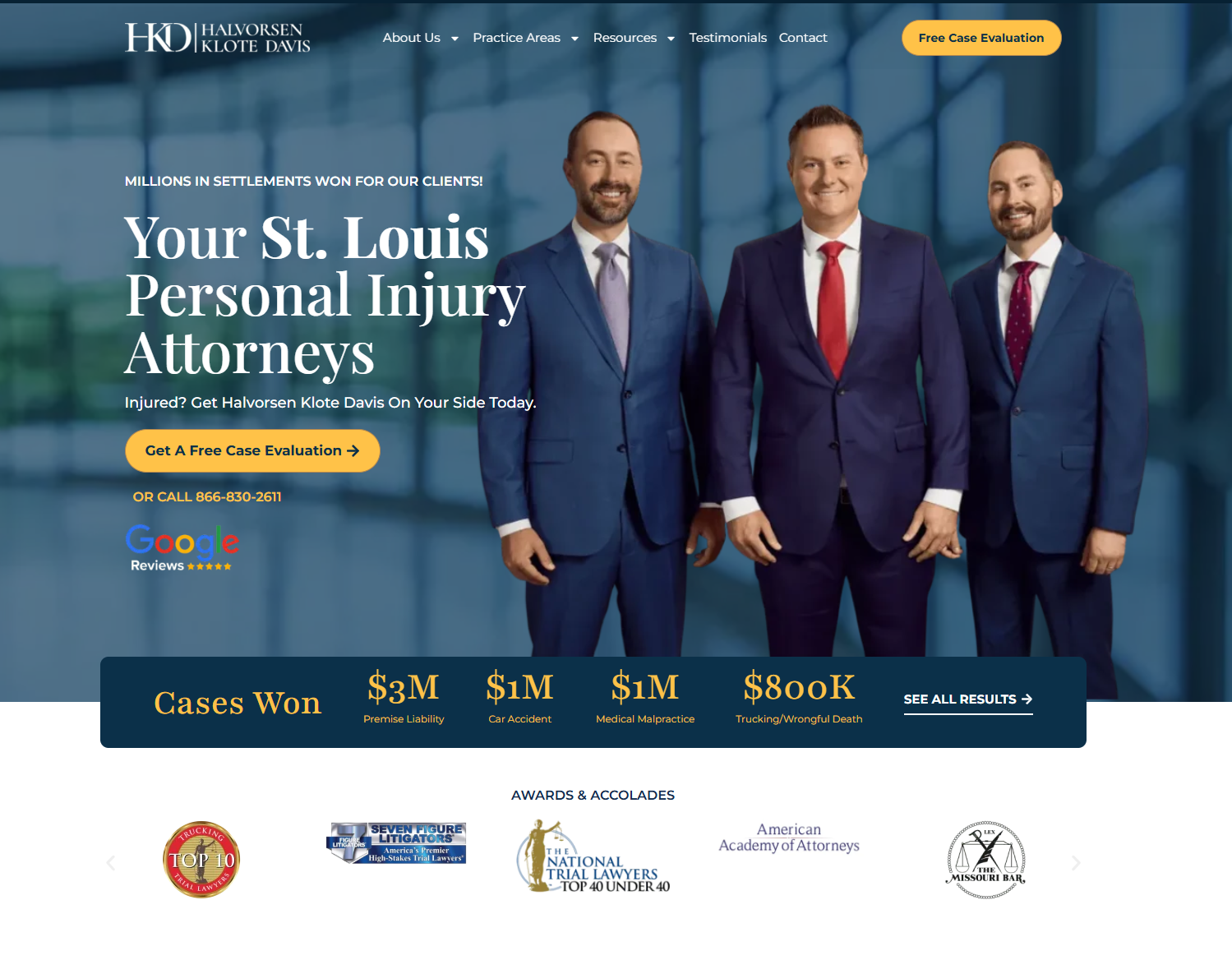


Halvorsen & Klote, 680 Craig Road, Suite 104, St. Louis, MO 63148 — a second, independently identifiable law firm. Wilson shipped case materials via FedEx (Tracking No. 775791177266, April 2, 2024). Named firm staff: Joel Halvorsen (Partner), Delaney Miller (Paralegal), Sarah O'Leary, Greg Klote, Shaina Jackson.
A documented client case: Chad Grant v. Portfolio Recovery Associates & CKS Prime Investments — including Equifax, Experian, and TransUnion. On June 27, 2024, the firm's paralegal wrote: "We have found a violation for your client, Chad Grant." On July 30, 2024, Halvorsen wrote to Wilson: "Brian we never heard from this client and it's been almost a month. We'd really like to get started helping your clients and now that we are finding violations it's time to crank it into gear."
The firm established a structured intake process on January 29, 2024: required documents (dispute letters, credit reports, envelope copies), a standardized case template (Name, DOB, SSN, Defendant(s), Violation, Date, broken down by credit bureau with specific account numbers), and a Dropbox file-sharing system. Named UFL staff involved: Nathan Jones (nathan@unitedfundinglogistics.com).
Two separate, real, independently identifiable law firms — Atlas Consumer Law (Sulaiman Law Group, IL) and Halvorsen & Klote (MO) — are documented through email correspondence, FedEx records, named staff, named clients, and at least one independently verifiable court case. The combined documentation spans December 2021 through May 2025. This directly rebuts the HCAO's claim that Defendants "never employed a 'legal team.'" However, these are outside referral relationships — legally distinct from "in-house counsel." Wilson states he also had in-house counsel (see below).
"In-House Counsel" — Wilson's Account
Wilson states that consumer attorneys contacted him after seeing his videos about credit bureaus and collection agencies stonewalling consumers. He states he personally funded this legal-referral effort out of his own pocket.
"NOWHERE DOES IT SAY WE DO CONSUMER LITIGATION, CONSUMER ATTORNIES CONTACTED ME WHEN THEY SAW MY VIDEOS ABOUT THE THREE BUREAUS AND COLLECTION AGENCIES STONEWALLING US. I DID THIS OUT OF MY OWN POCKET, I LOST OVER 1.4 MILLION DOLLARS FOR THAT DEPARTMENT, IT RUINED ME."
The $1.4 million figure is Wilson's own stated estimate. NFA has not independently verified this amount. It is presented here as Wilson's claim, not as a documented fact. Wilson also states he had in-house counsel — Tyesha Elam and another individual — but documentation for the in-house counsel arrangement has not yet been supplied to NFA. This is an open evidentiary item.
The Actual Contract — What Clients Actually Signed
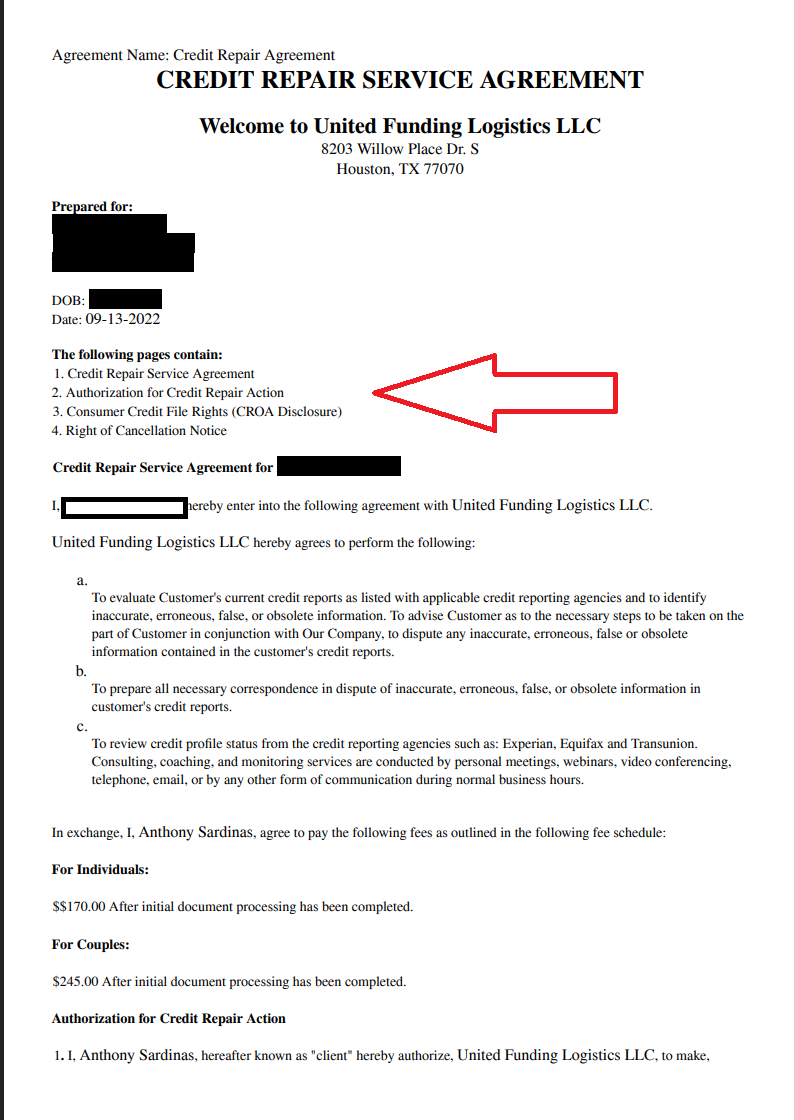
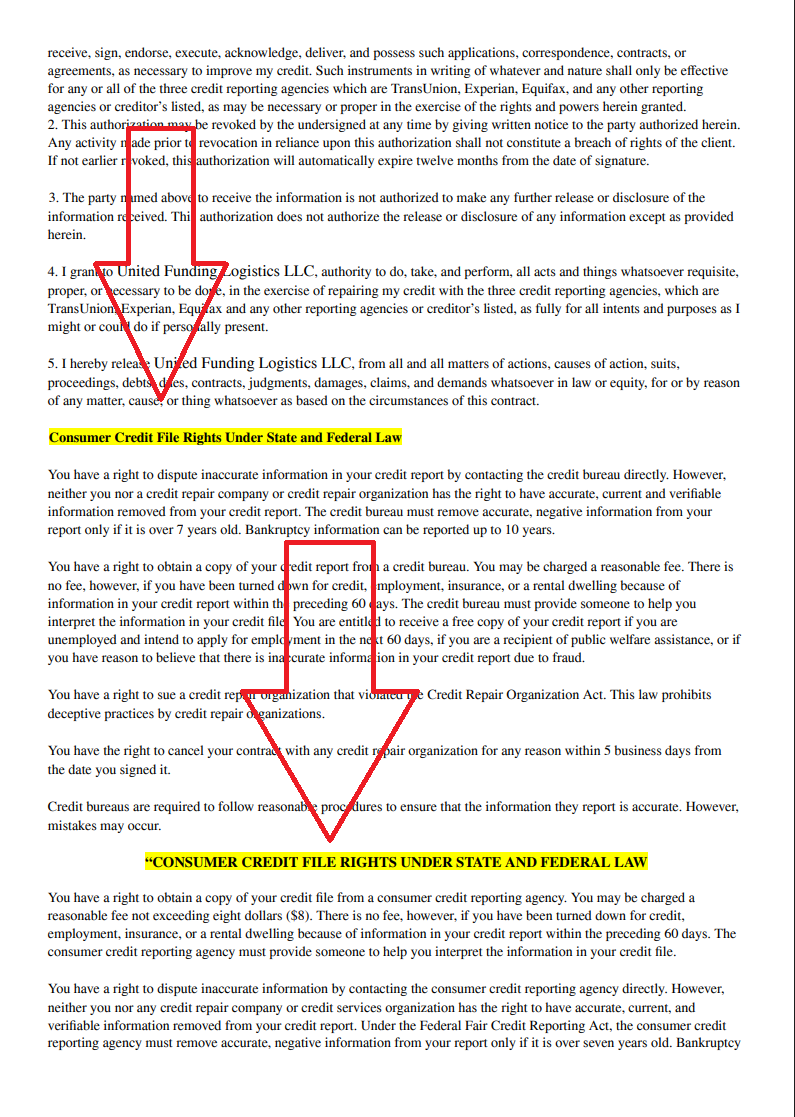
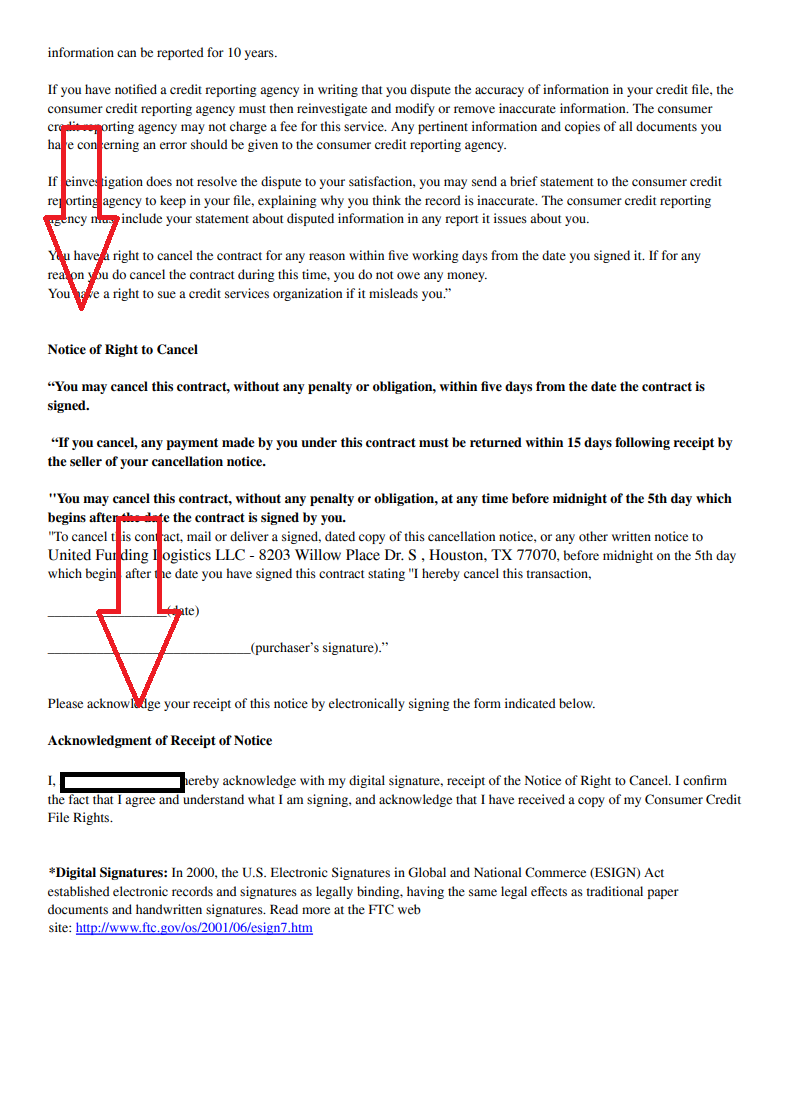
The most direct rebuttal to the claim that clients were promised legal services they never received is the contract itself. NFA has reviewed a signed UFL "Credit Repair Service Agreement," dated September 2022. Client identifying information has been redacted per editorial standards.
The signed UFL contract specifies the following scope of services: (1) evaluate credit reports and identify inaccurate/erroneous information, (2) advise on necessary steps and prepare dispute correspondence, (3) review credit profile with Experian, Equifax, and TransUnion, (4) consulting/coaching/monitoring via meetings, webinars, phone, or email. Fee: $170 (individuals) / $245 (couples). Standard CROA disclosures included: right to dispute directly with bureaus, right to cancel within 5 business days for a full refund. Nowhere in this contract does it promise, describe, or reference consumer litigation, lawsuit filing, or in-house legal counsel as part of the service. The scope is limited strictly to credit report evaluation and dispute correspondence.
The contract is what clients actually agreed to and paid for. The attorney referrals — Atlas Consumer Law, Halvorsen & Klote — were something separate Wilson built on top of the base service, funded himself, when real consumer attorneys reached out after seeing his content. That is a very different story than "he lied about having a legal team and never delivered."
Credit Beast — The Real Story
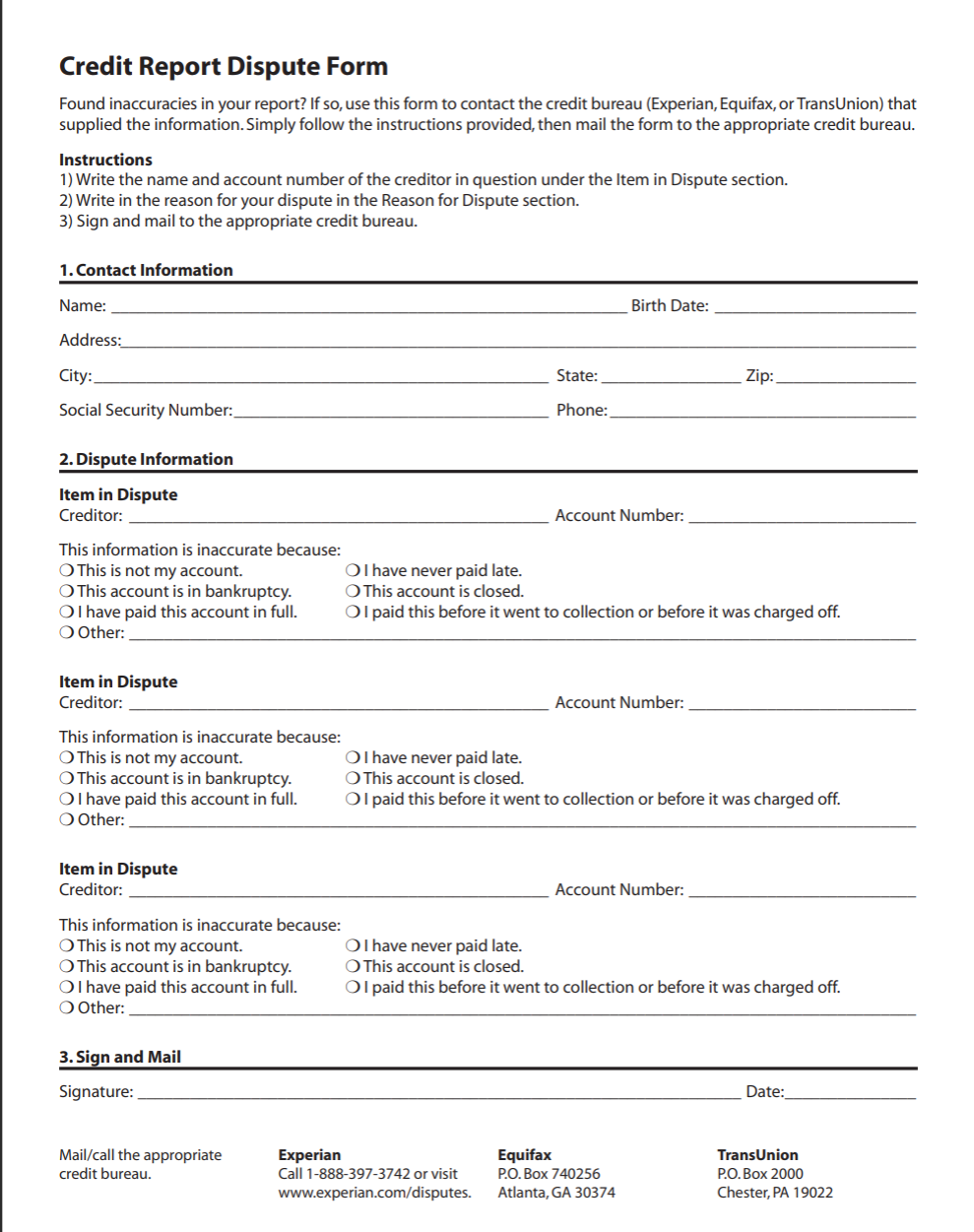
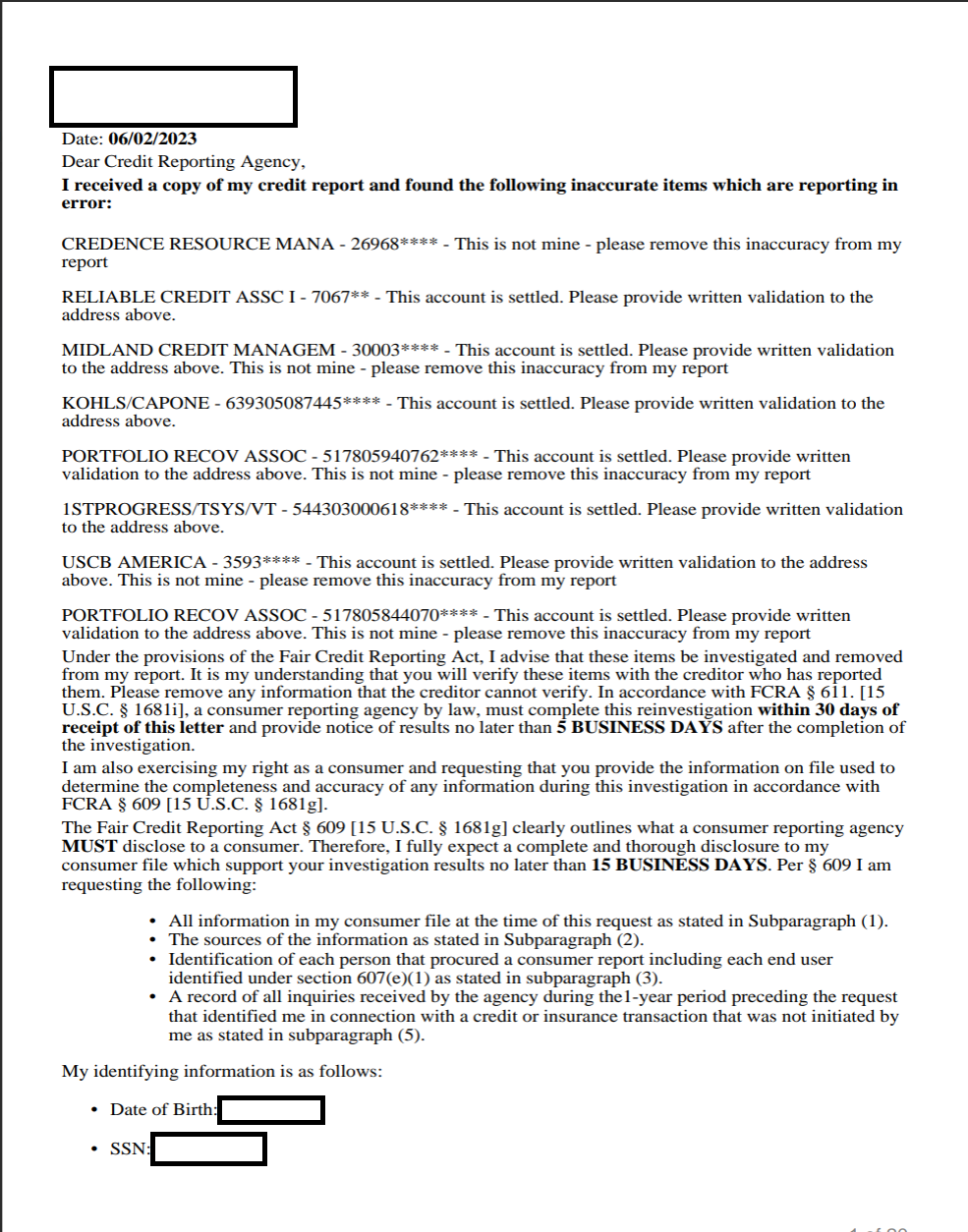
The HCAO petition alleges Wilson "oversaw" a deceptive Credit Beast subscription program and was its "key contact person." Wilson's account of what Credit Beast actually is:
UFL originally offered hard-copy dispute services — client information was collected and dispute forms were mailed via USPS to the three credit bureaus. As the business grew, UFL adopted a larger CRM that added electronic disputes as an optional upgrade. Clients could stay with hard-copy mail disputes or opt into the electronic system, which gave them a phone app plus email and text message updates on dispute status. Hard-copy required waiting for the bureaus' mailed responses; electronic was faster. Wilson states this choice was explained to every client. "That is why I started Credit Beast," he states — "and it tracked every single dispute."
"My Credit Beast, LLC" appears in Wilson's own business email signature for years, consistent with it being a genuine part of his business — a dispute-tracking tool, not a hidden or deceptive add-on.
The $49.99 charge from "GLF*MYCREDITBEAST.COM" (Alabama, phone 855-506-9175) that hit Wilson's own UFL debit card in May 2023 was confirmed by Wilson as not his — "that is not even my 855-phone number." This was a genuinely separate third-party fraud against Wilson, unrelated to his own legitimate Credit Beast dispute-tracking system. The two are distinct matters: Wilson's Credit Beast is his own tool; the Alabama charge was someone else using a similar name to defraud him.
Texas Bonded and Registered
The HCAO's Count Two alleges violations of the Texas Finance Code, including failure to comply with credit services organization requirements. The evidence shows UFL took the specific statutory step required to lawfully operate:
United Funding Logistics Consulting LLC obtained Credit Services Organization Surety Bond #66817159 from Western Surety Company, $10,000, effective October 4, 2023, filed with the Texas Secretary of State, Registrations Unit, as the security required by Texas Finance Code § 393.302 for lawful operation as a credit services organization. The bond is on file with the state. This does not resolve every disclosure-specific allegation in Count Two, but it directly refutes any implication that UFL operated as an unregistered or unbonded entity.
The six primary-source documents below rebut the HCAO's Count Two allegations that UFL operated without the required credit-services-organization security and consumer disclosures. They are reproduced here side by side, in the order the petition challenged them.
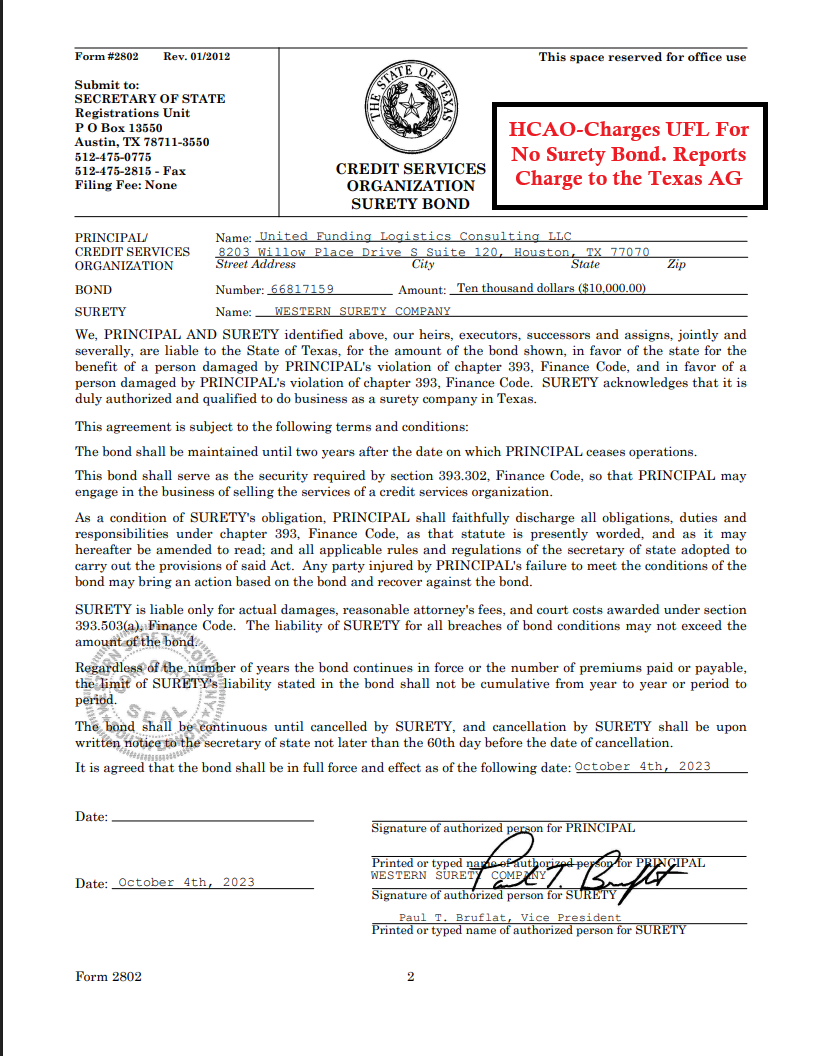
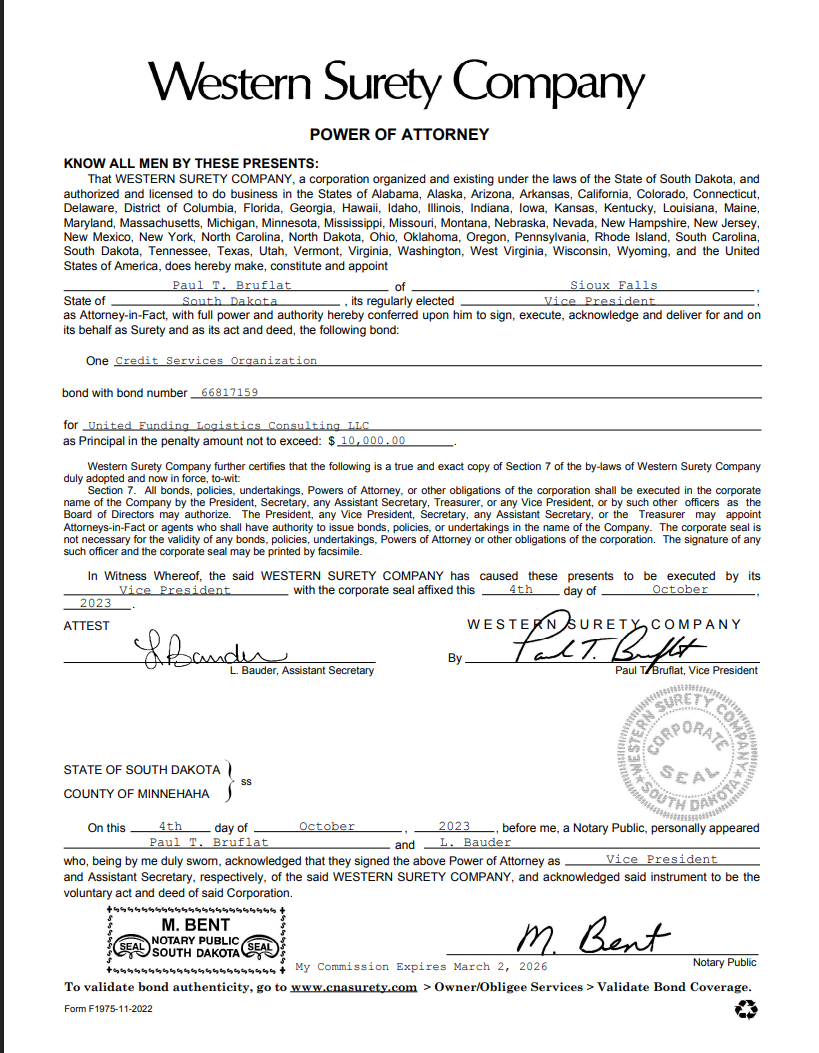
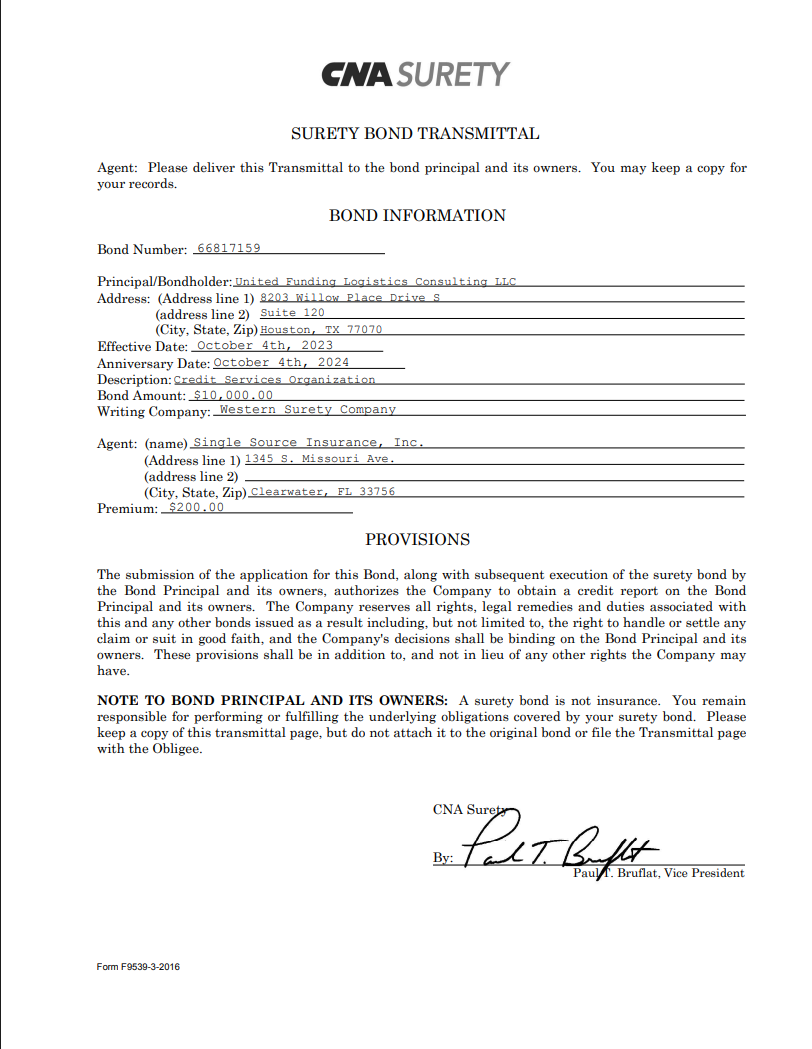
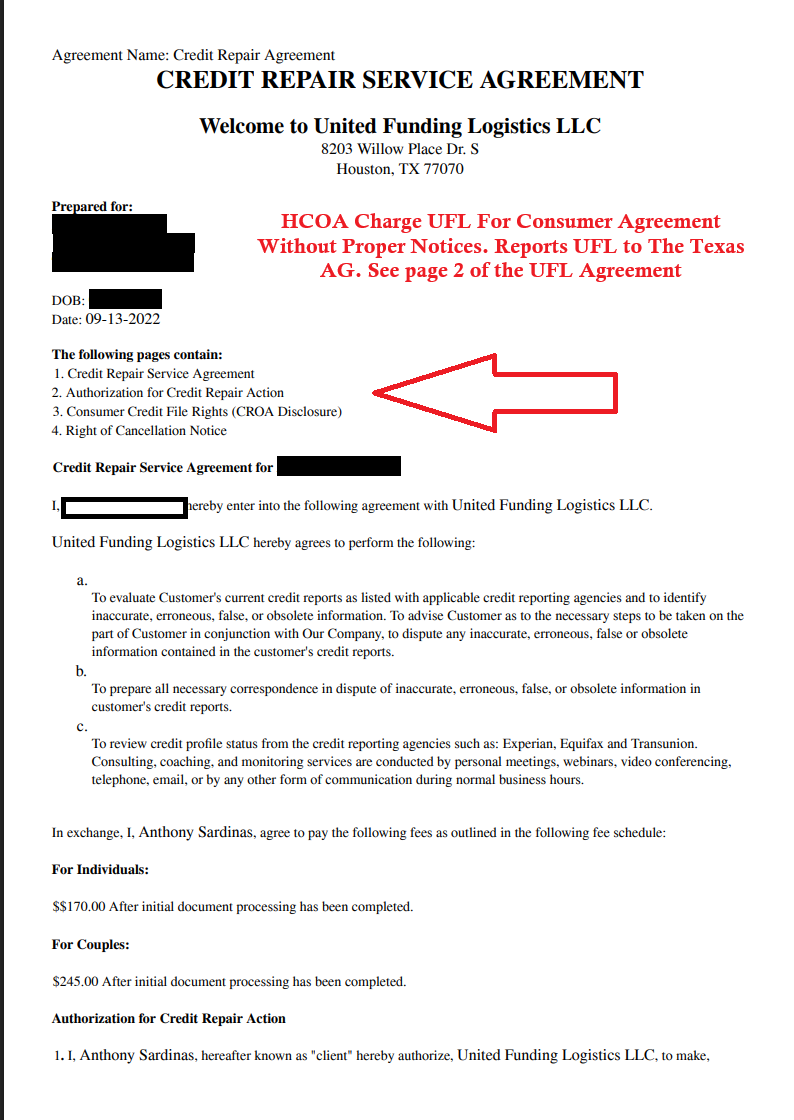
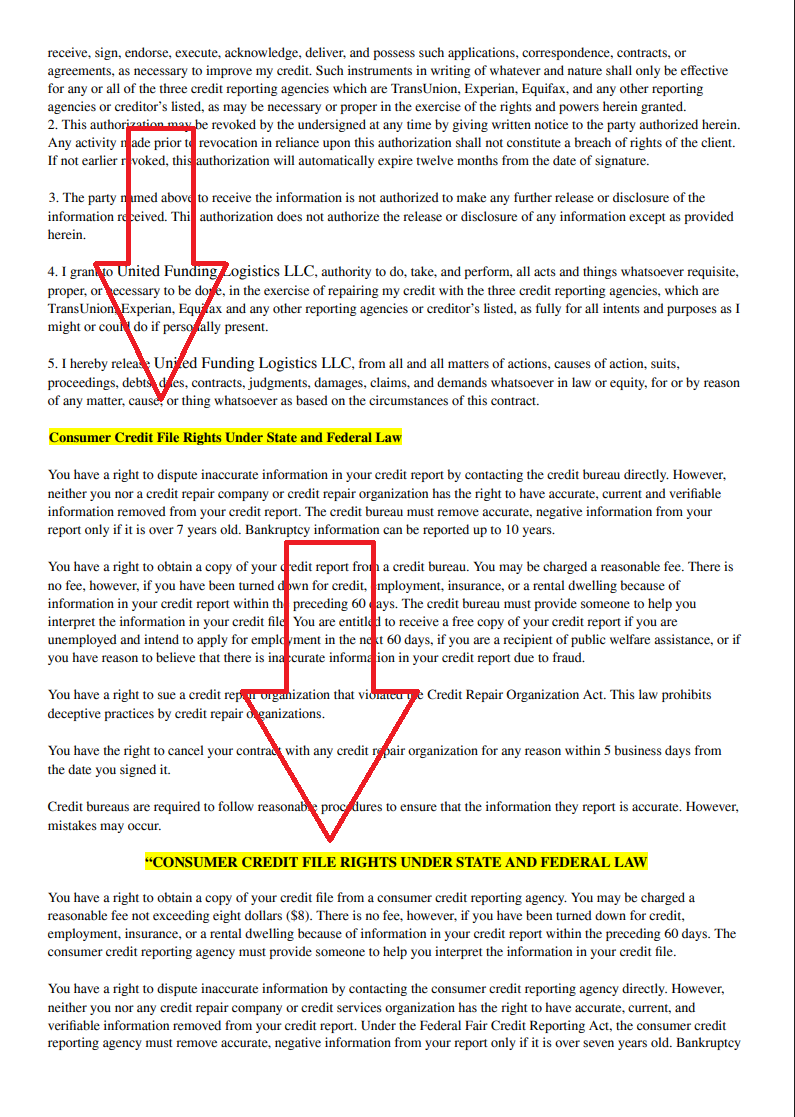
The Petition's Footnote vs. The BBB's Alert — Side by Side
The HCAO petition's footnote 3 and the BBB's "Pattern of Complaints" alert cover the same subject — review manipulation — but they are not identical. The difference matters.
| BBB Alert (Published) | HCAO Petition, Footnote 3 |
|---|---|
| "The business is requesting individuals to submit a '5-star' review with the BBB as a condition of receiving money from a FCRA complaint filed by the business." | "Defendants further misled and threatened customers... One or more Defendants solicited fake positive reviews from their employees." |
The BBB's alert is about conditioning reviews on settlement payments. The HCAO's footnote escalates this to a new, uncited claim: that UFL employees personally wrote fake positive reviews. This specific accusation appears nowhere in the BBB's own alert. No source is cited for it in the footnote. And it directly contradicts the documented evidence in this investigation — where fake negative reviews were auto-verified by BBB (Exhibits B, C) and real positive reviews were blocked (Exhibit E). The County Attorney's petition contains a related but broader allegation and, in at least one instance, makes a claim not supported by any evidence in this record.
The Public Branding
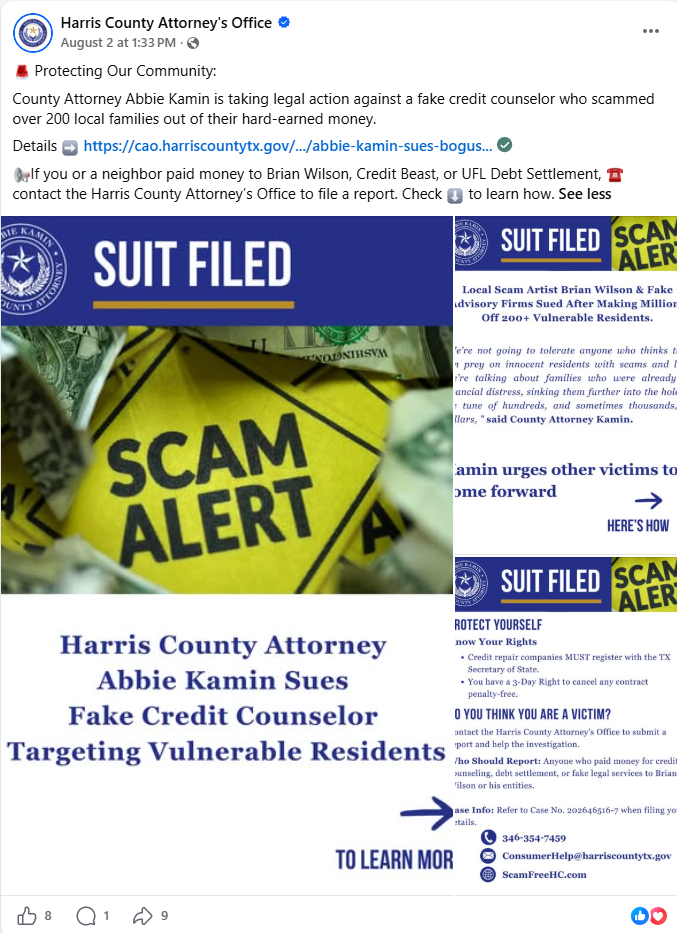
A Public Statement That Prejudices An Ongoing Proceeding
The Facebook post does not merely say Harris County alleges that Wilson committed violations. It states, as established fact:
"County Attorney Abbie Kamin is taking legal action against a fake credit counselor who scammed over 200 local families out of their hard-earned money."
The accompanying graphic also brands the matter "SCAM ALERT." That language matters because Texas Rule 3.07 prohibits a lawyer from making — or assisting someone else in making — a public statement when the lawyer knows or reasonably should know it carries a substantial likelihood of materially prejudicing an adjudicatory proceeding.
The Rule is even more specific: the likelihood of a violation increases when an adjudication is ongoing or imminent and the public statement concerns:
"the character, credibility, reputation or criminal record of a party."
That language is striking when applied to the post. Calling a named civil defendant a "fake credit counselor" who "scammed over 200 local families" before adjudication very plainly concerns that defendant's character and reputation.
The Harris County Attorney publicly branded Wilson a scammer on Facebook before any court had ruled on the merits. The post referenced the lawsuit as if the allegations were established facts — not pending claims. Wilson had not been deposed. He had not had his day in court. But the state's top lawyer for Harris County had already told the public what he was.
The Harris County Attorney publicly characterized Wilson as a scammer via social media before any court ruling. No Filter America independently verified on August 17, 2026 that the Harris County Attorney's Office published the August 2 Facebook post. The post remained publicly accessible on HCAO's official Facebook page at the time of verification. HCAO's accompanying graphic describes Wilson as a "Fake Credit Counselor Targeting Vulnerable Residents," while the post states that he "scammed over 200 local families out of their hard-earned money."
The Scale Problem
The Harris County case references "over 200 families" allegedly defrauded. Wilson's database contained 36,000 client transactions. Two hundred complaints out of 36,000 transactions is approximately 0.5% — and Wilson maintains that many of those complaints came from impersonation victims who were never his clients.
The math matters. If 200 people filed complaints, and 90+ fake TikTok accounts were actively scamming consumers using Wilson's name and face, and an Alabama-based entity was billing Wilson's clients under a similar name — how many of those 200 complainants were actually Wilson's clients? And how many were victims of the impersonation operation he reported to the FBI?
Wilson raises a question he believes deserves examination in discovery: what universe of consumers did Harris County use, where did those names originate, and did that universe disproportionately reflect negative BBB interactions? The complaints the BBB stamped as "Verified" became part of the record the county referenced.
HCAO ¶¶46–49 — "Class-Action Lawsuit Scam" — The Evidence They Ignored
- ¶45 — HCAO alleges Wilson's contracts "falsely, misleadingly, and deceptively said that '[t]he Company' would provide a variety of legal services," quoting the UFL Debt Settlement contract itself: "The Company agrees to provide the Client with debt settlement services, including but not limited to, preparing motions as needed for civil debt cases where the Client is a pro se litigant, drafting validation requests, and conducting debt settlement negotiations on behalf of the Client." (Dated September 24, 2024; signed by Brian Wilson, CEO, UFL Debt Settlement, LLC.) HCAO further alleges "these contracts were executed by one or more Defendants who were not legally allowed to provide legal services," because "UFL Debt Settlement, LLC is not a law firm and Wilson is not a Texas attorney. None of Defendants could legally offer these services."
- ¶46 — Defendants "decided to make false, misleading, and deceptive claims about class-action lawsuits" and "falsely represented to consumers that they filed, or arranged to be filed, one or more class action lawsuits on the consumers' behalf."
- ¶47 — HCAO alleges Wilson falsely advertised that he had "arranged for a 'class action lawsuit' to be filed on [consumers'] behalf against the credit reporting agencies for purported FCRA violations."
- ¶48 — Cites a Wilson TikTok video claiming data was transferred to "the law firm for the FCRA complaint" with payouts of $6–7k for three consecutive disputes; some "ten to eleven… they're huge payouts." HCAO further alleges Wilson "falsely stated he had personally invested $1.4 million of his own money into the class action lawsuit."
- ¶49 — The Core Allegation — "In the end, however, Defendants never arranged for any lawsuits to be filed on their customers' behalf."
HCAO labels the contract "misleading and deceptive" — then reproduces the very language that defeats the allegation. The contract expressly limits services to clients who are "pro se litigant[s]": preparing motions for civil debt cases where the client represents themselves, drafting validation requests, and conducting debt settlement negotiations. A pro se litigant is, by definition, a person who represents themself without an attorney. Preparing paperwork for a self-represented client and negotiating settlements on their behalf is not the practice of law — it is the expressly-permitted scope of a debt settlement services company under Texas Finance Code Chapter 393 and the FTC Telemarketing Sales Rule.
HCAO's assertion that "UFL Debt Settlement, LLC is not a law firm and Wilson is not a Texas attorney" is a statement of fact, not of wrongdoing. Wilson never claimed to be a Texas attorney, and UFL Debt Settlement, LLC never held itself out as a law firm. The contract Wilson signed — which HCAO itself quotes — says "debt settlement services," not legal representation. Where actual legal action was required, Wilson referred clients to licensed counsel — including, as the exhibits below document, the FCRA litigation firm Halvorsen & Klote.
This is the claim HCAO chose to put on the record — that the entire class-action narrative was fabricated; that no law firm was ever really engaged; that Wilson simply pocketed recurring fees while promising consumers payouts that never existed. It is a serious allegation. It is also demonstrably, documentarily false. The evidence below was in existence before, during, and after the filing of the petition. The question is not whether Wilson had a real law firm relationship — the question is why HCAO filed this section of the petition as if he didn't.
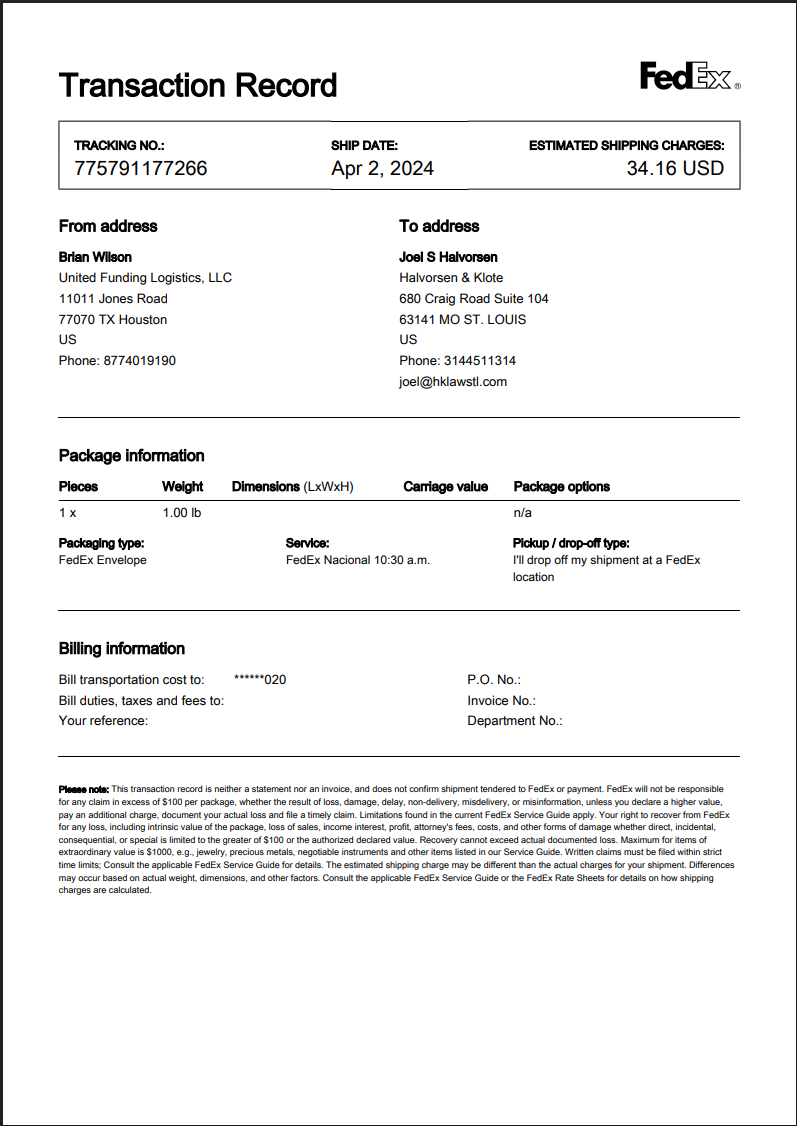
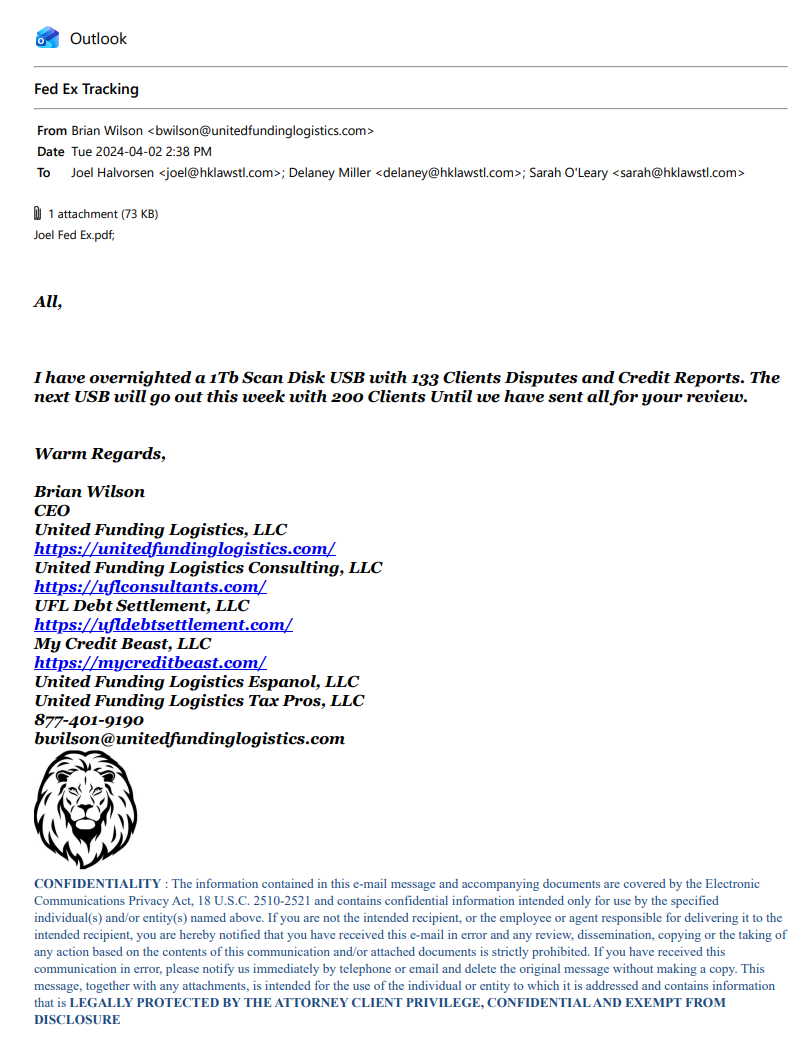
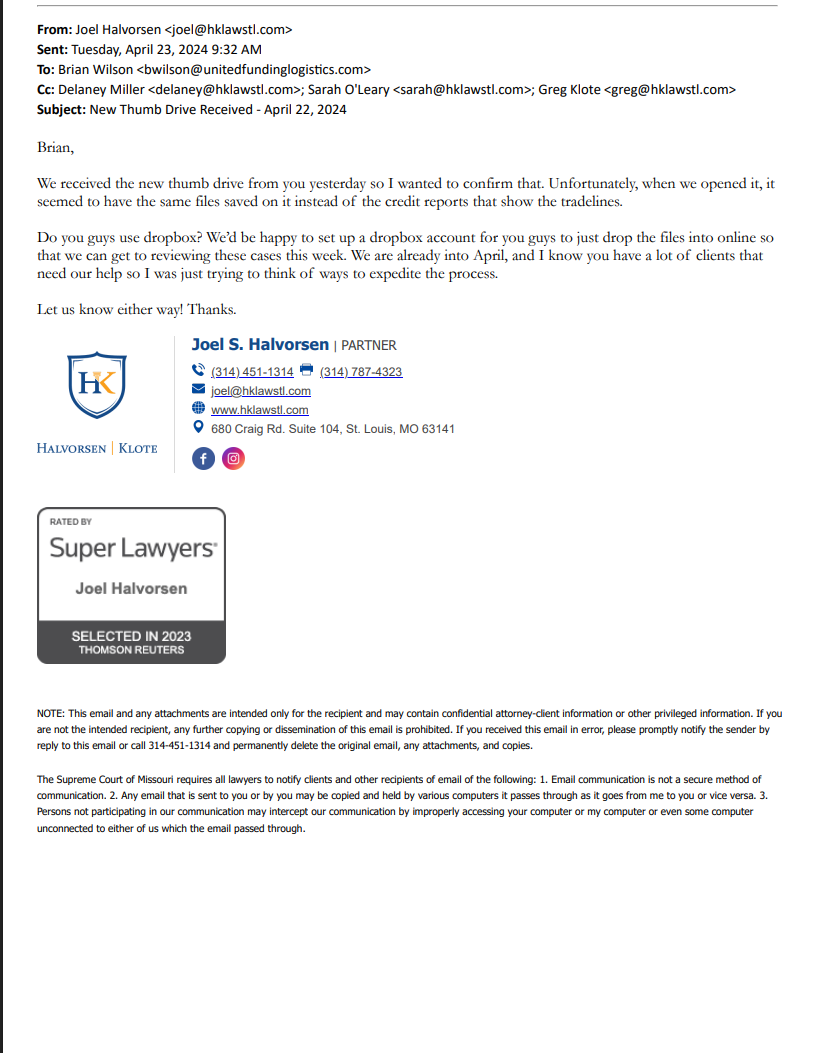
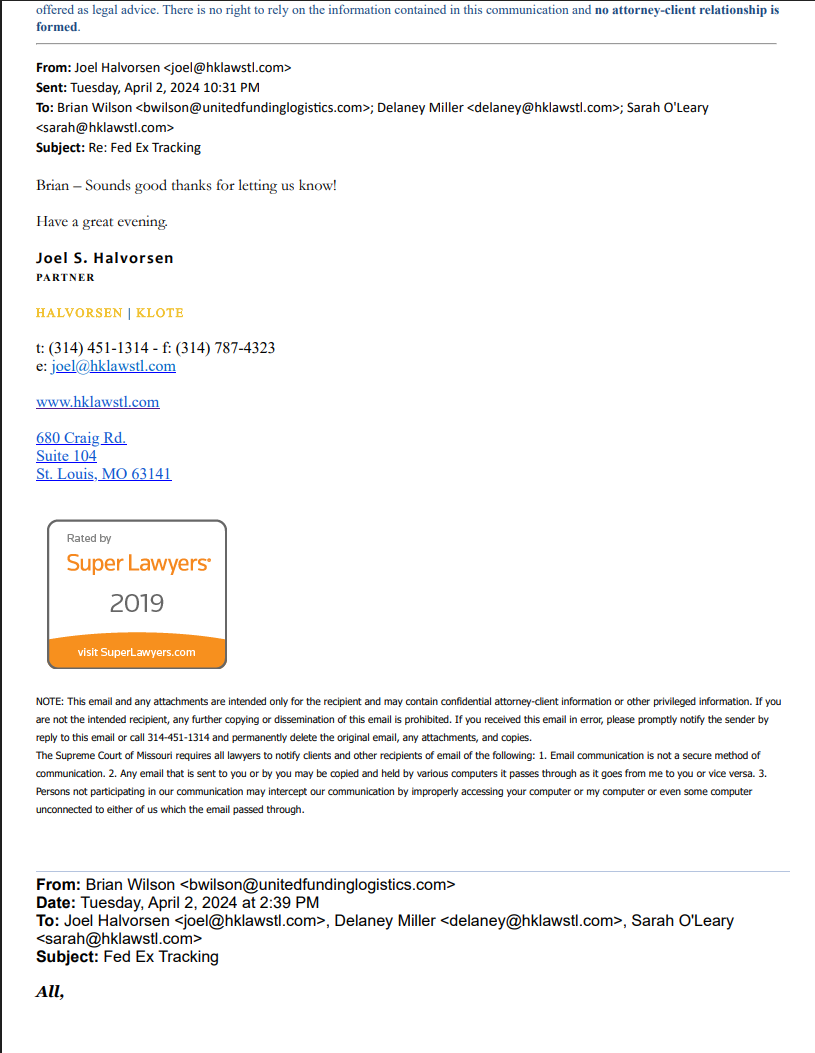
HCAO ¶49 asserts: "Defendants never arranged for any lawsuits to be filed on their customers' behalf." The record above — four independently corroborated, timestamped primary-source documents — shows the opposite:
- April 2, 2024: FedEx overnight shipment, Tracking #775791177266 — Wilson ships 1TB of client dispute data directly to Joel Halvorsen's law office in St. Louis.
- April 2, 2024: Wilson emails the three HK firm members confirming the USB and stating a second batch (200 clients) is coming that week.
- April 23, 2024: Halvorsen confirms receipt and requests Dropbox for faster case file review — "I know you have a lot of clients that need our help."
- April 3, 2024: Wilson proposes building an FCRA intake lead-capture page for Halvorsen's firm, modeled on the Atlas Consumer Law opt-in infrastructure already in place.
None of this is consistent with a man who fabricated a law firm relationship. All of it is consistent with a man who was actively transferring real client dispute files to a real Super Lawyers–rated FCRA litigation firm two years before HCAO filed this petition.
HCAO filed its petition in July 2026. The FedEx transfer and Halvorsen law firm correspondence is dated April 2024. The Atlas Consumer Law relationship is documented from December 2021 through May 2025 — over three years of real law firm referrals — and by January 4, 2022 Atlas had already filed federal cases or sent demands on behalf of 3 UFL clients.
HCAO's ¶49 — "never arranged for any lawsuits" — was written knowing that Wilson had submitted, in his UPLC hearing response (May 2026), attorney-client representation agreements, correspondence involving the Elam Law Firm, and consumer law firm–related materials documenting exactly these relationships.
The question is not whether Wilson had a real law firm. The evidence proves he did. The question is whether HCAO presented a complete picture to the court — or whether it selectively omitted the exculpatory record it already had access to when it filed.
On May 21, 2026, Wilson appeared before the District 4 Subcommittee of the Unauthorized Practice of Law Committee — alone, after his attorney withdrew when additional retainer was demanded, a request Wilson could not meet. He was told the hearing would proceed unless he signed a Cease and Desist Agreement. He refused to sign. He participated in 80 to 81 minutes of questioning concerning UFL Shield, Debt Shield, and related marketing language. He submitted attorney-client representation agreements, Elam Law Firm correspondence, and consumer law firm materials — all post-hearing — as part of a seven-point formal written response to UPLC Investigator Fred Krasny.
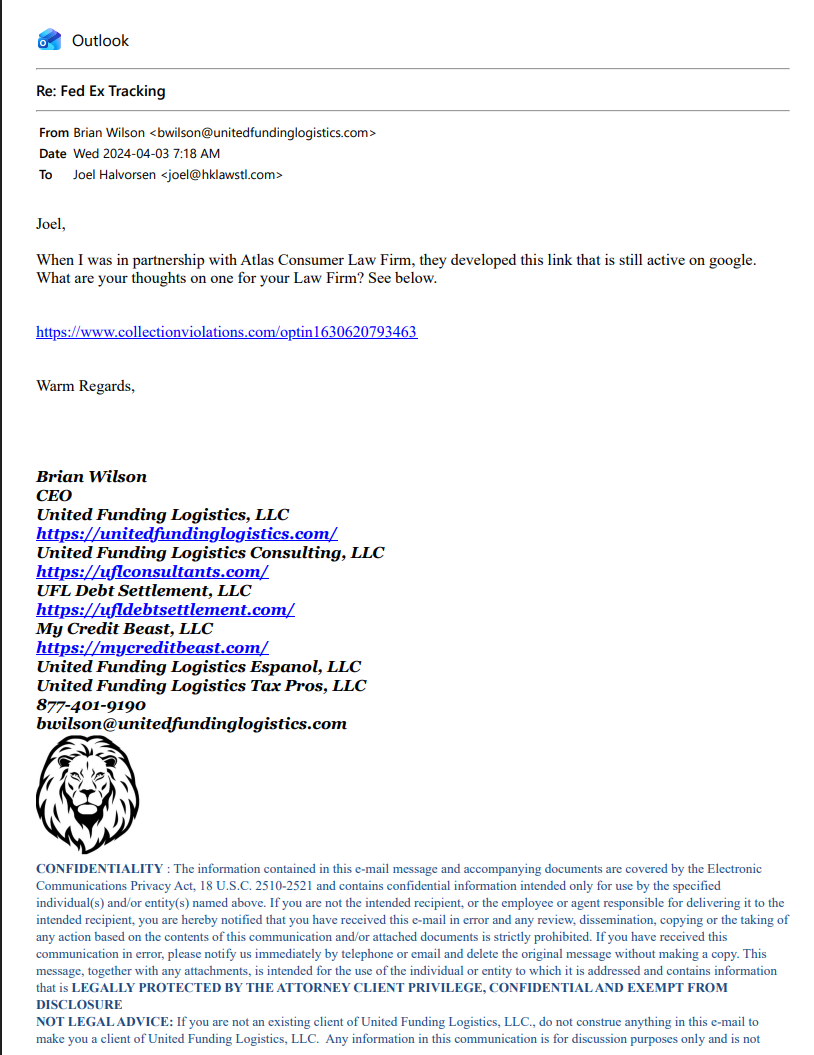
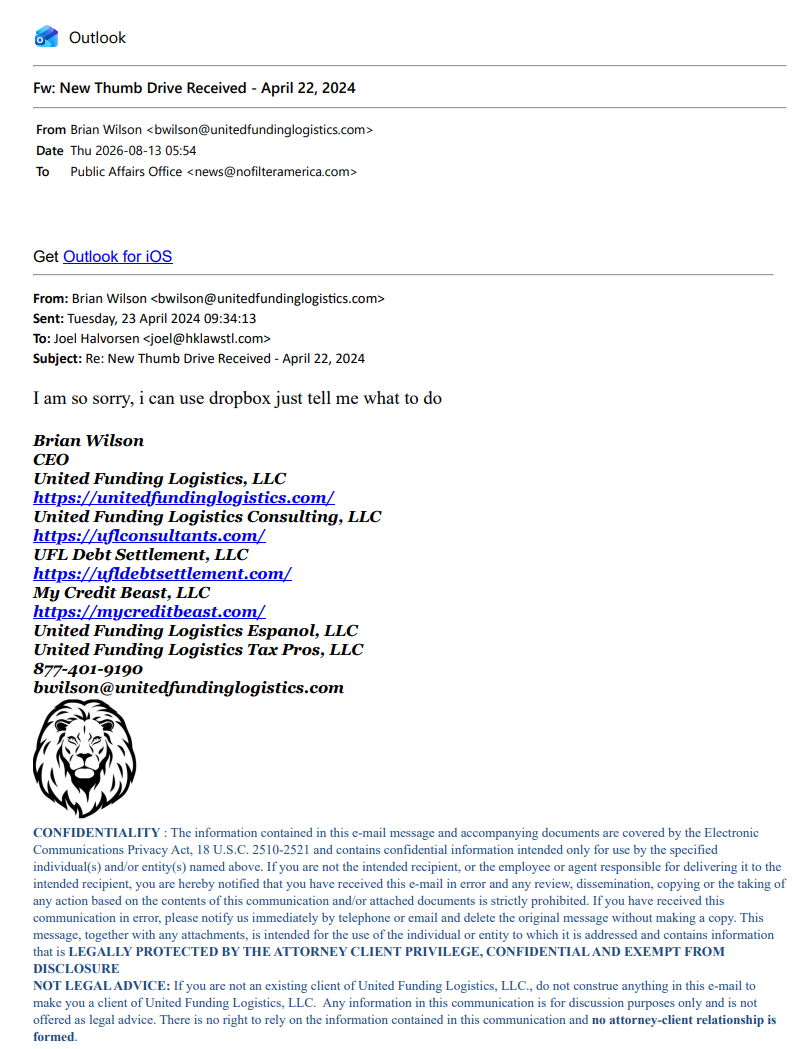
HCAO titled this section of its petition "Class-action lawsuit scam." The primary-source record — FedEx tracking receipts, attorney emails, firm-confirmed client data transfers, and a Super Lawyers–rated law firm's own written words — proves that an outside law firm (Halvorsen & Klote) was actively receiving and reviewing client files in April 2024, two full years before the petition was filed.
A scam does not overnight 133 client dispute files to a real attorney. A scam does not have a real law firm writing back: "I know you have a lot of clients that need our help." A scam does not build intake infrastructure modeled on a three-year Atlas Consumer Law referral relationship. The claim in ¶49 is not supported by the evidence. The evidence contradicts it.
Counsel in Name Only
Brian Wilson did everything a client is supposed to do. He hired a lawyer. He paid the retainer. When the Harris County Attorney’s Office came asking questions, he answered them — line by line, allegation by allegation, with documents attached. He believed his attorney was carrying that defense to the regulators. He was wrong. By the time the state came for him, the lawyer who promised to “do the talking” had walked away over $1,500, the licensing board had been told in writing that he had no counsel and held the hearing anyway, and the county attorney’s office filed suit repeating allegations Wilson had already answered a full year earlier. Nothing was ever refunded. This is the record of how a man with receipts was still steamrolled.
Wilson paid attorney Michael E. Trent a documented total of $4,400.00 — a $3,000 Chase cashier’s check dated June 20, 2025, plus two Zelle transfers ($1,200 and $200) to the number on file with the State Bar. Every payment is preserved as a receipt. Nothing was ever refunded.
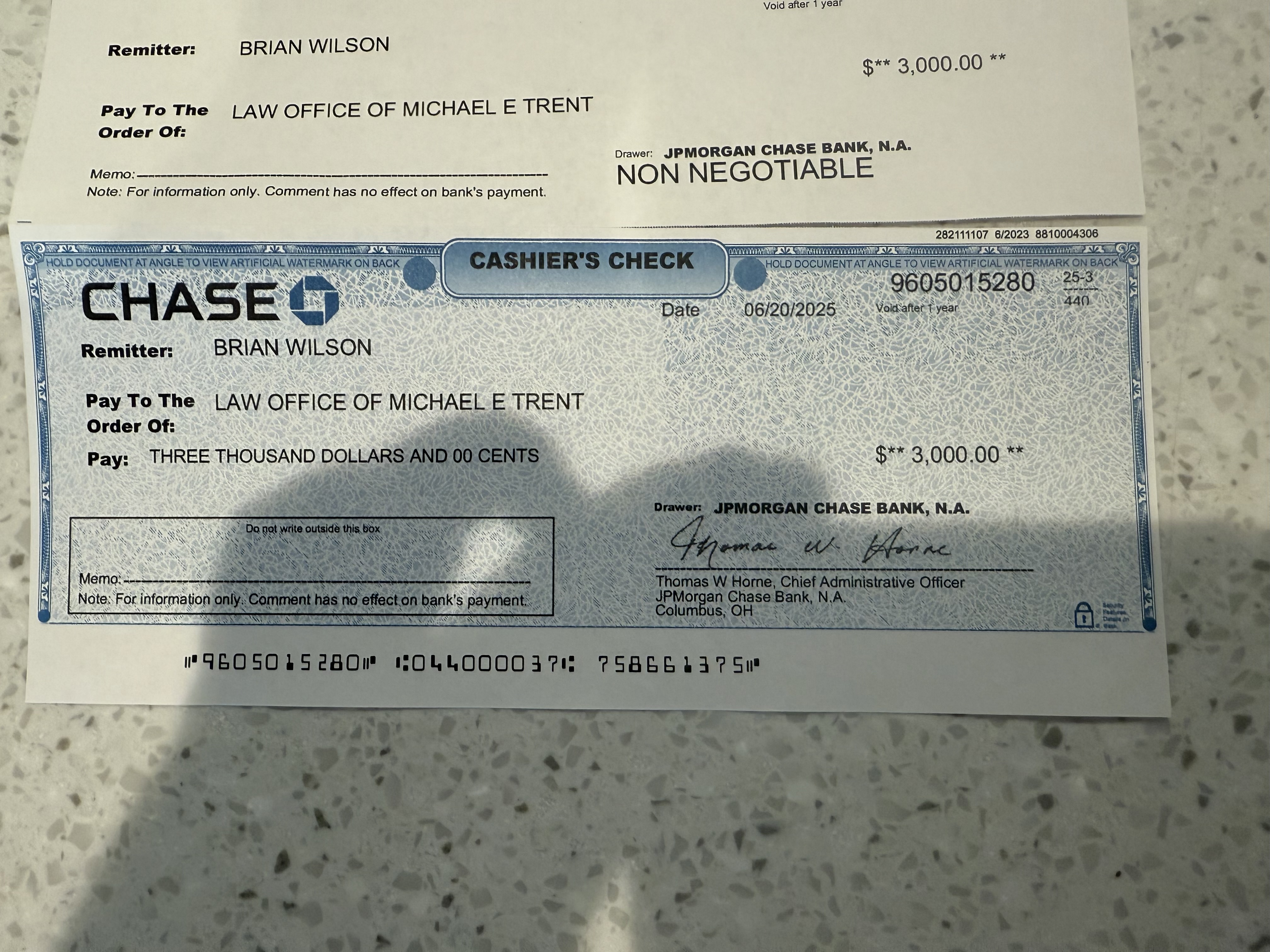
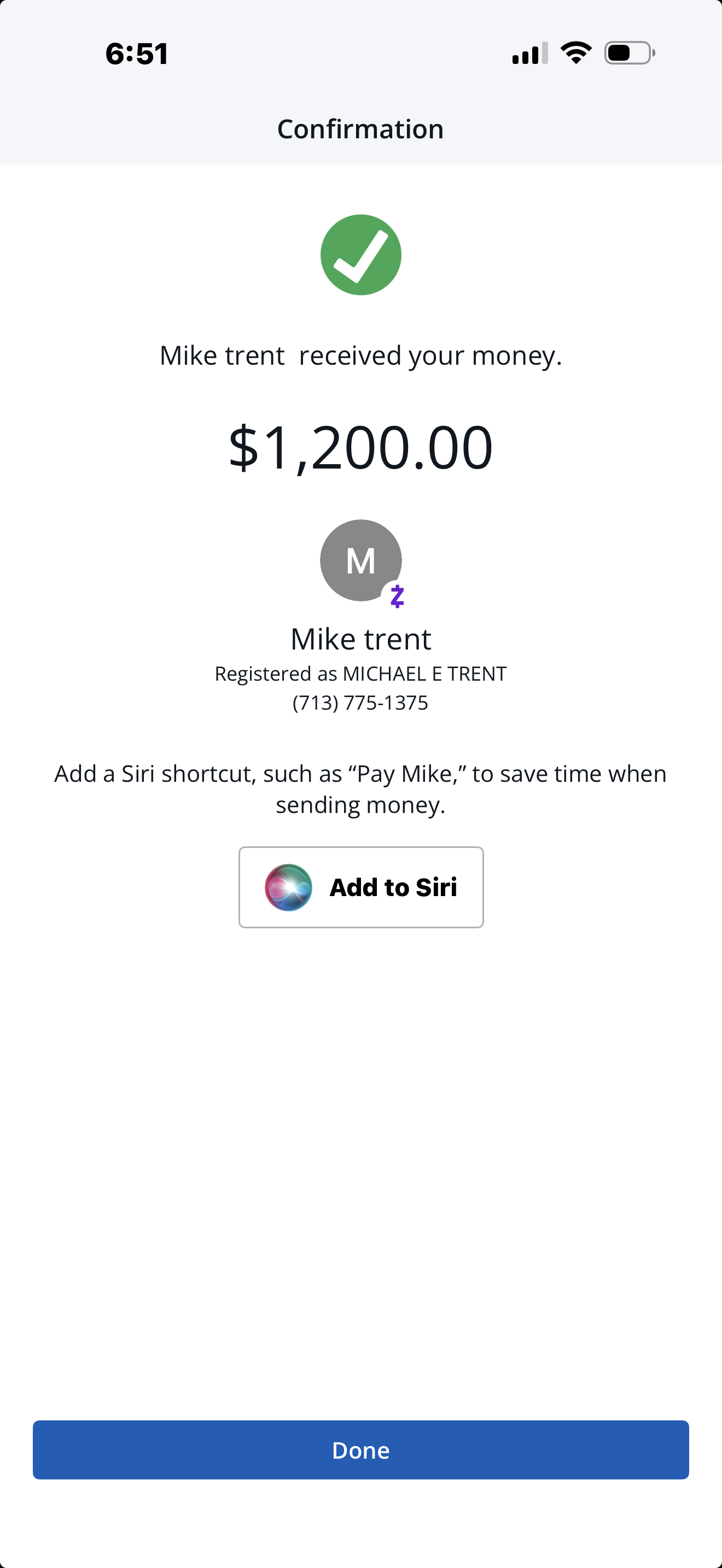
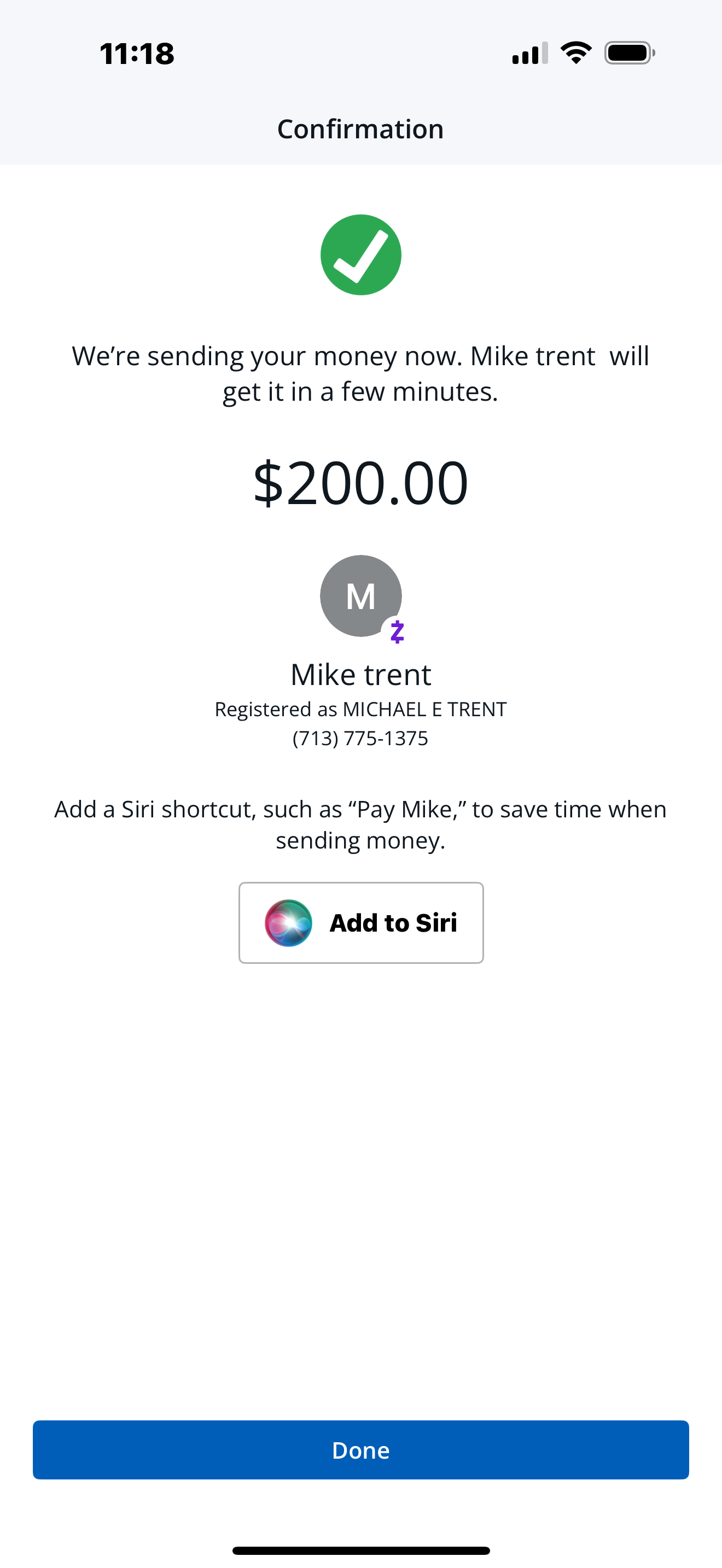
- Did Trent ever forward Wilson’s September 26, 2025 response to the HCAO? Wilson believed it was being relayed. It now cannot be verified.
- What was the total amount received from Wilson, and what — if any — refund was issued? The documented payments total $4,400. No refund has been produced.
- Why did Trent not appear at the May 21, 2026 UPLC hearing after personally requesting that date and assuring Wilson he would represent him?
- Why did the UPLC proceed after being notified in writing that the respondent had been abandoned by counsel and needed additional time?
Rules for Thee, Not Me — The BBB
Every business gets a range of clients. Most are honest. Most pay, get served, and move on. And then there are the ones who operate in a different gear entirely — the ones who take everything you give them and then build a campaign to destroy you. In the United Funding Logistics case file, one client stands out above all the rest. His name is Chris Shields, of Reading, Pennsylvania, and the documented record of what he received from Brian Wilson — and what he did in return — is the single clearest example of bad faith in this entire investigation.
Shields was not passed off to a junior processor. Wilson tells NFA he worked on Shields’ collection accounts personally. The record backs him: email exchanges from late September and early October 2023 show Wilson transmitting full dispute packages for Shields — hard copies and electronic disputes across all three bureaus, attachments running into the tens of megabytes, follow-up appointments scheduled, and a specific Resurgent double-entry flagged for correction. Wilson tells NFA he remembers Shields having numerous dispute upon disputes for collections accounts. This was not a neglected file. It was an actively worked one.
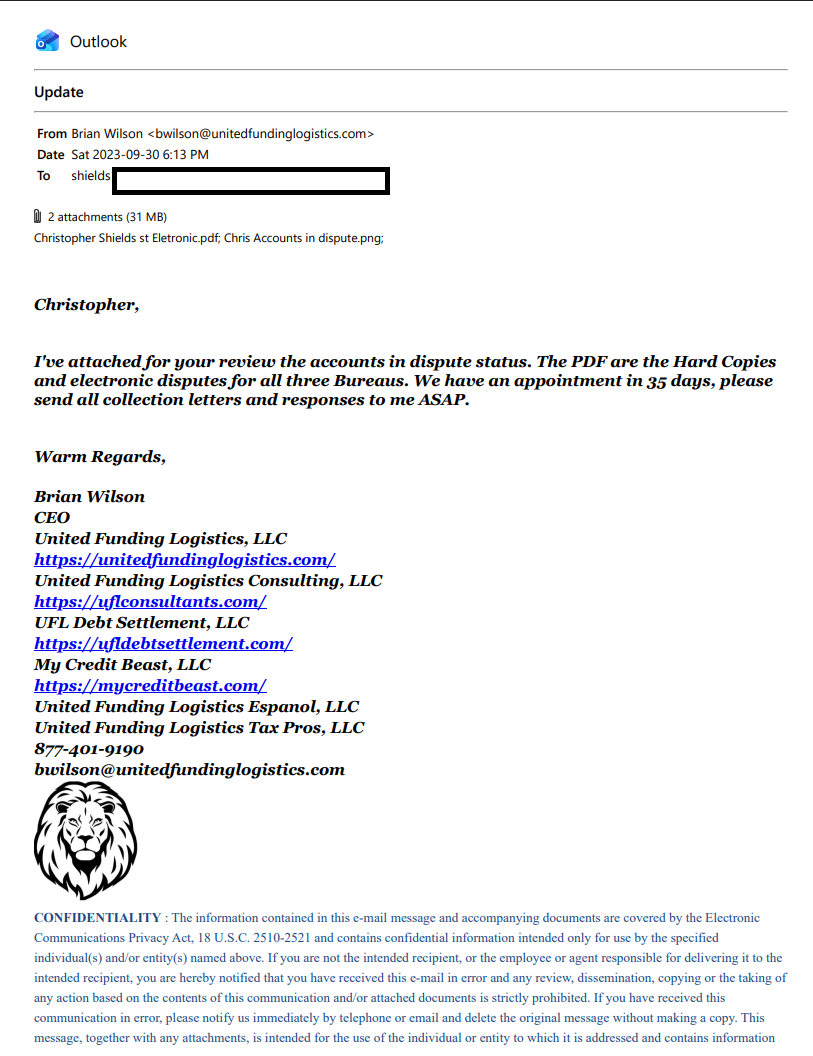
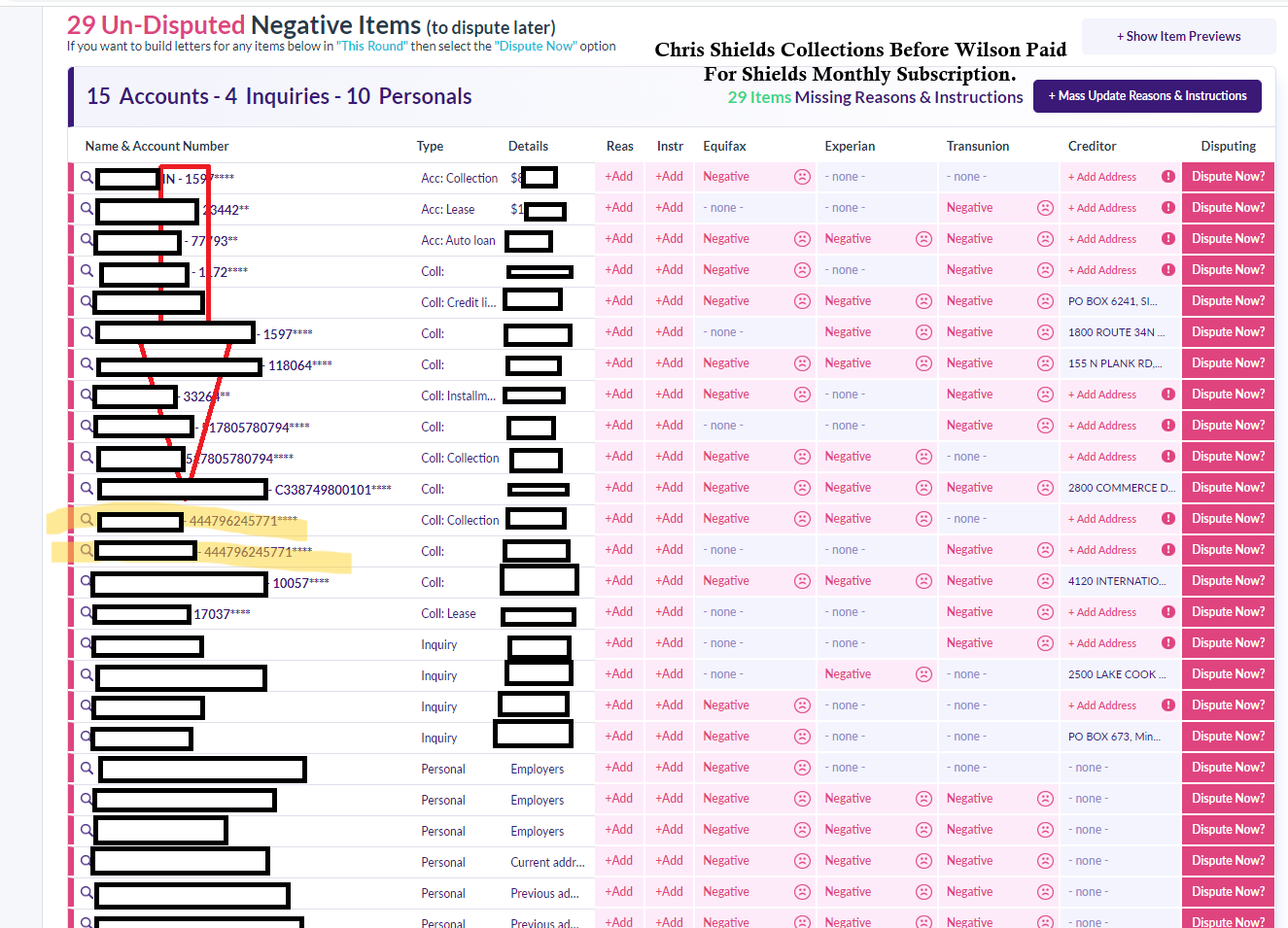
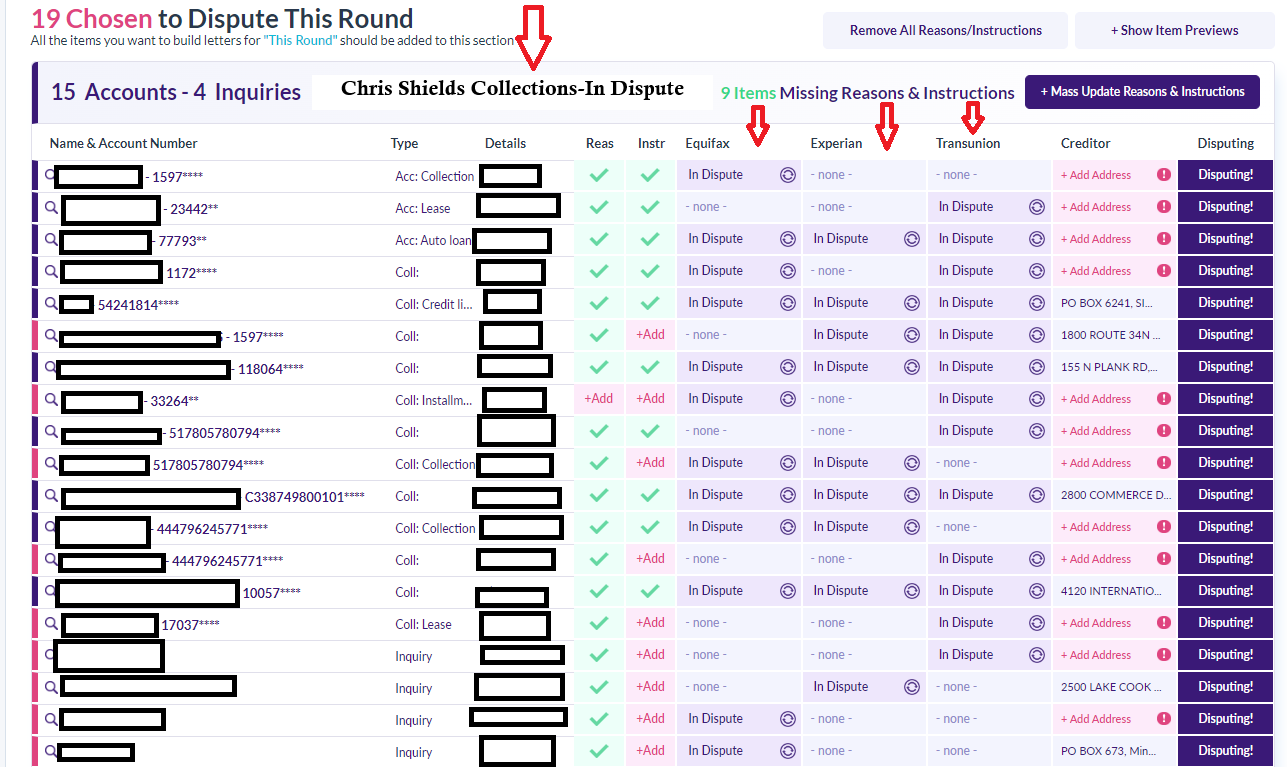
Wilson tells NFA he appreciated Shields — and that he paid out of his own pocket for Chris Shields’ IdentityIQ monthly subscription for months so his disputes would show live updates. IdentityIQ is the credit-monitoring product that lets a consumer watch a dispute move through the bureaus in real time. It costs money. Shields did not pay for it. Wilson did — so that a client he was already working personally could see his own results as they posted. There is no business rationale for a CEO to personally subsidize a single client’s monitoring subscription. Wilson did it as a courtesy. The “Free Link” email is the receipt.
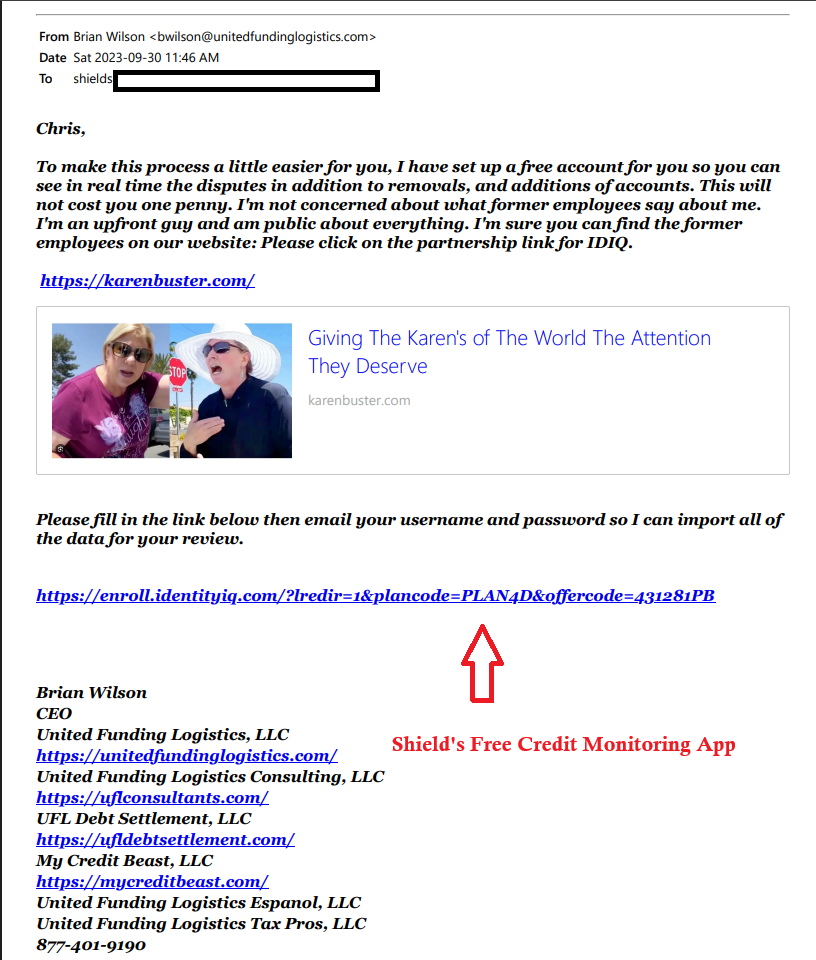
Wilson tells NFA he paid for the IdentityIQ subscription so Shields’ disputes would show live updates. The record proves it. Shields was a hard-copy dispute client — the basic path, where every dispute is mailed to Equifax, TransUnion, and Experian as physical letters. Wilson paid, out of his own pocket, for the IdentityIQ tier that does both at once: it mails the hard-copy disputes to all three bureaus and mirrors them into a live electronic dashboard simultaneously, so Shields could watch each mailed account flip from “Negative” to “In Dispute” as the bureaus processed his letters — all at no cost to Shields. The September 30, 2023 hard-copy letters to all three bureaus (Exhibits N, O, P) and the live “In Dispute” dashboard (Exhibits Q, R) are the same disputes — the mailed copy and its electronic mirror, paid for by Wilson. The work was real. The subscription was used. And Wilson was the one paying for it — for a client who would, within eighteen months, file the complaint that helped trigger the Harris County lawsuit.
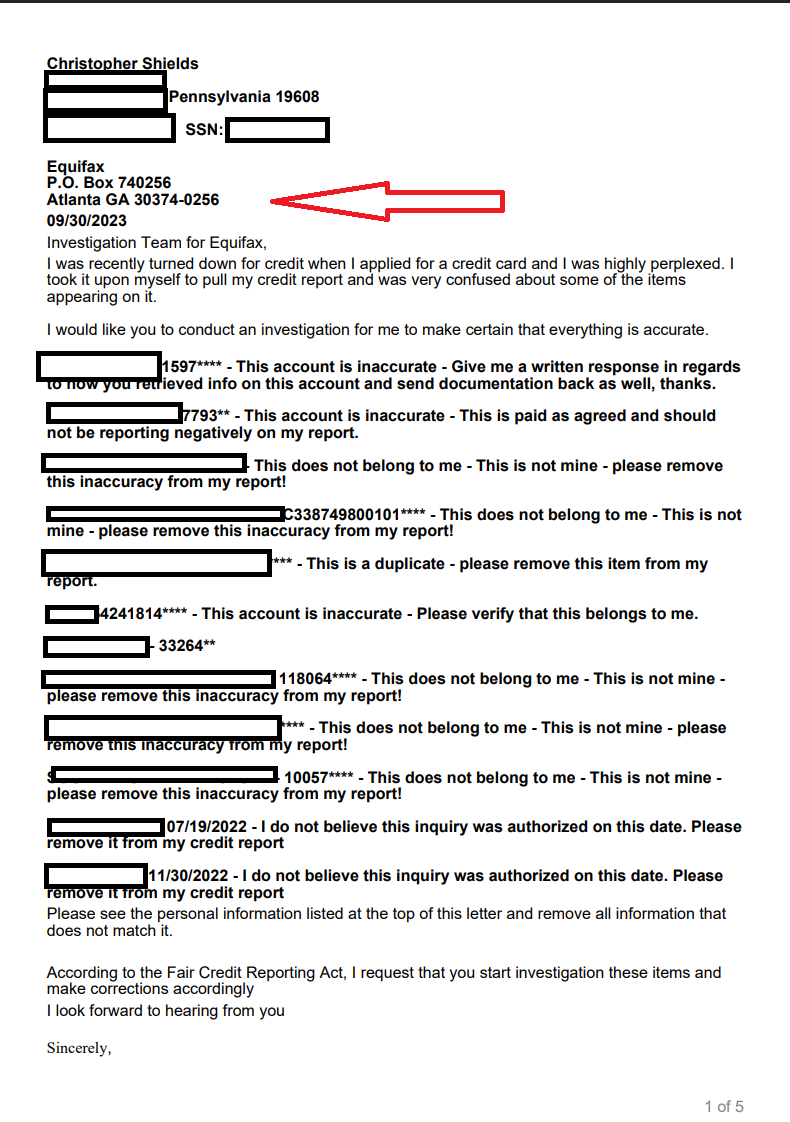
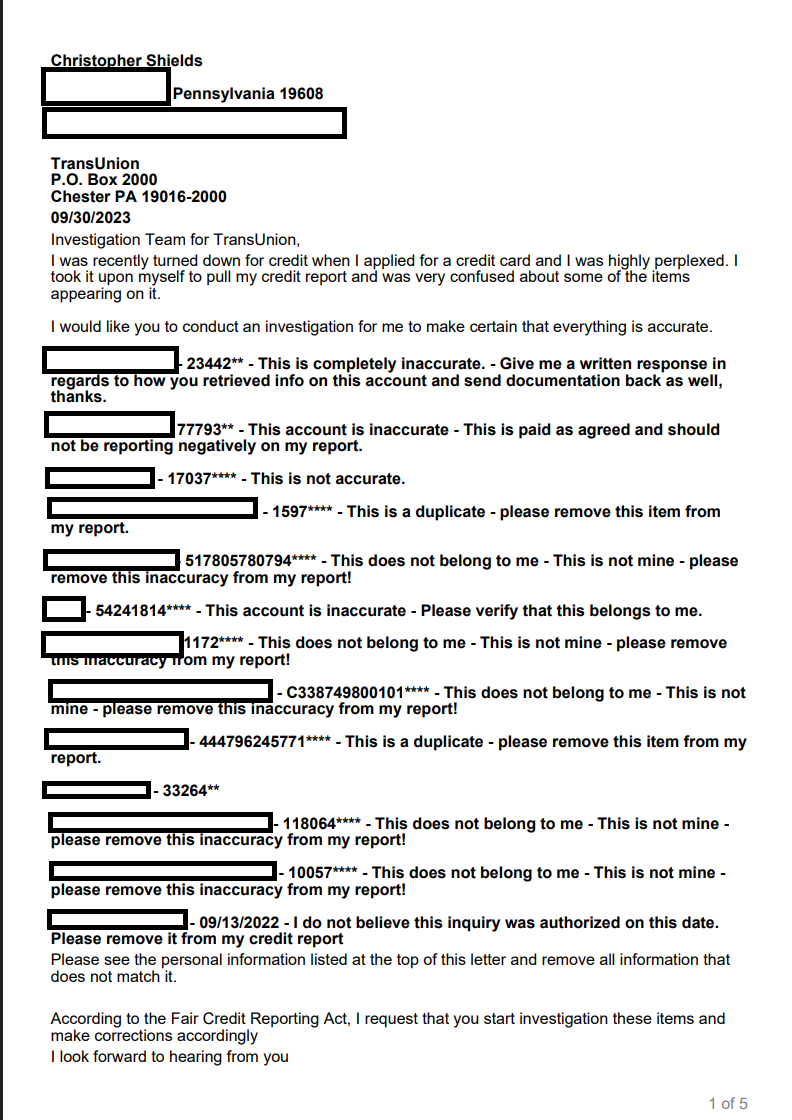
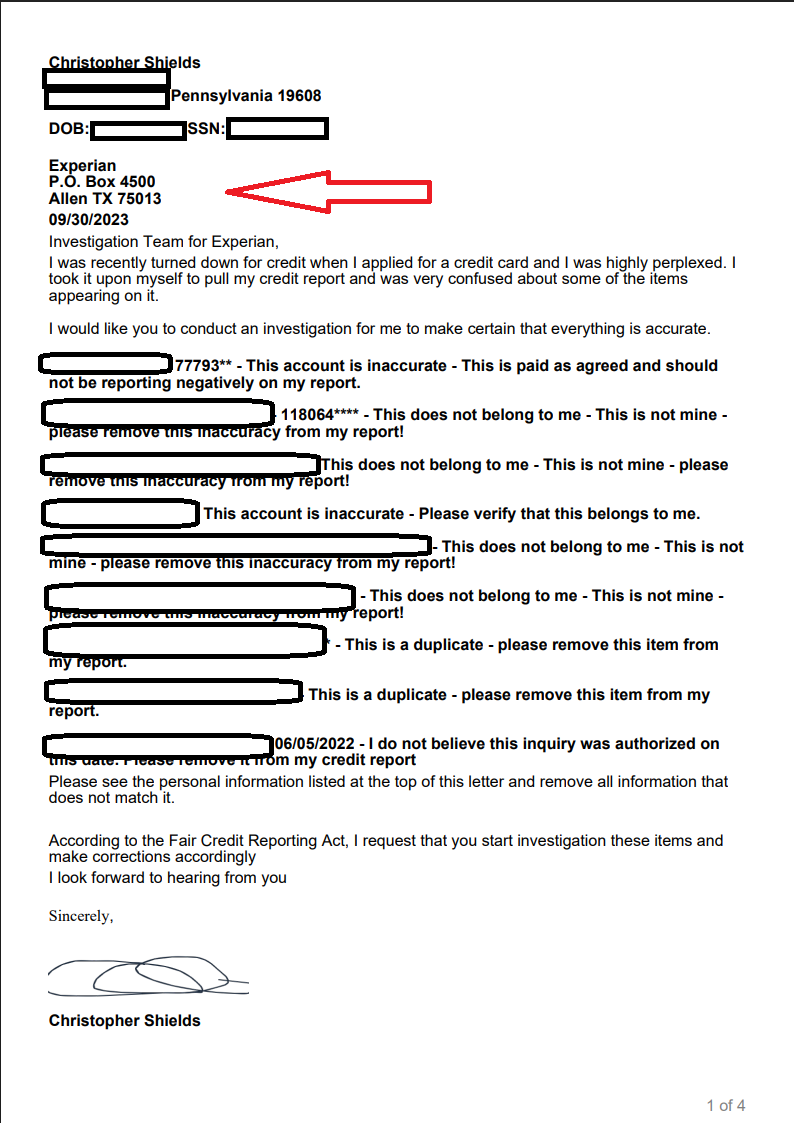
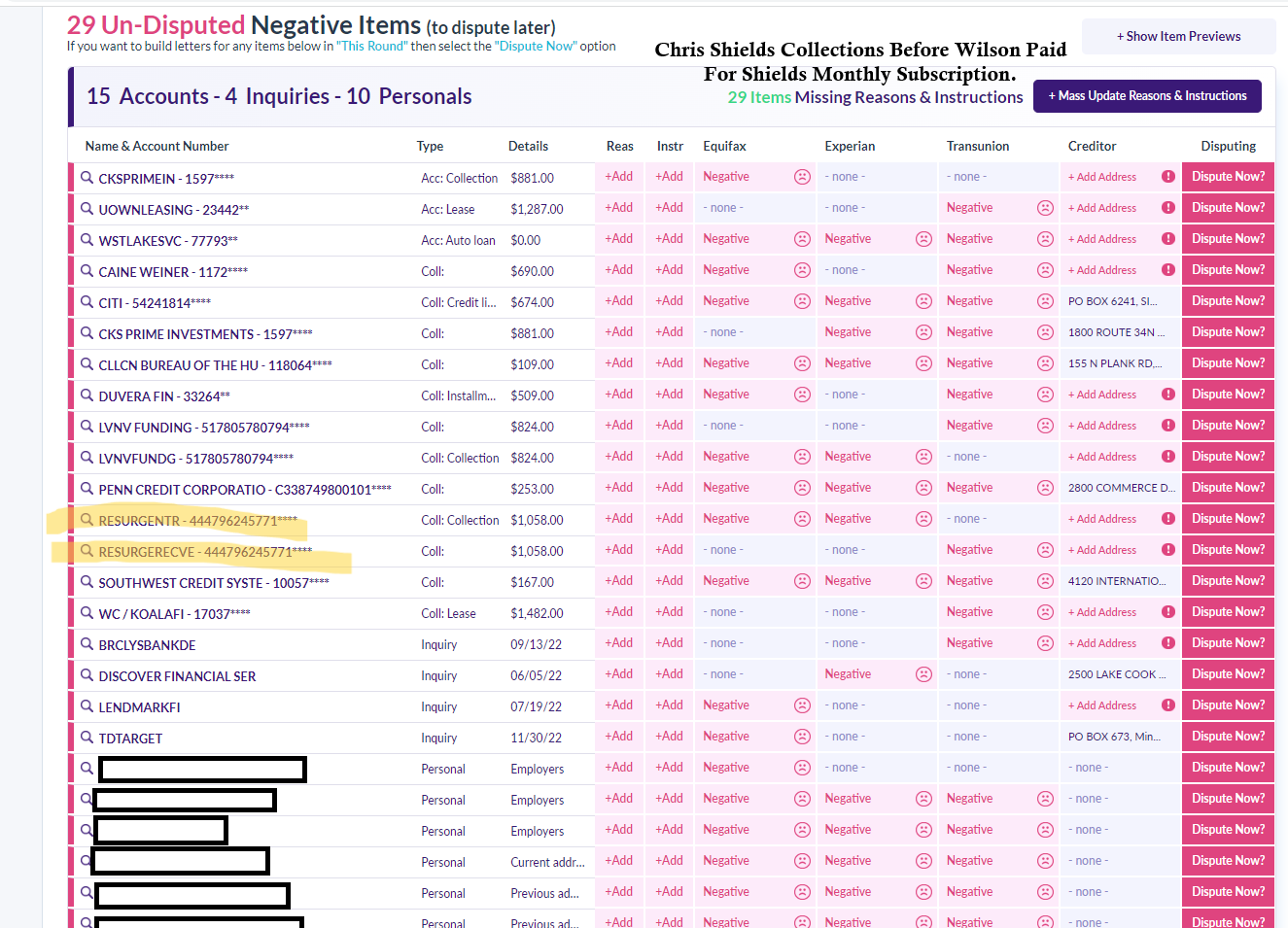
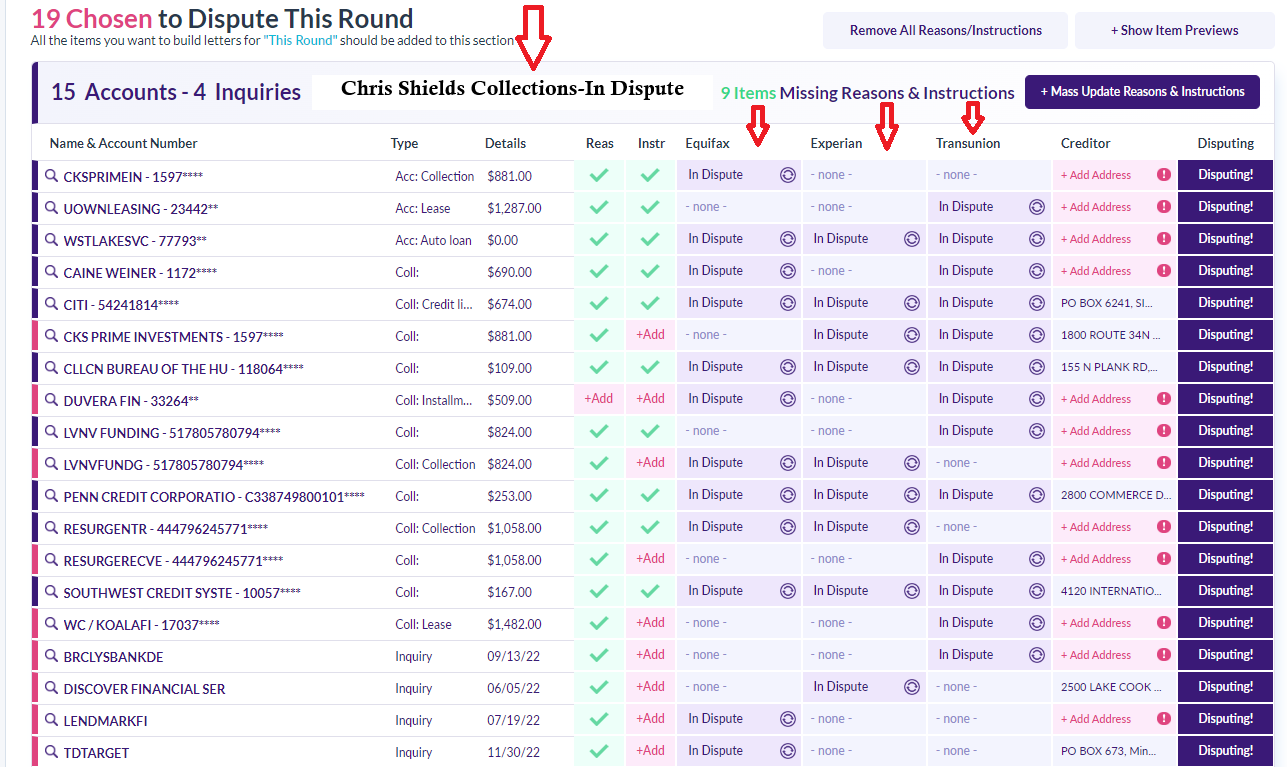
Then Shields did Wilson a real favor. Wilson tells NFA that Shields reported fake accounts and unfortunately exposed Wilson’s own employees stealing from his company via TikTok. A disgruntled former employee had been using TikTok to contact UFL’s clients directly — trying to pull them away and bad-mouthing Wilson in the process. Shields was the one who surfaced it. He even saved the screenshots of the TikTok chats before they disappeared, emailing them to Wilson with the note that it had been “a good idea to screenshot all of those TikTok chats because it’s all gone on the app.” Wilson trusted Shields enough to let him help document an internal theft. This was not a distant vendor relationship. This was a client Wilson leaned on during a crisis.
On April 17, 2025, Chris Shields — the client whose accounts Wilson had worked personally, whose subscription Wilson was paying, and who had helped Wilson document an internal theft — filed a consumer protection report against United Funding Logistics with the Harris County Attorney’s Office in Houston, Texas. Shields lived in Reading, Pennsylvania. He filed a complaint against a Houston business with a Texas county attorney. On May 28, 2025, the Harris County Attorney’s Office (HCAO Matter No. 2025CSU50155, signed by investigator Jesse M. Blakley) wrote back confirming the investigation. The man Wilson was paying a monthly subscription for had filed a complaint against Wilson. The irony is the entire point of this section.
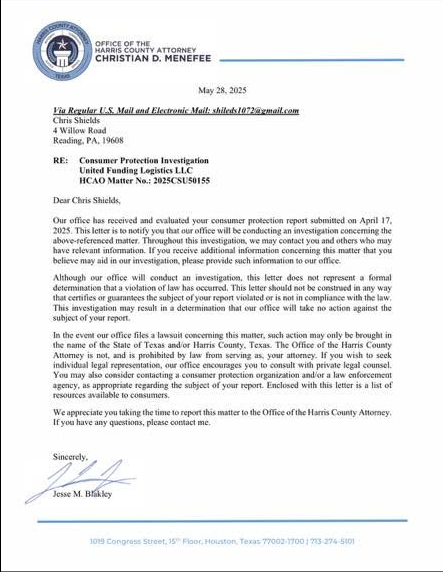
Shields did not quietly file and wait. He posted the Harris County Attorney’s response letter publicly on Facebook, celebrated the lawsuit in the comment thread — “Harris County Texas heard and listened! They filed suit against Brian Wilson and all of his LLC companies!” — and urged others to “file file file.” He then created a public Facebook group called “Collective Action Against United Logistics Funding LLC” to recruit others to join him. The group attracted 40 members — fewer than three dozen people for a “collective action” against a business with 36,000 client transactions. The campaign failed on its own terms. But the intent was never in doubt.
On May 24, 2026, nearly a year after filing the complaint, Shields went out of his way to search for Wilson on Facebook and send him a direct message: “Hello, Brian!” — at 9:08 AM. Wilson and Shields were not friends on Facebook. Shields lives in Sinking Spring, Pennsylvania. He had to go looking for Wilson. Wilson tells NFA he has been through a lot lately — and the record of a man who filed a complaint, recruited a public group, celebrated a lawsuit, and then cold-messaged the person he helped sue supports every claim Wilson makes about the instability of the people who came after him.
Before the Harris County Attorney ever filed the petition alleging Wilson “never employed a legal team,” the same rumor was already circulating in private channels — spread by an anonymous insider who, in the very same message, admitted her own brother had been on that legal team and was fired. In an Instagram direct-message exchange recovered from Shields’ own phone, a user operating under a throwaway handle identifies herself as “Victoria,” tells Shields her brother “Stephan” worked on UFL’s legal team until he was let go, and confides that her boyfriend “Corey” still works for Wilson. She then begs Shields not to reveal the conversation — warning that “Brian is that kinda man that he’ll fire an innocent person just cuz of association.”
Read Shields’ words carefully. He does not say Wilson did no work. He says five rounds of disputes went out — and that the only thing that came back was a form letter from the credit bureau telling him the item was “wrong.” That is the bureau rejecting the dispute, not Wilson failing to file it. Once those mail-outs are in the mail to Equifax, TransUnion, and Experian, UFL has no control over the bureaus’ responses — or their failure to respond. Shields’ own grievance, in his own words, is with the credit bureaus, not with Brian Wilson. The complaint he filed against Wilson with the Harris County Attorney’s Office appears to misattribute a bureau non-response to the business that filed the disputes for him — for free.
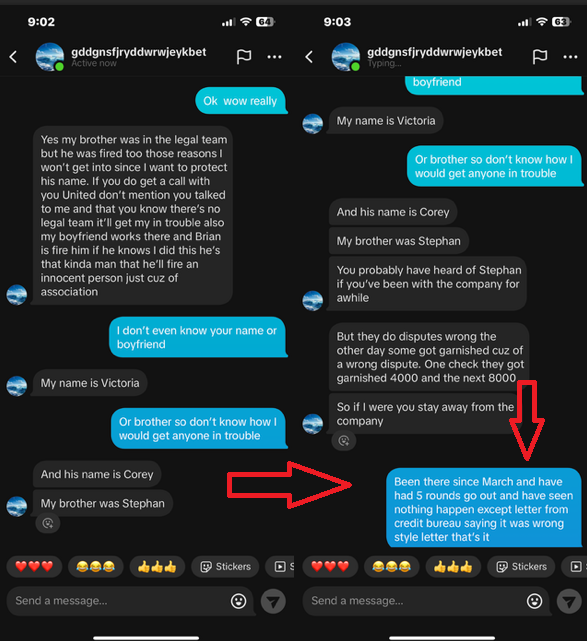
- Why would a client file a complaint against the CEO who was personally paying his monthly subscription? The record shows Shields was receiving free, CEO-level service. The complaint is not a response to neglect.
- What kind of person helps a business owner document employee theft, then builds a public campaign to destroy that same business owner? The same man who saved the TikTok screenshots created the Facebook group.
- Why did Shields search for Wilson on Facebook and message him a year after filing the complaint? A complainant who has already succeeded in triggering a lawsuit does not need to greet the person he sued.
- Does this not prove that some people operate in bad faith — and that no amount of free, personal, good-faith service can protect a business from a client determined to do harm?
The Double Standard
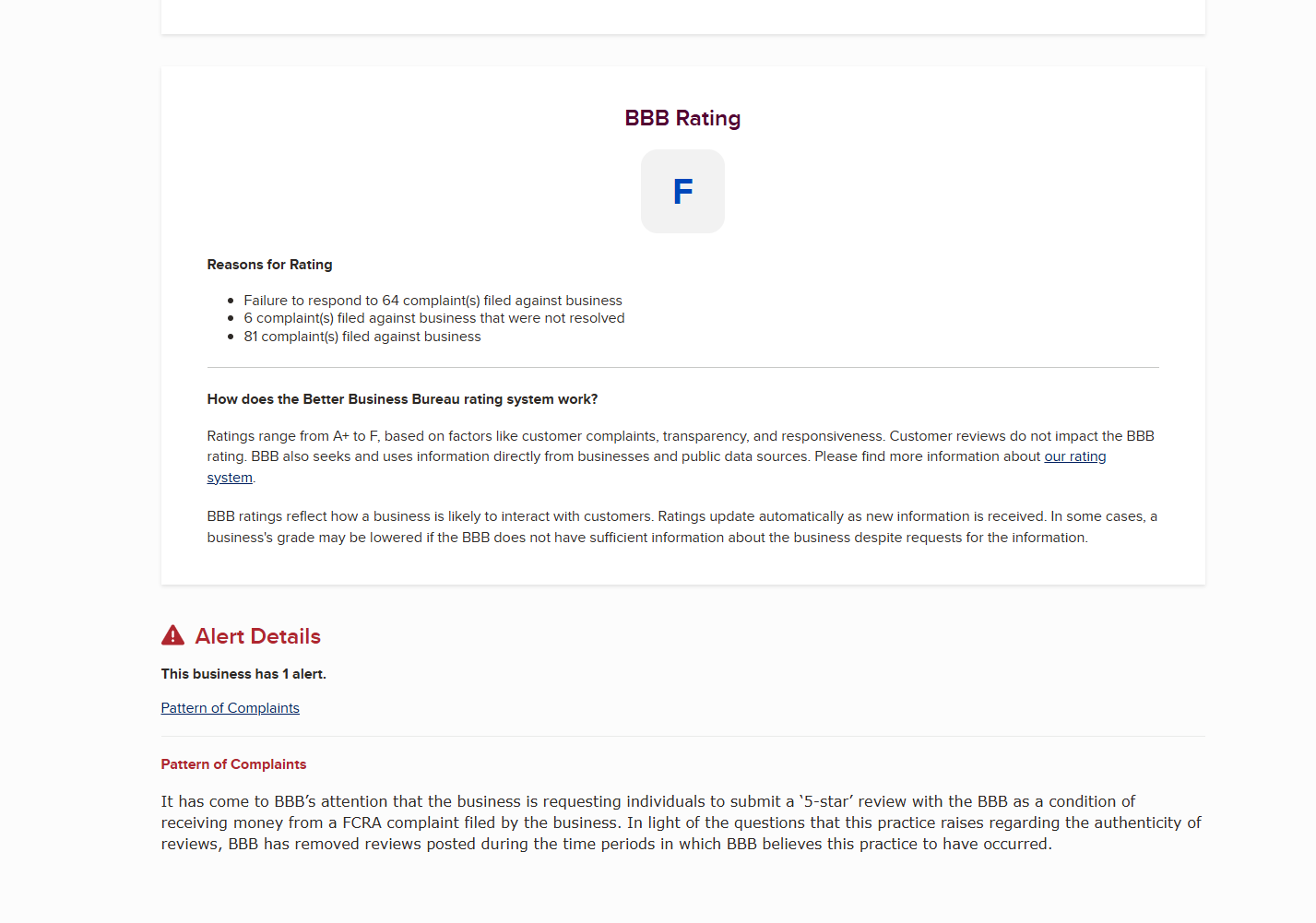
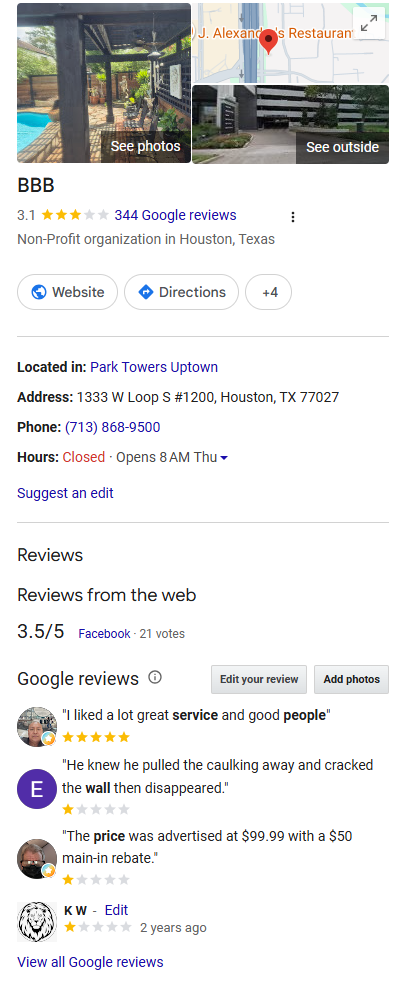
The BBB rates businesses on how they handle complaints. It gave United Funding Logistics an F for failing to respond to 64 complaints and for 6 unresolved complaints out of 81 total.
Now consider the BBB's own numbers.
The BBB Houston branch's Google Business Profile shows 343 reviews with a 3.1-star average rating. According to the BBB's own screenshot evidence, over 120 of those reviews are 1-star — consumers describing poor treatment, unanswered complaints, and ratings they believe are unfair.
The exact count of 1-star reviews on the BBB Houston Google profile is disputed between two sources: the PDF caption states 124, while Wilson's verbal statement says 127. NFA is reporting "over 120" until the exact figure is confirmed. By the BBB's own grading standard — which factors complaint volume and resolution — this volume of negative reviews would correspond to an F rating if applied to the BBB itself.
81 complaints filed against UFL → F rating
90+ positive reviews removed based on unproven allegation
Complaints from non-customers published as "Verified"
No hearing before review removal
343 Google reviews, 3.1-star average
Over 120 1-star reviews on its own profile
No F rating applied to itself
No "Pattern of Complaints" alert on its own profile
Owner response to critical review: linked to karenbuster.com
$251,000/year salary for the president grading others
- Marketing language cited as unauthorized practice of law — a legal-regulatory action by the State Bar of Texas District 4 Subcommittee, not a BBB ratings function.
- 18 hours to sign a Cease and Desist or face a hearing alone — the May 21, 2026 UPLC Subcommittee hearing, after Wilson's attorney withdrew when additional retainer was demanded.
When Wilson left a 1-star review detailing specific, substantive criticisms of the BBB's practices — failure to verify complaints, marking legitimate responses as "NO RESPONSE," publishing complaints from non-customers — the BBB's response was not to address the issues. It was to link to karenbuster.com.
The organization that demands businesses respond substantively to every complaint responded with a URL.
The organization that gives F ratings for failing to respond to complaints has over 120 1-star reviews on its own Google profile and no F rating on itself.
The organization that removed Wilson's positive reviews based on an unproven allegation publishes its own 5-star reviews on the same platform where it maintains a 3.1-star average.
Rules for thee. Not for me.
The Incompetency — Debunking the Harris County Attorney
On August 15, 2026, No Filter America formally alleges investigatory incompetency against the Harris County Attorney's Office in its July 10, 2026 civil enforcement petition (Case No. 2026-46516, County Civil Court at Law No. 215). Every material factual assertion in the HCAO petition is contradicted by primary-source evidence in this file. The charge is not bad faith — it is that the office failed to verify the allegations it put before a court, relied on unverified third-party records, and named an FBI-reported fraud victim as a defendant. That is an investigation that was not, in fact, investigated.
The petition seeks more than $1,000,000 in restitution, permanent injunctions, and civil penalties up to $250,000 per violation. It rests on seven core factual allegations. Each is placed below side-by-side with the documentary evidence this investigation assembled. The pattern is uniform: the claim collapses the moment it meets a primary source the HCAO appears never to have examined.
The Allegation vs. Evidence Ledger
| HCAO Allegation (Petition, Case No. 2026-46516) | Documented Evidence in This File | Verdict |
|---|---|---|
| 1. "Defendants never employed a 'legal team' or 'in-house counsel.'" (¶37) | UFL Legal Department letters signed by Nimra K. Alexis, Chief Legal Officer; FCRA §611 demands from Tyesha Y. Elam, Esq.; outside counsel Atlas Consumer Law (Dec 2021–May 2025) and Halvorsen & Klote (Jan–Jul 2024) — 3+ years of documented attorney relationships. | DEBUNKED |
| 2. "Wilson or other Defendants forged signatures of attorneys." (¶37) | Stated only "upon reason and belief." No document cited. No exemplar produced. Every attorney letter bears a verifiable, licensed attorney of record. | UNSUPPORTED |
| 3. "Credit Beast LLC" named as a co-defendant in the fraud scheme. | Wilson reported "Credit Beast" to the FBI (IC3, May 2023) as an impersonation victim three years earlier. Bank of America fraud alert places MyCreditBeast.com in Alabama (merchant code "AL"), not Houston. The victim was named the perpetrator. | VICTIM NAMED |
| 4. "Defendants solicited fake positive reviews from employees." (Footnote 3) | Does not appear in the BBB's own "Pattern of Complaints" alert. Every exhibit shows manipulation running the opposite way: fake negative reviews auto-verified by the BBB; real positive reviews from Bryan Fitch and Cory Fuller blocked and forced to "prove" themselves. The HCAO then contacted the positive reviewers directly — paralegal Erin L. Robinson emailed Nathan & Devin Jones (June 18, 2025), framing their genuine reviews as a potential quid pro quo, even though Nathan Jones was an internal UFL FCRA file-transfer coordinator working with Wilson's attorney Joel Halvorsen. No document supports a "solicited fake reviews" claim; the agency used real reviews as a roadmap to Wilson's supporters. | UNSUPPORTED |
| 5. "Bogus 'lifetime' credit-repair scheme — no real services delivered." | 73 reviewed debt-collector response letters confirm $187,483.27 in documented debt relief — accounts closed, collections ceased, tradeline deletions — from Jefferson Capital, Cavalry, Midland, Portfolio Recovery, Afni and others. Wilson reports hundreds more. | DEBUNKED |
| 6. BBB "Pattern of Complaints" / F-rating as the evidentiary basis. | The BBB alert was built on complaints Wilson maintains came from impersonation victims and non-customers defrauded by 90+ fake TikTok accounts, not by UFL. The HCAO inherited unverified third-party records rather than verifying UFL's actual 36,000-transaction customer base. | CONTAMINATED |
| 7. Three "terminated" LLCs as proof of evasion. | The LLCs were terminated by the Texas Comptroller for failure to file the required Texas state franchise tax (the annual tax report every Texas LLC must file) — a routine administrative forfeiture that happens to thousands of Texas entities every year and has no connection to fraud. Wilson had already reported the impersonation and the entities to the FBI and HPD before any HCAO action. A routine tax-filing forfeiture treated as a confession. | MISFRAMED |
| 8. "Defendants never arranged for any lawsuits to be filed on their customers' behalf." (¶49 — "Class-action lawsuit scam") | Four timestamped primary-source exhibits: FedEx overnight Tracking #775791177266 (Apr 2, 2024) shipping 133 client dispute files directly to Joel S. Halvorsen, Halvorsen & Klote; Wilson's Apr 2 email to the firm confirming the 1TB USB and a second batch of 200 clients; Halvorsen's Apr 23 "New Thumb Drive Received" reply requesting Dropbox for faster case review — "I know you have a lot of clients that need our help"; Wilson's Apr 3 Atlas Consumer Law FCRA opt-in proposal. A Super Lawyers–rated firm was actively receiving and reviewing client files two years before the petition. (See §09B.) | DEBUNKED |
The Two Claims That Define the Incompetency
The full rebuttal of the "no legal team" allegation — with the four attorney letters — is presented in Section 08. The forgery allegation, the most serious criminal implication in the petition, is the one with the least support, and it is worth stating plainly here:
"...upon reason and belief, Wilson or other Defendants forged signatures of attorneys on documents."
"Upon reason and belief" is not evidence. No forged document is identified. No attorney has disclaimed a signature. No handwriting analysis is cited. The allegation rests entirely on inference from the already-debunked claim that no legal team existed. In a petition seeking $1,000,000+, an unverified criminal accusation against a named individual is not diligence — it is defamation dressed as a footnote. Remove the premise and the forgery theory has nothing to stand on.
The single most damning indicator: the HCAO named "Credit Beast LLC" as a fraud co-defendant when Wilson had reported "Credit Beast" to the FBI as the entity defrauding him three years earlier — documented in his IC3 complaint (under Title 18 U.S.C. §1001), the HPD incident report, and the Bank of America Alabama merchant-code alert. An office that names an FBI-reported victim as a fraud defendant has either not read the file or not understood it. Either answer is incompetency.
Seven allegations. Zero that survive contact with the primary-source record. A counsel team "that never existed" — debunked by four attorney letters. A forgery — unsupported by any document. A defendant — who was the FBI-reported victim. A review scheme — that runs the wrong way. A "bogus" service — backed by $187,483.27 in documented relief. A "pattern of complaints" — built on impersonation victims. A set of "terminated" entities — a routine Texas franchise-tax forfeiture treated as a confession. This is not a case investigated and lost on the merits. It is a case that was never investigated at all.
"The Harris County Attorney's Office did not investigate this case. It inherited it — from a ratings body whose own process this investigation has discredited — and put it before a court without testing a single allegation against a primary source. That is not lawfare. That is incompetency."
The Reckoning — A Formal Complaint to the State
On August 12, 2026 — today — Brian Wilson filed a formal complaint with the Statewide Unauthorized Practice of Law Committee Administration, requesting a statewide administrative review of District 4's handling of his case.
The complaint is 18 pages. It references 12 exhibits (A through L). It documents the entire arc: three separate files opened against UFL, an 18-hour deadline to sign a Cease and Desist, a hearing conducted without counsel, a chairman who told Wilson he could leave to get a lawyer after he'd already been denied one, an investigator who said a decision would be made in his absence, and 82 days of silence on a recording the UPLC itself promised would exist.
What the Complaint Asks For
Wilson is requesting:
- A statewide administrative review of District 4's conduct across all three file numbers
- Production of the hearing recording that was promised and never delivered
- Preservation of all records, including communications with the Better Business Bureau concerning Wilson's matters
- Review of the hearing exchange where Wilson was told he could leave but a decision would be made without him
Wilson's preservation request specifically asks UPLC to retain "communications with the Better Business Bureau concerning these matters." This suggests Wilson suspects — but has not confirmed — coordination between the UPLC and the BBB. This is an open question, not a confirmed fact. If such communications are ever produced, it would directly support the thesis of institutional coordination. It is reported here as an unconfirmed suspicion, not as established fact.
The Exhibits That Back It Up
The complaint is not just Wilson's account. It is supported by 12 exhibits — primary source documents that convert his assertions into documented correspondence:
| Exhibit | Contents |
|---|---|
| A | Initial UPLC notice addressed to "Ben Hamel" (Jan 28, 2026) |
| B | UPLC Notice of Investigatory Hearing (May 7, 2026) — promises recording |
| C | Email thread confirming three separate complaints (May 18, 2026) |
| D / D-2 | Original and corrected Cease & Desist agreements |
| E | Request for additional time to retain counsel (May 19, 2026) |
| F | UPLC denial: "The answer to your request for more time is no." (May 19, 2026) |
| G | Hearing counsel exchange — contemporaneous statement (May 21, 2026) |
| H | Post-hearing notice of evidence upload failure |
| I | Post-hearing supporting evidence submissions (May 21-22, 2026) |
| J | Request for hearing transcript and recording (May 22, 2026) |
| K | Formal supplemental response and record request |
| L | Harris County civil enforcement petition |
Exhibits A through G have been reviewed by NFA. They confirm word-for-word the quotes attributed to investigator Fred Krasny in Wilson's complaint. The hearing exchange documented in Exhibit G-2 is now a fully corroborated primary-source exhibit, not just a summary.
The complaint is filed. The state has it. What happens next is up to them.
False Reports to the Texas Attorney General — The Notice HCAO Cannot Walk Back
VIII. PRESUIT NOTICES · 27. "Prior to filing this suit, Plaintiffs notified Defendants of the general nature of the violations that are the subject matter of this suit. In addition, prior to filing this suit, the Office of the Harris County Attorney provided notice to the Consumer Protection Division of the Office of the Attorney General of the general nature of the violations that are the subject matter of this suit."
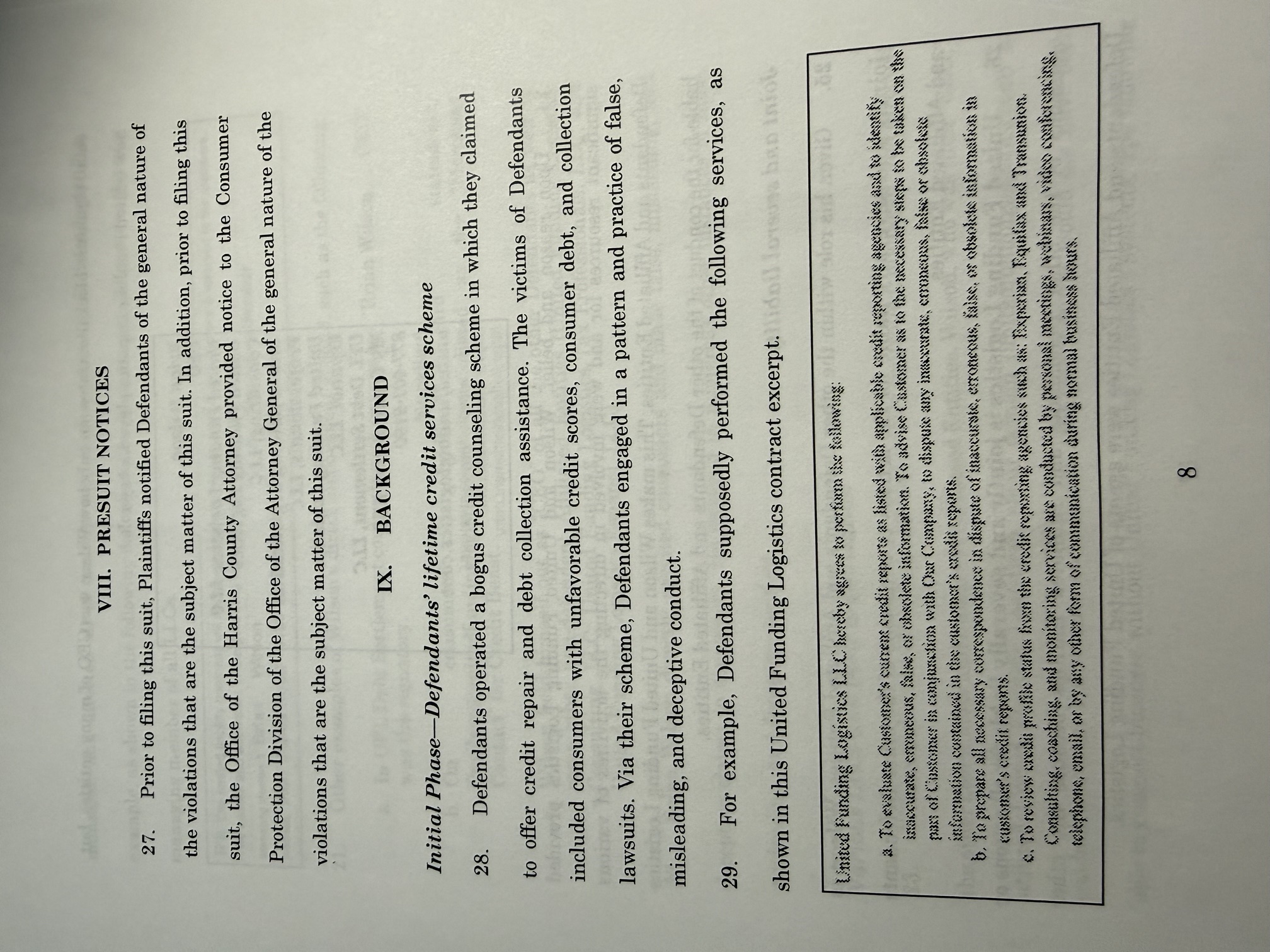
¶27 is not procedural boilerplate. It is a statutory pre-suit notice certifying to the Texas Attorney General's Consumer Protection Division that the Harris County Attorney reviewed the file and is bringing a consumer-protection enforcement action on a substantiated record. A county attorney does not notify the AG of "the general nature of the violations" without supporting documentation — the notice represents to a superior office that the violations exist and the evidence backs them.
The "general nature of the violations" HCAO transmitted to the AG is the same body of allegations this investigation has now documentarily debunked from primary sources:
- "Bogus credit counseling scheme" (¶28) — yet the contract excerpt HCAO itself reproduces in ¶29 describes standard, lawful credit-report-dispute services. Nothing in the quoted language is "bogus" or illegal — it is the expressly-permitted scope of a credit-services organization under Texas Finance Code Chapter 393 and the FTC Telemarketing Sales Rule.
- "Class-action lawsuit scam" (¶¶46–49) — debunked by FedEx Tracking #775791177266, the April 2, 2024 Wilson → Halvorsen & Klote client-file transfer, the April 23, 2024 Halvorsen confirmation, and the three-year Atlas Consumer Law referral ledger documenting filed federal cases by January 4, 2022.
- "Never arranged for any lawsuits" (¶49) — directly contradicted by the Halvorsen & Klote and Atlas Consumer Law primary-source records, all of which predate the filing of the petition.
The exculpatory record was in existence before the petition was filed and before the AG notice was sent:
- December 2021 – May 2025: Three-year Atlas Consumer Law (Sulaiman Law Group) referral relationship — documented.
- January 4, 2022: Atlas files federal cases / sends demands on 3 UFL clients; 127-client ledger confirmed by Nasim Ghebari.
- April 2–3, 2024: Wilson overnight-transfers 133 client dispute files to Joel S. Halvorsen, Halvorsen & Klote (FedEx #775791177266).
- April 23, 2024: Halvorsen confirms receipt and requests Dropbox for faster case review.
- May 2026: Wilson submits attorney-client representation agreements, Elam Law Firm correspondence, and consumer law firm materials to the UPLC Subcommittee.
- July 2026: HCAO files the petition and notifies the Texas AG of the "general nature of the violations."
HCAO reviewed the exculpatory records before notifying the AG — and transmitted a debunked narrative to a superior office anyway. That is materially false reporting to the Texas Attorney General.
HCAO did not review the file before certifying violations to the AG — it inherited an administrative narrative (likely the BBB's "Pattern of Complaints" file) and forwarded it upward as fact. That is a failure to investigate before invoking the authority of the State.
The debunked allegations in this petition did not stay in a Houston civil courtroom. Through ¶27, they were transmitted to the Consumer Protection Division of the Office of the Attorney General of Texas as the stated, certified basis for the suit. That notice cannot be quietly walked back — it is a fixed, dated representation by the Harris County Attorney that the violations are real and the record supports them.
The primary-source record — FedEx tracking receipts, attorney emails, firm-confirmed client-file transfers, and a three-year referral ledger with filed federal cases — proves the opposite. A county attorney does not notify the Attorney General of consumer-protection violations without supporting documentation. The documentation HCAO certified to the AG does not support the violations it reported. It contradicts them.
Timeline of Events
The Formal Record — A Sworn Demand for Administrative Accountability
On August 12, 2026 — 82 days after his original request for the hearing recording the UPLC's own notice promised would exist, and still without it — Brian Wilson filed an 18-page formal complaint and request for statewide administrative review with the State Bar of Texas Unauthorized Practice of Law Committee. The filing documents the District 4 Subcommittee's denial of counsel, the failure to produce a promised recording, the misjoinder of three file numbers, and the demand that Wilson sign a Cease and Desist Agreement under duress or face an uncounseled hearing. It is the sworn record of a citizen asking a state administrative body to answer for its own conduct — and it is published here in full.
"FORMAL COMPLAINT AND REQUEST FOR STATEWIDE ADMINISTRATIVE REVIEW" — 18 pages, 12 exhibits. Filed by Brian Wilson, CEO, United Funding Logistics, with the State Bar of Texas, Unauthorized Practice of Law Committee, requesting administrative review of District 4 Subcommittee conduct across File Nos. 2022-0299, 2023-0171, and 2023-0233. Submitted August 12, 2026.
Source Record
The evidence in this report was supplied by the subject. No Filter America is continuing to investigate the Better Business Bureau of Metropolitan Houston, the Unauthorized Practice of Law Committee, the Harris County Attorney's Office, and the impersonation network documented in these pages. New evidence will be published as it is verified.
Have You Been a Victim of the BBB?
If you have experienced rating manipulation, review suppression, fake verified complaints, or retaliation by the Better Business Bureau — or if you have been affected by any of the impersonation accounts documented in this investigation — we want to hear from you.
Submit a Tip →